Pigging Out. We All Do It

Tags

,

Leftover restaurant Caesar's salad doctored with my lamb stew and a glass of vino.

Restaurant leftovers with wine.

From Julie:

Is it not a great and guilty pleasure to stand in the kitchen and stuff your face with leftovers without worrying about calories or manners?

On nights when Steve’s out, I love emptying the fridge of teflon containers and plastic-wrapped bowls and pouring myself a glass of wine for my kitchen counter feast. It’s so wonderfully decadent. And because the rule is no holds barred, I am so grossed out by my excessiveness that sticking to a game plan of fastidious gym attendance and low carb entrees is a piece of cake, until the next urge to splurge descends with a vengeance.

From Lois:

My pig-out leftovers don’t make it to the “teflon containers and plastic-wrapped bowls.” I do like to stand, though. The best pig-outs for me are after a party. Once the party is over, I walk amongst the ravaged, scooped-out platters and taste everything. Just a fork-full. Unless there is an open bag of potato chips. That I need to sit down for. I can eat them until the corners of my mouth are sore and split from the salt and sharp edges — until I roll on the floor, content, but with stomach curdling, and arms and legs splayed out in a gluttonous tribute to the joy of just letting go.

My Back Room: Memories Amidst the Dust Bunnies

Tags

,

studio pre cleanseBY JULIE SEYLER

I have been cleaning up and cleaning out the back room. It is the master bedroom of my apartment, but has always functioned as a studio — a place where I had my easel and oils and drawing books and pastels and thread and canvas and stretcher bars and papier-maché and beads.

But I am starting to move stuff out. The house in New Jersey has an attic and the attic is to become a working space of mine. I am organizing and gathering and chucking, and between the dust bunnies and crap, I found a cache of memories.

There are notebooks filled with slides of paintings, and drawing books filled with collages. I have photograph books that hold the two-dimensional representation of my three-dimensional papier-mache sculptures that took over my living room in my old apartment. It was so sad because they were too big to come with me when I moved to this apartment. Rediscovering my stash of work reminded me of the years when I would wake up and paint and come home from work and paint and in-between draw, sew, take classes, make collages, and paint.

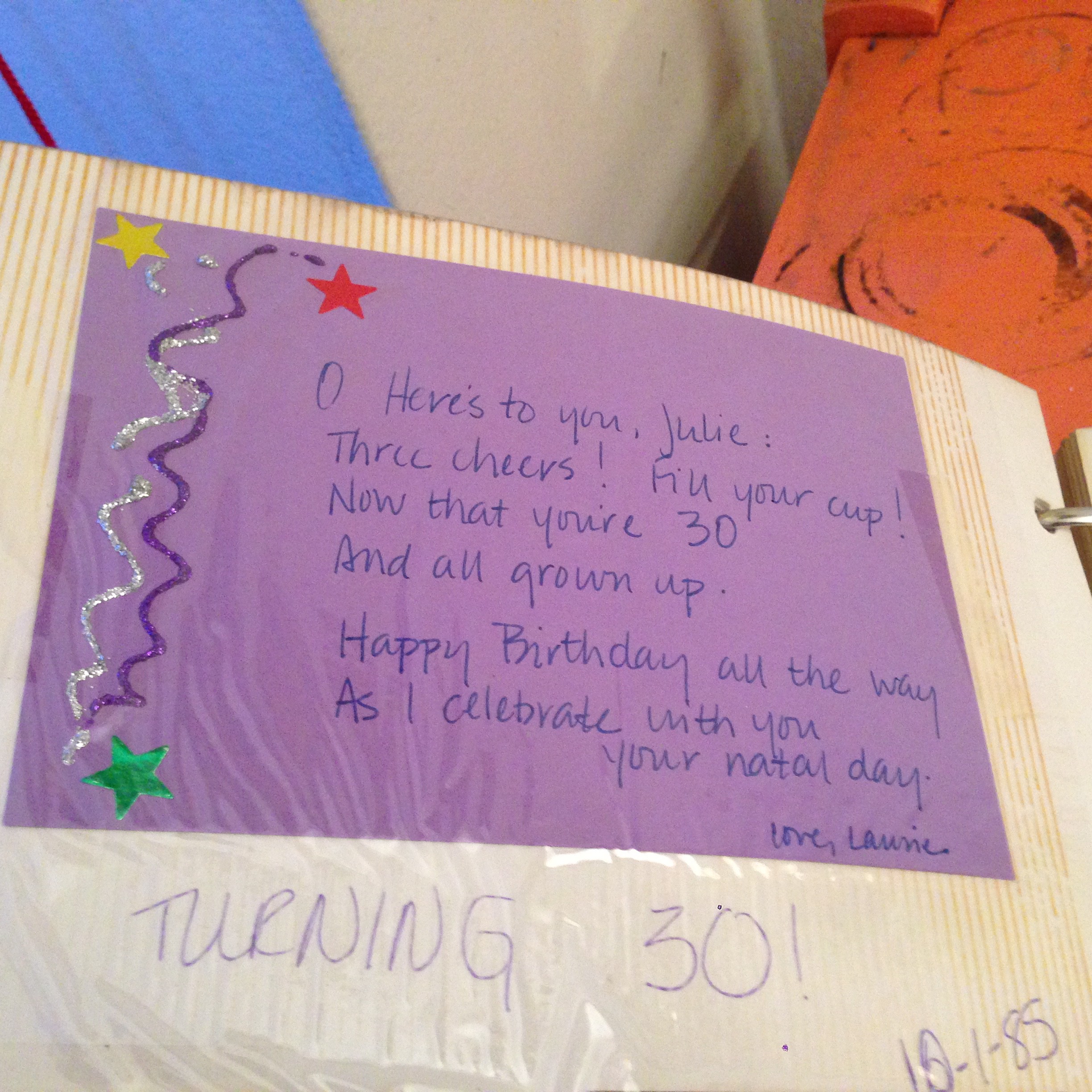
I pored through my photograph albums and found forgotten gems like this one:

IMG_1005

I just cracked up. What a poem! What a poet!

I found a two-page photo spread of a 1996 ski trip to Vermont which included pics of Lo and her toddler sons, a dirty sink, a pot of fondue and a kitchen floor carpeted in bubbles. For some reason I have no recollection of that trip, probably because I don’t ski. I tumble and fumble. Best to forget those embarrassing experiences. But Lola had instant recall. She remembered who made the fondue, how the sink got completely clogged and that someone put liquid soap into the dishwasher, thereby leading to a bubble explosion.

So amidst the dreaded chore of cleaning, vacuuming and dusting, I got to “review” some ephemera of my life at this ripe old age of young middle age. (We are only young middle age, still, right?) I am sure when I again look back, the glow of the past will have an even more burnished lustre, but no doubt that, just like this time, I will be enthralled remembering how much fun I’ve had and how many fabulous people I have known and loved for these many years.

This Ex-Hippie is Old: My Hip is Osteoarthritic

Tags

, ,

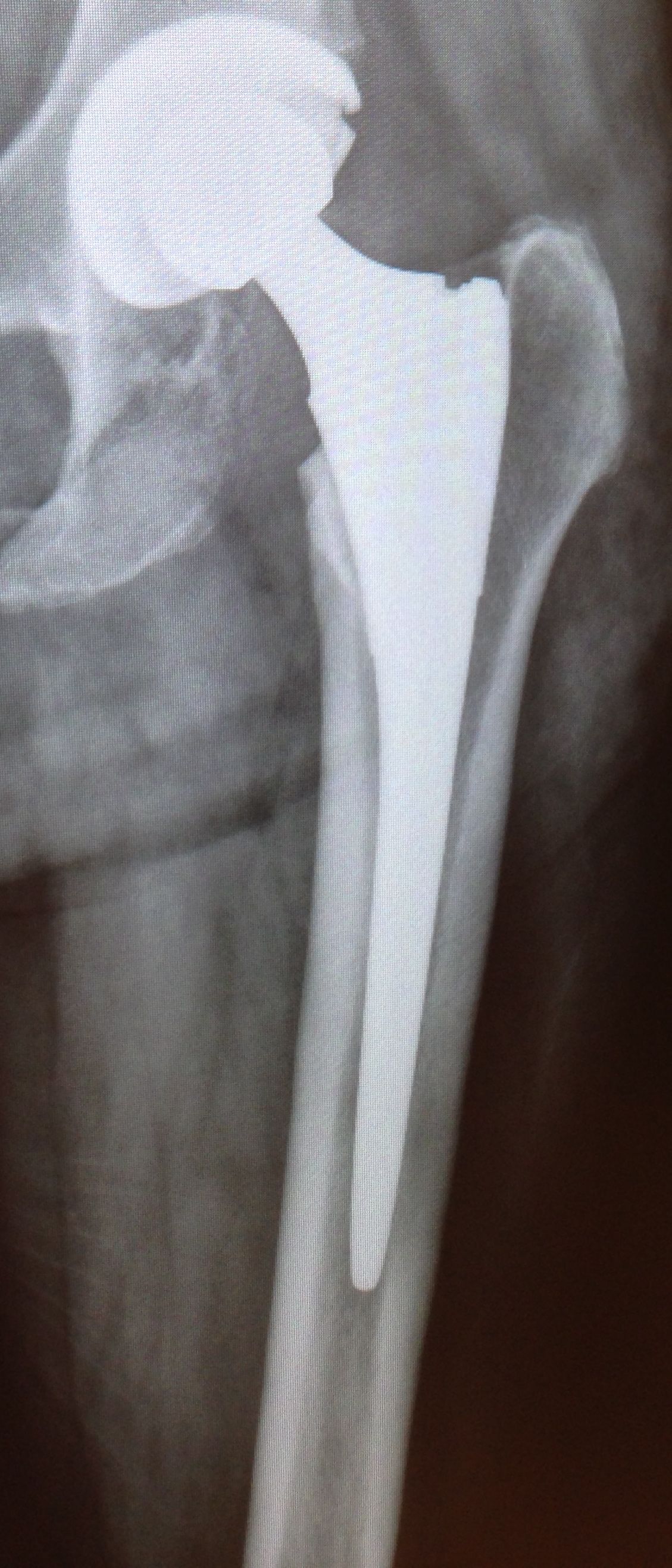
Is this my future anatomy?

Does my future include a prosthetic device?

BY BOB SMITH

I’ve had a persistent low-grade ache in my right thigh for over a year now. I wrote it off to too much running and not enough stretching, but lately the pain has gotten worse.  So I started getting regular massages, switched from the treadmill to the elliptical trainer, and did flexibility exercises hoping to erase the problem, but nothing changed.

Then, like Ebenezer Scrooge, I had a Christmas Eve miracle and revelation.

Every year we host an elaborate Christmas Eve feast featuring all sorts of seafood as well as fresh, crisp-crust bread and exquisite pastries from the local bakery.  But to get any of those goodies without waiting on line for an hour, you have to get to the bakery as soon as they open on Christmas Eve morning.  My over-50 body forces me to toddle out of bed every night in the wee hours to use the bathroom, so I’m the natural for that crack of dawn bakery run.

When I got there at 5:50 the lights in the main serving area weren’t on yet, but I saw activity inside. My right leg tends to stiffen up if I’m sitting still for a while, so rather than leaping out of the car and running across the street as I would have years ago, I carefully eased out of the driver’s seat and stood for a second to gauge the pain and let the stiffness dissipate. Not too bad – after a couple of seconds it felt fine, and I walked into the bakery with only a slight hitch in my step.

Incredibly, there were already three people on line, waiting in semi-darkness for the women bustling behind the counter to recognize the start of business. By the time I had my three dozen rolls and box of pastries ten minutes later, there were eight people behind me on a line, growing by the minute, that was snaking out the door. I’d dodged the bullet.

When I got home, because of my achy leg and partly out of just plain laziness, I decided I’d carry everything (including my convenience store coffee and newspapers) in one trip.

That took some planning: first I put the coffee on the hood of the car, leaving the house keys hanging from my left pinky. Then I put my left arm around the bulging bag of warm rolls, and with my right hand folded the newspapers under my left arm.  I slid my right index finger under the red and white twine on the pastries so the box dangled below my hand, then carefully kicked the door shut using my pain-free left leg.

My left hand was still free (except for the keys on my pinky), so I used that to awkwardly reach down and grab the coffee cup from the hood while still hugging the bag of rolls and squeezing my armpit on the newspapers. I figured once I got up the steps, I could put the pastry box on the side table by the door, take the keys from my left pinky with my right hand, and unlock the door. Mission accomplished!

But my hip had other plans.

I began to climb the steps, but because of the pain I failed to raise my right foot above the riser, and tripped. Because I was walking so slowly, I fell in slow motion. The box of pastries rocked, my finger released the string, and the heavy box slid away across the step, unharmed, as my right hand came down to break my fall.

As my left side came down, I somehow placed the tall Styrofoam cup of coffee onto the porch without spilling a drop. Simultaneously, my arm splayed out and the bag of rolls plopped onto the step ahead of me – remaining upright and jostling, but not dislodging, any of the rolls sticking out of the top. Even the newspapers had fallen from under my arm onto the step in a neatly folded stack.

I stood there, feeling foolish, with the house keys waggling on my pinky.

The Christmas Eve miracle: I’d spilled nothing and was unhurt. The revelation: I’d fallen climbing my own front steps, and could have been badly injured. So I made an appointment with my doctor, got an x-ray, and a week ago was diagnosed with osteoarthritis of the right hip. So now I’m officially old, with an old person’s chronic ailment, an old person limp, and maybe a need for an old person remedy: a new hip.  We’ll see.

But it’s all good. Like Scrooge, I’m thrilled to be alive — even if it means hobbling around like Tiny Tim.

‘Relationship’ with Computer Fraught with the Artificial

Tags

, , , , , , ,

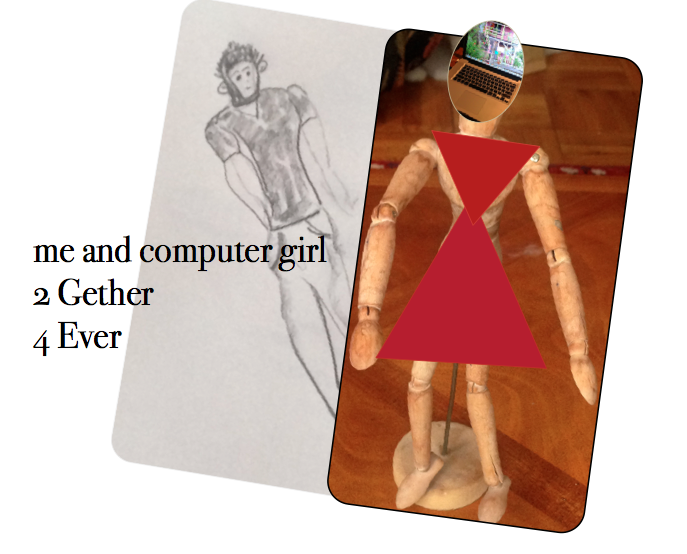
Me and my gal.

BY FRANK TERRANELLA

The upside of Netflix being shut out by movie studios from streaming new Hollywood movies is that they have had to look high and low for content. The low has been some putrid indie films. The high has been some great British television. An example of the best is a British television series called “Black Mirror.” There are only six episodes available, but they are well worth your time.

Black Mirror has been described as an anthology series like The Twilight Zone, and it does have some similarities in that each episode is thought-provoking and often deals in moral or ethical issues. It’s set in the near future and technology plays an important role in each episode. For example, there is an episode called “The Entire History of You” that envisions a time where we all have video recorders attached to our eyes and implanted in our heads. This allows us to play back everything we experience at will on nearby television screens. While this instantly settles disputes about what people said, it also causes lots of problems. For example, the question “where were you last night?” is not simply answered by words any longer. Now we go to the videotape to actually see what you saw last night. It’s an intriguing concept and one bound to improve honesty. But a young couple with trust issues finds the pitfalls of having all this “evidence” to dwell on.

Another episode that really struck me was one called “Be Right Back” in which a man tells his wife he’s just going out and will be right back, but then gets killed in an auto accident. At the funeral, a friend tells the widow that there is a service available that takes all of a person’s online activity (pictures, emails, tweets, etc.) and creates a humanoid in that person’s form that has that person’s personality including memories, vocabulary and sense of humor. She urges the widow to simply re-create her husband from his online persona. After some initial misgivings, she agrees. The humanoid arrives and is indistinguishable from her husband and has all his online memories. But there are problems in any human-humanoid relationship and the episode shows them and how they are resolved. The episode seeks to explore the question whether a person is really just the sum of his online communications. By the way, the widow is played by Hayley Atwell, whom you may know as Agent Carter in the recent ABC television series.

The “Be Right Back” episode reminds me of another film that explored the romantic relationship between man and machine. It is the 2013 Spike Jonze film “Her” starring Joaquin Phoenix and the voice of Scarlett Johansson. There, Phoenix plays a man who literally falls in love with the Siri-like voice of his computer. This is not as far-fetched as it sounds. As computer assistants become more and more sophisticated, we are encouraged to think of them as persons. That’s why they have names. But any relationship between artificial intelligence and real intelligence is bound to be fraught with problems and that is what “Her” shows. Can a person be in love with a dis-embodied voice or is a body necessary? If you think about it, this is not a new question. In the past, there have been dis-embodied, long-distance relationships by mail or later telephone. Most of these did not work out once the parties met face to face, because real life is different from the intellectual life.

About six months ago I wrote about the peril of mistaking a life online with a real life. I urged readers to “Friend someone who lives in your neighborhood, rather than on Facebook. Deliver a Tweet in person. Interact with flesh and blood people and not just their avatars.” Television programs such as  “Black Mirror” and films such as “Her” show why artificial friends are as unhealthy as imaginary ones. It’s easy to be seduced by technology. That voice on your phone sounds so real. It’s always polite and helpful. Real people can be bothersome, rude and even hostile. But ultimately an online relationship is a fantasy. And living in a fantasy world, you always run the risk of a rude awakening.

Martin Luther King Jr.

Tags

,

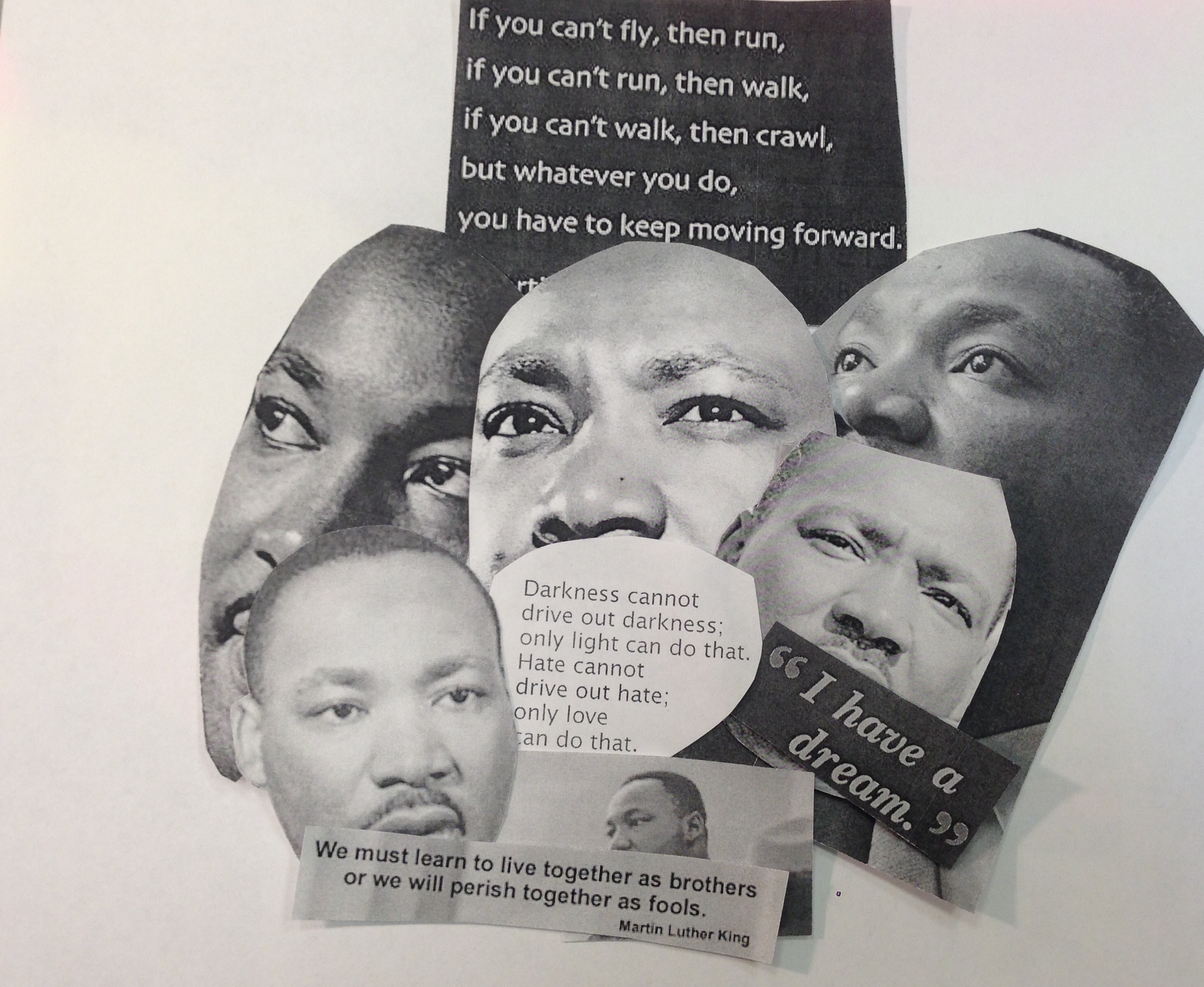
MLK

His eyes reflected compassion, kindness, fearlessness and brilliance.

Martin Luther King Jr. would have turned 86 this past Thursday, January 15. What would he think of the state of affairs that we live with today? Would he consider his “dream” for racial equality as somewhat undone, unraveled? Or still evolving?

The eloquence of his message is as relevant in 2015 as it was in 1968 when he died. Perhaps we could honor him today by examining present-day America through his eyes.

An ‘Exit’ Strategy for Terminally Ill

Tags

, ,

Exit

BY BOB SMITH

I read an article recently in The New York Times about a not-for-profit organization called Final Exit Network (FEN), whose slogan is “Supporting the Human Right to a Death With Dignity.” Humans have a “right” to death with dignity? Tell that to the freight train bearing down on your disabled vehicle stuck on the tracks, with you inside unable to unclick the seatbelt.

Of course, the FEN’s specific focus is narrower: “to work toward obtaining the basic human right of competent adults to choose to end their lives on their own terms when they suffer from irreversible physical illness, intractable pain, or a constellation of chronic, progressive physical disabilities.”

To fulfill that mission, the FEN will tell you how to end your life. They have what they call the Exit Guide program — kind of the opposite of a life coach — where qualified individuals receive “relevant information, home visits if possible and a compassionate presence for individual and family.” First you must join FEN and submit an application, along with a doctor’s evaluation of your condition and prognosis — like a note from Mom telling the teacher it’s okay to send you home early. If you’re sick enough, and if you can attest that neither your family nor your primary caregiver will interfere, the FEN folks will assign you an Exit Guide.

From the guide, you’ll get “detailed information about the method [FEN] recommend[s], and the inexpensive equipment you will need to obtain.” Because in many places it’s a crime to help someone die, FEN never supplies equipment, but the guide “will provide you with information on all alternatives for care at the end of life, including all legal methods of self-deliverance that will produce a peaceful, quick, certain and painless death.”

And what do they often recommend? Asphyxiation by inhalation of helium.
You get a tank of helium, the same stuff they use at the party store to make festive floating balloons. You attach vinyl tubing to the tank, and run the open end into a large plastic baking or turkey brining bag. Then you securely tape the bag around your neck, and turn on the gas.

I can’t decide whether or not this is right or wrong, necessary or not. Instinctively it seems abhorrent; unthinkable. But then, I’m not living in the constant hell of pain that the people who seek out FEN’s services apparently seem to be enduring.

But I’m uneasy with the associations the helium exit brings to mind. I’ve seen people at parties inhale a lungful of helium, which allows them to talk for a few seconds in high-pitched, squeaky cartoon voices. It’s pretty funny to see a burly guy transformed into Tweety Bird at a party. But is it dignified to die that way? I guess if you’re in the bag making your exit, you’re not talking much.

And the bag itself, used to bake a roast, or to brine a turkey, is usually such a happy thing. You put something really good into it and it comes out better. When you’re done using that bag for its intended purpose, you’re warm, well-fed, and very happy. Even the vinyl tubing is a party accessory — it’s just like the tubing that attaches the plastic spigot to the beer keg at our summer parties.

Thank God I’m not in a position to consider using FEN’s services. I just wish they’d come up with a “method of self-deliverance” that doesn’t make me think of so many silly, happy things. Death with dignity? Maybe. But please, not death with Daffy Duck.

Louis XIV: The 17th Century ‘Selfie’ King

Tags

, ,

King Louis XIV greets visitors at the Palace of Versailles.

King Louis XIV greets visitors at the Palace of Versailles.

BY JULIE SEYLER

We live in a society of limitless ego and self-promotion. Instagram and Facebook, Twitter and Pinterest make it possible for each of us to have our portrait in the public eye continuously. But long before the Internet, there was one man who perfected the ability to say “Look at me!”

Louis dressed in the style of an ancient Roman by Jean Warin.

Louis dressed as a Roman Emperor by Jean Warin in the Salon de Venus.

He was Louis XIV, also known as “The Sun King,” a nickname, so to speak, that embodied his political belief that as the earthly representative of God he had been anointed with the divine right to rule over France, and so he did from 1638 when he was 5 years old to 1715 when he was 77. His home in the exurbs of Paris, the Palace of Versailles, 550,000 square feet of gilt and gold and mile high ceilings, is his testament to himself.

Louis by Gian Lorenzo Bernini.

Louis by Gian Lorenzo Bernini in the Salon de Mars.

I had a chance to visit Versailles in November, and of course I oohed and ahed and was awed by this historical Disney extravaganza. But what made it especially fun was spotting the busts of Louis, sculptures of Louis, and paintings of Louis that directed the audience of the past and the audience of today to “look at him.” He never let anyone forget his presence was present around the clock.

Louis on a horse by Rene-Antoine Houasse

Louis on a horse by Rene-Antoine Houasse in the Salon de Mars.

Over his 72-year reign, the longest of any European monarch, it is estimated that Louis commissioned over 300 portraits of himself. Whether he was dressed up for his close-up as the god Apollo or the conquerer Alexander the Great or the human representation of the country of France, he made sure he was never forgotten.

Louis XIV. Victorious in the Salon de Mercure.

Louis XIV. Victorious in the Salon de Mercure.

Imagine what he could gave accomplished had he had the Internet and a phone with a stick at his disposal.

Fear, Deconstructed

Fear. Personified.

Fear. Personified.

BY FRANK TERRANELLA

On March 4, 1933 Franklin Roosevelt took office in the midst of a national emergency. The closest thing in recent times was the economic meltdown in the fall of 2008. The fear on Wall Street was palpable. But then, thanks to the reforms that FDR made that were not repealed by Bill Clinton, there was no run on the banks. Our financial system was saved through an infusion of capital from the federal government.

Ironically, the very people who continually preached that the government should just leave them alone came running to the government when their fear led to panic. And Uncle Sam bailed them out.

Fear is a curious thing. It makes rational people abandon reason. FDR knew that. In fact, he began his inaugural address like this:

President Hoover, Mr. Chief Justice, my friends: 

This is a day of national consecration. And I am certain that on this day my fellow Americans expect that on my induction into the Presidency, I will address them with a candor and a decision which the present situation of our people impels.

This is preeminently the time to speak the truth, the whole truth, frankly and boldly. Nor need we shrink from honestly facing conditions in our country today. This great Nation will endure, as it has endured, will revive and will prosper.

So, first of all, let me assert my firm belief that the only thing we have to fear is fear itself — nameless, unreasoning, unjustified terror which paralyzes needed efforts to convert retreat into advance.

FDR knew that if he could calm people’s fears, he could get them to act rationally. If he could take emotion out of the equation, people would use their brains and they would find solutions to the nation’s problems.

I bring all this up because just as 2008 was a distant echo of 1933, so too is the fear that ran rampant in the 1930s alive and infecting our nation in 2015 in myriad ways.

We fear terrorists, illegal immigrants, criminals. Democrats fear Republicans and Republicans fear Democrats. Our politics is rampant with fear. Let’s take just one simple example. According to the GunPolicy.org there are about 300 million guns in the United States. These guns killed 12,532 people in 2014. Estimates are that 1 in every 3 Americans owns a gun

Why do people have guns? Fear.

Talk to a Second Amendment enthusiast and you will find a very scared person. Gun ownership increases with fear. And fear defeats any rational attempt to legislate controls on guns. So is it any wonder why the more people are killed by guns, the more people want to own theirs?

Another more mundane example is SUVs. Despite high gas prices until very recently, SUV sales have remained high. Why? Because once you own an SUV you feel defenseless in a smaller car. What if you get hit by an SUV? Many people rationalize that you need to have a light truck in order to survive on the road today. And what’s that all about — fear. So people have flocked to buy these gas guzzlers and some even went so far as to buy Hummers, the assault rifle of SUVs.

Finally, there is the fear of “the other.” This is an ancient fear that rears its head at regular intervals. Currently, the “others” include Mexican immigrants, homosexuals and Muslims. Our political discourse, aided and abetted by the Supreme Court, adds to the problem by using fear as a political weapon. If you really were to pay attention to the political advertisements that are coming our way in the next two years you would be paralyzed with fear. What to do?

Americans have got to get a handle on their fears. Now I know that for many people that is a tall order. But surely the 74% of Americans who believe in life after death can bring themselves to suppress their fear of death enough to act rationally on issues like gun control.

One positive effect of having had cancer twice is that I no longer fear death as much as I used to. So for me the feeling that a gun in my house may hurt someone I love trumps the fear that might lead me to buy a gun for “protection.” The rationality of my decision is bolstered by the recent sad story from Idaho where a 2-year-old playing with a gun he found in his mother’s purse shot and killed his mother in a Walmart. Think it was a freak accident? Think again. The very same tragedy happened a month earlier in Oklahoma. There, the three-year-old child picked up the gun while his mother was changing a one-year-old’s diaper. Why does the mother of a small child who probably has safety plugs on the electrical sockets at home carry a gun?

That four-letter word, FEAR — fear that always results in bad judgment and often leads to tragedy. I could go on and on about the ways in which fear infests our nation. I haven’t even mentioned the overblown reaction to 9/11 that puts military in our bus and train terminals and make us take our shoes off at airports. But my wish for 2015 is that Americans get a grip on their fears and contemplate Franklin Roosevelt’s wise admonition — “The only thing we have to fear is fear itself.” Only then can we begin to rationally solve our nation’s problems.