Remembering Mesopotamia

Tags

, , , , ,


The Tigris and Euphrates Rivers.

The Tigris and Euphrates Rivers.

By JULIE SEYLER

There are many things to be said about Iraq, and the political pundits are weighing in non-stop on MSNBC, CNBC, CNN, FOX, PBS from the left to the right. (This is in-between keeping us abreast of what’s going on in Honduras, Syria, Israel, Gaza, Ukraine and Afghanistan). I am speechless over the terror gripping virtually every continent, but with Iraq, I cannot help but remember sixth grade history when we learned that it sits amid the Tigris and Euphrates Rivers, otherwise known as “The Cradle of Civilization”.

The heritage of Iraq is one of greatness. It descends from the Persian Empire, a civilization once populated by the Sumerians, Assyrians, Babylonians and Akkadians and their sophisticated comprehension of the world should be celebrated, not forgotten. The Sumerians recorded the first written word, (circa 2900 B.C.), figured out that a circle was 360 degrees, and grasped that the planets circled the sun and not the other way around:

Constellations that we still use today, such as Leo, Taurus, Scorpius, Auriga, Gemini, Capricorn, and Sagittarius, were invented by the Sumerians and Babylonians between 2000-3000 B.C. These constellations had mythical origins, the stories of which are common throughout the western world.

From excavations and archaeological digs we know that these earliest urbanites brewed beer, wrote poetry and were savvy commercial traders. We also know that they were craftsmen. Within the ancient tombs and buried cities, archaeologists have discovered golden filigreed crowns, necklaces of delicately chiseled leaves, and beautifully sculpted silver spouted vessels which were used either for libations or cult objects.
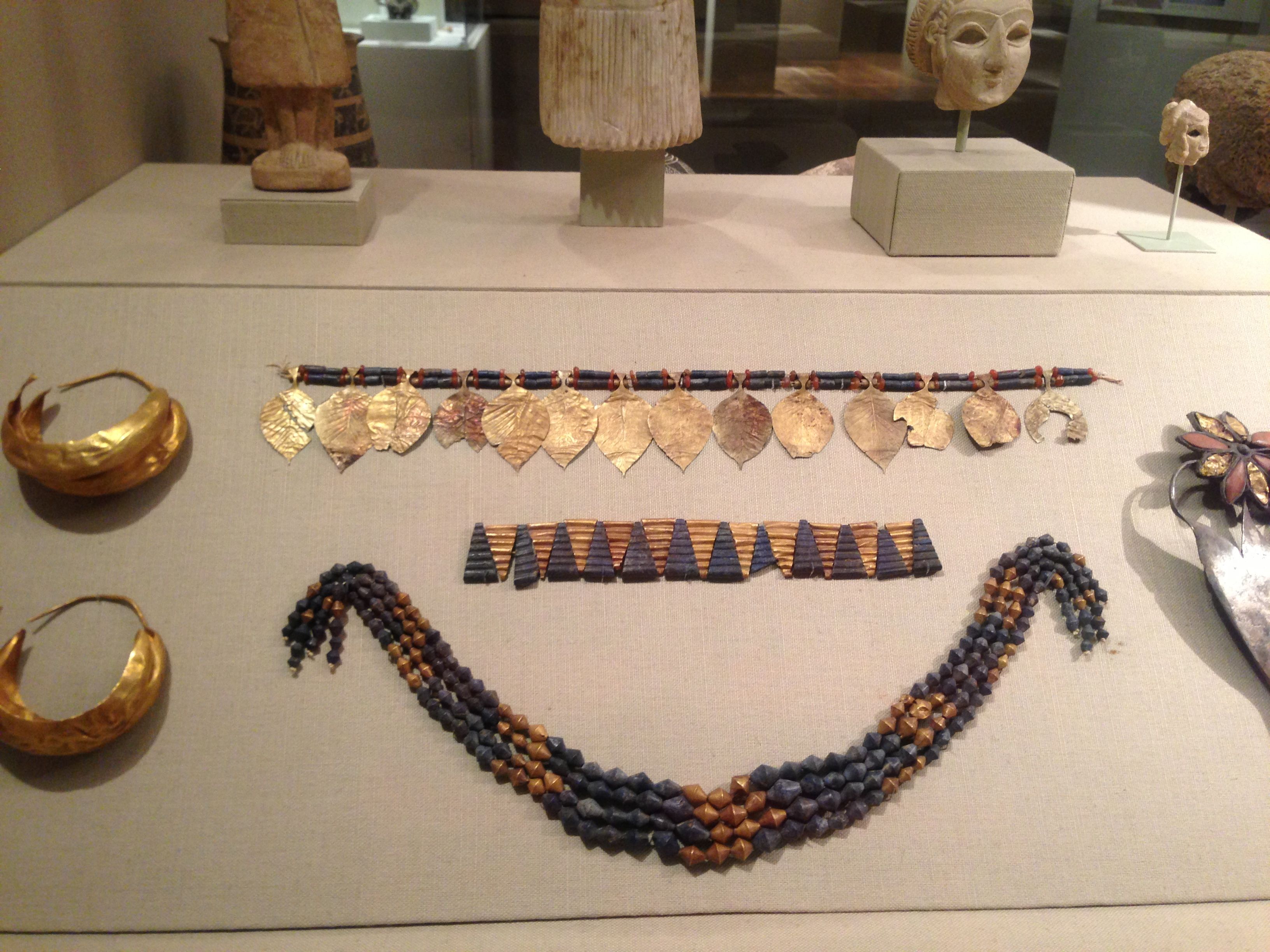
Jewelry found at the Royal Tomb of Ur. 2600-2200 B.C. Metropolitan Museum of Art.

Jewelry found at the Royal Tomb of Ur. 2600-2200 B.C. Metropolitan Museum of Art.

Kneeling bull holding spouted vessel. 3100-2900 B.C. Metropolitan Museum of Art.

Kneeling bull holding spouted vessel. 3100-2900 B.C. Metropolitan Museum of Art.

To remember all this and to balance it against the knowledge that the Islamic State in Iraq and Syria, “ISIS”, now known simply as the Islamic State, has not only eclipsed Al Qaeda as the world’s most powerful and active jihadist group, but seeks to monomanically annihilate history is beyond heartbreaking:

In areas that fall under their control, the jihadists work carefully to entrench their rule. They have attracted the most attention with their draconian enforcement of a fundamentalist interpretation of Islamic Shariah law, including the execution of Christians and Muslims deemed kufar, or infidels.

The goal of ISIS is to destroy. It boggles the mind, but perhaps it is not so novel or exceptional, given that it was war and violence that ultimately brought down the Persian Empire.

And yet there is wisdom being spoken and hopefully it will prevail. Ali al-Nashmi, a professor of history at Mustansiriya University in Baghdad, was quoted in The New York Times on July 27, 2014:

The world lost Iraq, but we must fight, you and me and all the friends, to do something, something mysterious and very far off. We must teach history in the primary school and show our kids Iraq’s great civilization.


Five Stages of Liberal Grief

Tags

, , ,

stage exportBY FRANK TERRANELLA

There are five stages of grief that were first proposed by Elisabeth Kübler-Ross in her 1969 book “On Death and Dying.” As a lifelong liberal, I have been going through them since Ronald Reagan was elected in 1980.

Stage 1: Denial — When Reagan was elected, it seemed to me that this was just a “throw the bums out” reaction to the incredible inflation and gasoline shortages we were experiencing at the time. It didn’t help that Jimmy Carter was perceived as weak on Iran and that Nightline reminded us every night for 444 days that 52 American diplomats and citizens were being held hostage. It turned out that Reagan and the Republicans were like the house guest who never leaves. They occupied the house on Pennsylvania Avenue for 12 years. And then with only a break for a conservative Democrat who gave us “Don’t Ask, Don’t Tell,” the Defense of Marriage Act, the Religious Freedom Restoration Act and the repeal of Glass Steagel, we had another 8 years of so-called “compassionate conservativism.”

Stage 2: Anger — By the time George Bush was “elected” in 2000, my denial was over. Now I was angry. I was angry first that an election had been stolen and then that the thief was hell-bent on starting a war in Iraq. For the first time since the 1960s, I marched in the streets and took part in vigils against the war. The anti-war efforts were completely ignored by the Bush administration. The anger dissipated after a few years.

Stage 3: Bargaining — By 2004, a helplessness feeling had set in. What could we have done better to elect John Kerry? Clearly our message had not gotten out. Were we doomed to have a President who was a joke to the rest of the world? Perhaps we could compromise some principles in order to elect someone who was not a liberal but was at least a moderate. The bargain we struck got us Barack Obama who immediately took compromise to a new level by adopting the Republican healthcare plan.

Stage 4: Depression — As I watched a Democrat expand the use of drones, wiretaps and deportations to unprecedented levels, depression sank in. This was “our guy” doing this. What is it going to be like when the next inevitable Republican takes over?

Stage 5: Acceptance — Just this year, as I turned 61, I came to the realization that I am never going see the kind of nation I thought I’d see when I first became socially conscious 45 years ago when my age digits were reversed. I also will never get to travel to the Moon or own a flying car. In the decade or so that I have left before senility sets in I will have to accept that I live in an imperfect world. Good ideas don’t always beat bad ideas. Altruism doesn’t always trump greed. I have officially entered the cynical sixties.

But just to be sure I don’t get too cynical, I have also this year been given a wonderful grandson in whom I can place all my youthful hopes and dreams for America. I may never get to see a kinder and gentler America where guns and wars are rare and where equality pervades every segment of society. But Bryce may see it. One can only hope.

Me and My Fitness Bracelet, Together Forever

Tags

, ,

leslie fitness
BY LESLIE LEWIS

Recently I gave in to societal and family pressures and purchased “FB”, a fitness bracelet with a tracker inside to record my fitness and health stats. After syncing the tracker, I could view my info on my computer or Smartphone.

“FB” quickly replaced the couch as my BFF, coach and confidant. I started zealously tracking everything possible:my sleep patterns, water intake, activity time, and calories. Soon, however, my seemingly innocuous new friend began to show its other face.

One morning, after days of streamlined eating I happily looked forward to reviewing my success, but it smirked at me malevolently. I’d been ingesting way too many fat grams each day. Also, although “FB” input my steps and sleep patterns automatically, my food and water intake and activities were not. Slavishly logging my intake began biting chunks out of my day and I ignored my friends and lengthening “to do” lists.

“FB”’s mesmerizing effect was strongest when it came to tracking the steps I took each day. A maniacal happy face popped up when I reached the preset target of 10,000, and I received a virtual prize. Soon, I began to crave these noncaloric goodies. On days when I didn’t reach 10,000 steps, “FB” noncommittally reported how many I had taken, but I knew what it really thought of me. I began aimlessly tramping about the house and inventing errands within walking distance to win “FB”’s approval.

Like a parolee’s ankle monitor, my fitness bracelet knew my status, everywhere and at all times. There was no escaping it. Worse, I couldn’t bear the thought of it looking into my soul and being disappointed in me. Ask for a caramel latte with whipped cream? I could almost hear “FB” bang down the gavel and sneer, “motion denied”!

Was I doomed to trudge down the conveyor belt of life, frantically tapping in grams, ounces and calories? And then it happened. One step on the scale and the sun broke through the clouds, birds began to sing and flowers to bloom. I had lost 5 pounds! Giving “FB” a kiss, I ran down the street to ask a neighbor if I could walk her dog.

Beach It in the Rain with Seven-Shake Bloodies

Tags

, ,

Rain

Rain, and no shine.

BY LOIS DESOCIO

Last weekend was cloudy, with on and off showers, which made for near-perfect beach days. As someone who grew up on the water, a sunny day over 75 degrees used to mean the beach was mandatory. A rainy day was a respite. No sun, no beach.

But as I’ve aged, and no longer sit in the sun, I’ve come to love the beach in the rain. Crowds stay away, and swimming under a slow and steady drizzle (sans thunder and lightning) is sublime – a rain-and-sea-and-me bond.

A rainy day on the sand is also ripe for a gathering under the umbrella for Bloody Marys.

So the forecast for this weekend is rain. Beach it. And bring along the bloodies.

Bloody clinkHere’s my Seven-Shake Bloody Mary recipe, as salty as the sea, and adapted from an old friend’s father, who used to make these for us 20-somethings on a hungover morning-after back in the 1980s, when we would spend the night, and wake up on the beach. (Always make one at a time so as not to lose count, and risk disturbing the chemistry):

*Stuff an 8-ounce shaker with ice, and add 2-4 ounces of vodka
*Add:
7 shakes of Tabasco
7 shakes of celery salt
7 shakes of Worcestershire
7 shakes of pepper
7 shakes of garlic powder
Fresh horseradish – add to your liking. Me: I like my bloody speckled. I add two heaping tablespoons.
*Top with Clamato juice

Shake lightly – pour the whole thing into a chilled glass (take out all the ice except for a cube or two), and garnish with either pickles, olives, celery, shrimp, lemon slices, cucumbers, bacon! – or all seven.

I Hate Growing Old

Tags

, ,

i hate growing old 1
BY JULIE SEYLER

There are some days, not all days, but some of them where the revelation that I am growing old, bit by bit and inch by inch hits like a ton of bricks. It may be because despite how perfectly I have applied my mascara, my eyes still look withered or no matter how much time I spend grooming my hair its 58-year old texture just refuses to behave and looks ghastly or it might be because I had a mighty fine work-out only to discover when I get in the shower there is a dull ache in my arm. Instead of knowing it will go away, the thought creeps in, “Is this the start of something big? Is my cartillage leaking out?”

Nothing is the way it used to be and the idea that this spiral of slow decline is the new norm is just one big icky thing that does not make me happy. That’s when I call Lois, the eternal optimist whose favorite slogan is “It’s going to get better!”, but she is a peer and she too is in the process of figuring out this new story line. So we commiserate and crack up at the absurdity of how the body betrays its host and figure this means its time to plan a dance party.

My Kind of Jeopardy: Geriatric

Tags

, ,

Trebek Bob

BY BOB SMITH

Lately, we’ve been watching Jeopardy almost every night. It’s broadcast every weekday at 7 p.m., but we program the DVR to record it so we don’t have to watch any commercials. This has the added benefit of skipping a couple of days and then go on a mini Jeopardy binge – watching two or three shows in one evening. Modern technology can be a great thing.

I can’t recall having watched the show regularly when I was younger, so I’m not sure if I could ever have gotten all, or even most of the answers correct. But it’s clear there would be one of two results if I were to get on the show today:
a) I’d end up with zero dollars because I’d never figure out exactly how and when to push the button on the “signaling device.”
b) I’d somehow master the signaling device, but I’d answer so many questions wrong I’d end the show in negative numbers.

The last episode we watched was part of the Teen Tournament, in which the three contestants were in 7th, 9th, and 11th grades, which makes me at least 10 years older than their combined ages. The winner was the 7th grader, a bespectacled boy wearing his Dad’s best tie bunched up in a lumpy knot. The kid had barely begun puberty, but when “HE WAS PRESIDENT DURING THE WAR OF 1812,” flashed up on the screen, he promptly buzzed in and correctly replied “Who is James Madison?”

Alex Trebek always talks briefly with the contestants about an interesting fact from their lives. This 7th grader told the story of how, during his first confession (what – four years ago?), the priest had addressed the assembled prospective penitents before taking them aside individually to hear their sins. Once the priest’s speech was done, this lad was first in the confessional booth.
However, the priest forgot to disengage his lapel microphone before settling down in the confessional, so this kid’s entire first confession was broadcast to his, no doubt, delighted classmates waiting in the pews outside.

Which normally would be a pretty embarrassing event, but as Alex Trebek observed:
“And they heard everything? But this was your first confession, right? So how bad could it be?”

I suspect he was confessing to having a secret system for cheating at Jeopardy. How else would he know about things like “MOZART’S LAST AND PERHAPS MOST POWERFUL SYMPHONY SHARES ITS NAME WITH THIS PLANET.”

My answer (a wild guess, just for laughs): “What is Uranus, Alex?”

But the correct response, from the mouths of babes: “What is Jupiter?”

I certainly didn’t know that in 7th grade. In fact, I wasn’t aware of it until yesterday. And there’s a pretty good chance, given the way my memory is drying up, that I won’t know it next year either. Or even tomorrow.

The kid won more than $19,000, and qualified to compete in the quarterfinals of the tournament against other freakishly knowledgeable teenagers. I’ll watch, and try to keep up with them, but I don’t have much hope with categories like “NEW TESTAMENT GEOGRAPHY;” “PHYSICS;” and “KATY PERRY VIDEOS” on the board.

I might fare better if they had Geriatric Jeopardy with categories like “PAIN RELIEVERS;” “FLORIDA GOLF;” “SINATRA SONGS;” “NEW HIPS;” “OLD HIPPIES.” There’d be a pee break before Final Jeopardy, and if you’re lucky, you’d get to say “Make it a true Daily Double Knee Replacement, Alex.”

Oh yeah, that’s my kind of game.

.

Ellis Island: A Lens to Immigration History

Tags

, , ,

Ellis1

By FRANK TERRANELLA

Like many New York-area residents, I have never been to many of the tourist meccas like Ellis Island. And since three of my four grandparents were immigrants, I decided on a beautiful Sunday morning recently to see the ground zero of 20th century immigration for myself.

The great thing about a visit to Ellis Island is that the only way to get there is by boat. Of course, that’s the way it’s always been. Between 1892 and 1954 immigrants arrived at Ellis in boats from all over the world. The boats today run a route that includes Liberty Island along with Ellis Island on every trip. So even if you just want to see Ellis Island, you get a free trip to Liberty Island thrown in.

Ellis Island was hit hard by Hurricane Sandy in 2012 and some exhibits are still not back. But what’s there is gold.ellis2 There are artifacts galore and you can tour the great hall where immigrants waited to be called up to be interviewed. You can see where they ate and where they slept. You can see an above-average orientation film that tells the full story of American immigration. And they don’t try to cover up America’s checkered acceptance of immigration. There are whole exhibits to “nativist” hostilities to every immigration group. For some, like the Asians, the dislike was codified into laws that forbade immigration altogether for decades.
But what surprised me most about visiting Ellis Island was the people who accompanied me on the boat. It seemed to me that the vast majority of my fellow visitors were immigrants themselves, or perhaps simply tourists from foreign countries. English speakers were definitely in the minority. And this dismayed me. It seems to me that it would do many native-born Americans good to see the lengths our ancestors went to to try to deal fairly and humanely with immigrants.

From my reading of history, and from the exhibits at Ellis Island, I know that the people who created and worked at the facility were not all big fans of immigration. Yet they followed the law, and I suspect they even bent the law sometimes, to give many needy people a shot at the American dream. The key, of course, was that the laws during the time Ellis Island was operating either allowed unrestricted numbers of immigrants (as long as they were healthy and could prove they had a way to support themselves) or set the ceiling on the number of immigrants high enough that people did not have to wait years or even decades to come into the country legally.

The tour guides at Ellis Island go to great pains to explain that not everyone who came to Ellis Island got to stay in the country. If you were found to have any disease or were otherwise “unqualified,” you would be sent back to your home country. In fact, a member of my family who was found to have tuberculosis was sent back home. He would return to the United States years later after being cured of the disease.

I think that anyone who visits Ellis Island comes away with two thoughts: (1) it was a tough, nerve-wracking way to come into the country but, (2) the process was designed to be fair and efficient and it was that most of the time. One of the rooms you can visit is the make-shift courtroom where immigrants who were being denied admission could have their cases reviewed by administrative judges. The hearings went on all day, every day. Many were able to convince hearing examiners that they were being denied entry unjustly. Contrast this to the detention facilities we have today for unqualified immigrants that provide no right of appeal.

Clearly the immigration situation today is much different than it was 100 years ago. But when you visit Ellis Island, in the shadow of the Statue of Liberty, you can’t help but be thankful that Americans then, while not being crazy about the hordes of immigrants filling up New York City, were compassionate enough and intelligent enough to let them in, in the hope they would contribute to the country.

Essentially, in those days, America made a bargain with the world. You can come here if you promise to work hard and help make America a better place. Even the most ardent immigration opponent would have to agree that the immigrants who came through Ellis Island between 1892 and 1954 kept their side of the bargain. Are we sure that the thousands of people we turn away today because of ridiculously low limits on the number of immigrants cannot similarly contribute?

Before Birds Flew, There Was Changyuraptor

Tags

, ,

changy 3Now for something really far beyond the right side of 50 – specifically to the right side of 125 million. Yes, we are talking about an extinct species – the Changyuraptor. It puts getting old into perspective.

About 125 million years ago, before birds were birds, there existed dinosaurs with aerodynamic capacity. They are called microraptors, and in northeast China, dinosaur hunters have discovered the remains of a four-foot, nine-pound microraptor. The new species has been baptized Changyuraptor.

Unlike scaly dinosaurs, like Tyrannosaurus rex, “Changy” was covered in feathers from head to hind legs. But who knows if they were soft and downy; drab or colorful. The thing that makes “Changy” special, besides its wings and grand size, given that most microraptors weigh in at two pounds, was its tail. The paleo pundits calculate that the 30cm tail, (roughly 11 inches) was the control panel. It drove the up-and-down pitch of the animal, and made it possible for this pre-bird of prey to swoop down on its victims without crash landing.

So now we have a little more info about early avian flight, which means a little more understanding about how birds came to be, which ultimately led to Leonardo Da Vinci’s vision of a flying machine, and then Wilbur and Orville Wright’s powered airplane, up to today’s annoying experiences of flying commercial flights.

Anyway you look at it, flying is connected by six degrees of separation.