
Double vision.
BY LOIS DESOCIO AND JULIE SEYLER
We love eyeglasses. So it’s ta-ta to the summer shades, hello specs. We’re expecting to see less sun, but more fun.

27 Friday Sep 2013
Posted in Concepts
Double vision.
BY LOIS DESOCIO AND JULIE SEYLER
We love eyeglasses. So it’s ta-ta to the summer shades, hello specs. We’re expecting to see less sun, but more fun.
20 Friday Sep 2013

Everything’s connected. Mobile by Julie Seyler.
Does being generous in spirit lead to a better sex life?
Does being kind really beget kindness?
Is it true that if we give good karma to the universe, we will be showered with good karma back?
Do positive thoughts contribute to good health?
Does it matter if any of this is true, if the simple thought of it reduces stress to less?
Is it better to feel the pain as deep and hard as you can so you can thereafter embrace pure joy?
If you walk through a storm is there a rainbow at the end?
Can a good telepathic connection get you what you want when you need it most?
Who knows. But answering, “Yes!,” to all of those questions can’t hurt a thing.
12 Monday Aug 2013
Tags
8-tracks, cds, Concepts, Frank Terranella, Men, MP3, music formats, records, reel-to-reel, The Write Side of 50

If you are on the right side of 50, you have lived through a music migration from records to cassettes to CDs to MP3s. And if you’re someone who never throws out music in any form, you may also have 78s, 45s and 8-tracks. These days, I have to think of the vintage of the music I want to hear to know where to look for it in my house. Beatles – look for records. Bread – look for 8-tracks. Bee Gees – look for cassettes. And if you’re like me, you probably have bought CDs of your favorite albums from the ‘60s that replace records that have more skips than a five-year-old girl. 
Because I have gotten tired of buying and re-buying music in different physical formats, in recent years, I have taken to buying MP3s of my music and storing them on my computer, my phone, and my iPad. I back them up on the Internet. But despite all this redundancy, I don’t trust digital formats. They’re too ephemeral. I prefer to have physical backup. That’s why I still keep all the original source material that the old music came on. I also buy CDs as a backup of my most vital music.

Back in 1972, I purchased yet another music source – a reel-to-reel tape recorder. I used it primarily for recording, but I also purchased commercial “albums” that were available in that format back then. For example, I have the Moody Blues’ “Days of Future Past” on a reel-to-reel tape. Recently I dusted off my old reel-to-reel, and played some of those old tapes, and I was surprised at the great sound. Audio enthusiasts insist that records have better sound than CDs, but to my ears, reel-to-reel tapes have better sound than records. More than 40 years of sitting in boxes has not degraded the quality of the tapes. Of course, my children look at my reel-to-reel as if it was a contemporary of Edison’s wax cylinder. But they can’t dispute the great sound.

In addition to music, being on the right side of 50 means maintaining machines to play video cassettes, DVDs and Blu-Rays, but that’s another story.
All this is why I have a home entertainment center that looks like NASA launch control while my son has an Ipod connected to a speaker and an Ipad to stream video. I don’t care. I’m not throwing out any of my music and video formats. Someday I may want to listen to my 8-track recording of “Winchester Cathedral.” What? It’s available for 99 cents in the iTunes store? Anybody want to buy an 8-track player?
09 Friday Aug 2013
Posted in Concepts

A perfect day at the beach.
Summer 1973:

Recipe for the best tan ever.
Summer 2013:

There is no such thing as vanity.
06 Tuesday Aug 2013
Tags
As Time Goes By, Casablanca, Concepts, Frank Terranella, Herman Hupfeld, Men, The Write Side of 50

Herman Hupfeld will never be forgotten.
It’s one of the most famous songs ever written because it is the centerpiece of one of the most famous movies ever made. But its author is largely unknown – the answer to a trivia question. The movie is “Casablanca,” and the song is, “As Time Goes By.” But who wrote it?
Earlier this year I attended a screening of “Casablanca” at the State Theatre in New Brunswick, New Jersey, with the New Jersey Symphony Orchestra providing the music. Max Steiner’s classic score never sounded better. But Max didn’t write the song that people remember most from “Casablanca” – the song that Ilsa asks Sam to play again. Max Steiner, for all his musical genius, did not write “As Time Goes By.” A man by the name of Herman Hupfeld did that.
Who, you may well ask, was Herman Hupfeld? He was the son of a church organist in Montclair, New Jersey. He began his career in 1912 singing his own songs in Ziegfeld’s Midnight Frolic. This was the after-hours entertainment that Florenz Zeigfeld staged after the Zeigfeld Follies on the roof of the New Amsterdam Theatre on 42nd Street. Hupfeld went on to serve in World War I as a saxophonist in the United States Navy Band. In the 1920s, he wrote songs for various Broadway shows. He was the “go-to-guy” for what they called “additional material.”
In 1931, Hupfeld provided additional material for a musical called “Everybody’s Welcome.” The show had a book by Lambert Carroll, lyrics by Irving Kahal, and music by Sammy Fain. Fain and Kahal wrote, “Let a Smile Be Your Umbrella,” and Fain went on to write, “Love Is a Many Splendored Thing.” But “Everybody’s Welcome” did not produce a hit for the duo. The hit of that show, which ran for 139 performances, was the additional material provided by Herman Hupfeld – “As Time Goes By.” Rudy Vallee had a successful recording of it.
Fast forward to 1942, and Hal Wallis is producing a movie inspired by the 1938 Charles Boyer, hit “Algiers.” It’s based on an unproduced play by Murray Burnett and Joan Alison called, “Everyone Comes to Rick’s.” The screenplay adaptation by Julius and Philip Epstein has as a key plot-point, a song played by Sam, Rick’s pal and piano player, that used to be Rick and Ilsa’s favorite when they were in Paris together before World War II. Max Steiner tells Wallis that he would write a song for the movie. But Wallis feels that the song should be something old and familiar, a song that Sam actually would have played in the late ‘30s. The choice was Hupfeld’s, “As Time Goes By.” And the rest is history.
While the song became world-famous, Hupfeld remained in near obscurity at his home at 259 Park Street in Montclair, a short walk from the Watchung Avenue train station. Reports say that he rarely left his hometown. He wrote many other songs with titles such as “When Yuba Plays the Rhumba On the Tuba,” A Hut in Hoboken,” and “Let’s Put Out The Lights (And Go To Sleep).” He died in 1951 at the age of 57. He’s buried in the Mount Hebron Cemetery in Montclair.
While few people remember Herman Hupfeld, his creation lives on in film history. It’s safe to say that a century after his death, people will still be echoing Ilsa’s request, “Play it Sam. Play,`As Time Goes By.’”
29 Monday Jul 2013
Posted in Concepts
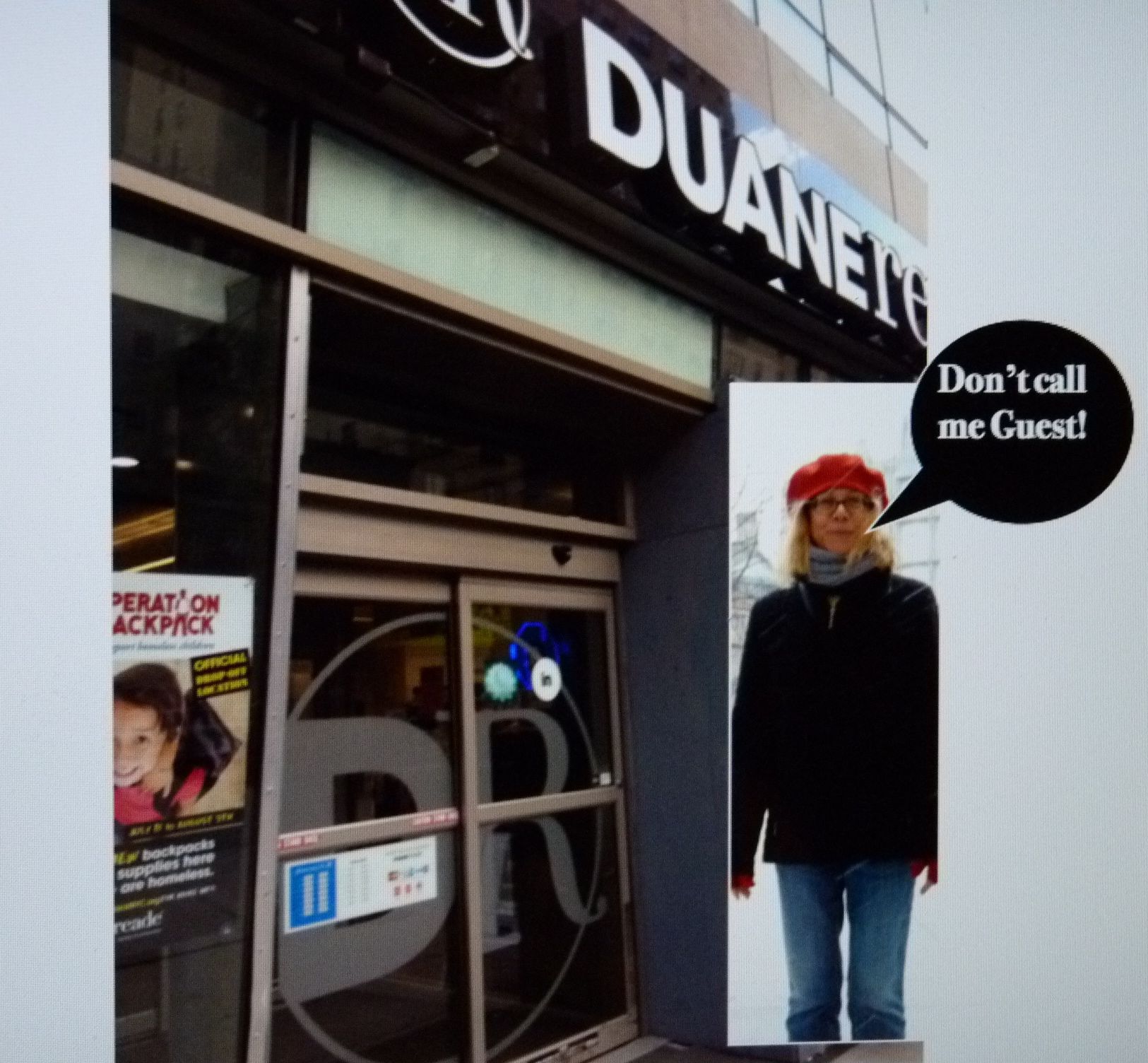
I am thinking about the most minor and insignificant of annoyances that pop up when what was once the common and the usual, shifts to a new code of unfamiliar nonsense.
At the moment, my pet peeve is being called a “guest” as in “next guest” at my local drugstore. Really? The Merriam-Webster Dictionary defines guest as a person entertained in one’s house. Since Duane Reade is not an abode, and I am not visiting to be entertained, I am hardly a guest. I am merely someone who has stopped by to drop money on assorted sundries.
But my question is: when and why did my “customer” status morph into guest-dom? Did some marketing wizard send out a memorandum:
To all Employees:
Profits can be increased 50% if our paying public feels warm and cozy!
Give them the feeling that they are entering our living room!
Make them feel special and connected to the cashier.
They are our GUESTS!
But I do not want to be a guest. I just want to be told I’m next in line so I can move on. And get out of the drugstore.
26 Friday Jul 2013
Posted in Concepts
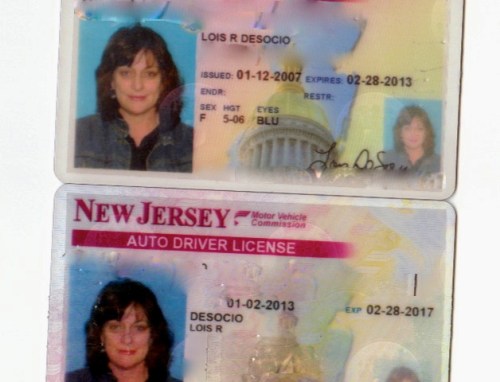
Amended license.
I’m not curious in the least as to how I will look in four years. It helps to not really know what I look like now. I only glance at certain parts of me in mirrors – mostly to make sure there is no food in my teeth, and that my hair is having a good day. I try to be in the background, or look down, when a camera is in my face. I believe it’s tonic to have a light-hearted approach, across the board, when it comes to getting older.
How old I look is better reflected by how young I feel, and ultimately what I exude, rather than that stark reality offered by a mirror (Mom?). I choose to believe that I don’t look a day over … um, 43. My mirror-image will certainly fall short of my mind’s eye, so I try to not mess with my head.
So, props, and a, “Gee – thanks a lot,” to the New Jersey Department of Motor Vehicles (NJDMV) for reminding me that I’m getting older, and for giving me a hint, ala milk-carton fashion, as to what they think I will look like when I’m 62.
In November 2012, the NJDMV initiated a driver’s license renewal program called, Skip the Trip.
If you were born before December 1, 1964, you don’t have to make the trek to the local motor vehicle agency to renew your license. Which means, you don’t have to take a new picture. Which means that my last photo for my license was taken in 2007, when I was 52. My new license expires in 2017, when I’ll be 62. I did a double-take when I opened my new license that came in the mail. Through some DMV digital-manipulation (can’t really call it enhancement), they have, albeit gently, aged me.
I’m still wearing that jean jacket that I tossed years ago. Even though my 2013 hair has lost its red-and-brown hue, and looks instead like a bad, black dye-job, my 2007 perfectly-placed bangs have not so much as moved, much less grayed. But I see no wrinkles! Just one eye bigger than the other, a smooshed nose, and a set of hollow, saggy, sad cheeks. And all of me is more oblong, sallow, and encircled (eyes included) by dark, bluish hues.
I called the NJDMV. I wanted to ask them: How’d you do this? What parameters do you use to age someone? Is it a standard formula, or do you investigate lifestyle, income … gene pool? Do you have forensic artists in a back room? I could find no information through Google, or on their Web site, and after 20 minutes on hold, I gave up.
But it could all be part of New Jersey’s exclusive, nifty, new facial-recognition software (which apparently doesn’t work if you smile too much for your license picture), one of a number of states that employ this system for security purposes. Our driver’s license photos are now all in national databases for the FBI and the police. And the State Department.
So a sense of humor is in order here. I figure that when I really am 62, even if I gain 35 pounds, am all gray, with circles under my eyes as dark as Eye Black, topped with saggy, saggy lids, or, even if I have a plastic surgeon do some heavy lifting that makes me look laminated and waxy (like the shiny sleeve that now comes with a driver’s license), I will most likely look better in that driver’s license photo than in any other photo, and for that matter, than how I will really look. Rather than reminding me that I’m continuing to age, my 2017 driver’s license could potentially serve as a feel-good, pocket-sized rear view mirror.
19 Friday Jul 2013
Posted in Concepts

Photo by Julie Seyler.
… an anniversary is an anniversary. And worth noting, whether it be with a big bash, a gift, a clink of flutes, or simply – a few sentences.
The Write Side of 50 turns eight months old today. So, we thank you again – contributors, readers, commenters, “likers” (and “dislikers”). We started out with an empty frame; a periphery: “We’re getting old,” we said.
Let’s write about it. And paint it, and take pictures of it, and ruminate, and celebrate. And ask others to chime in. So, we hope that bit by bit, and month by month, we’re successfully painting, snapping, and chronicling an engaging, more-to-come narrative; a picture of middle-aged life.
16 Tuesday Jul 2013
Posted in Concepts
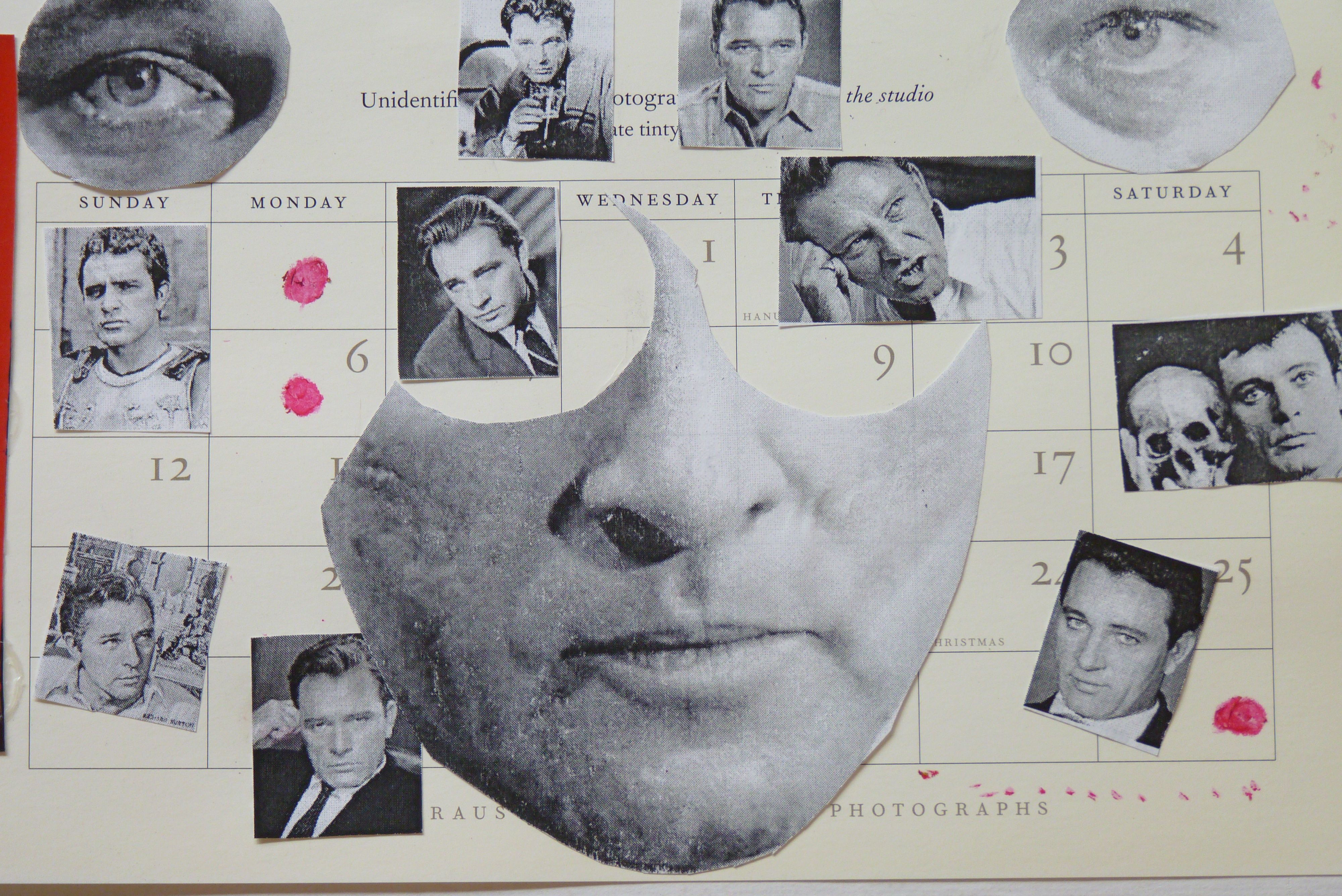
Frank recommended the biography of Abraham Lincoln as summer reading fare because of Abe’s nobility of spirit. I am recommending Richard Burton because of his spirit of noble passion. Frank and I both want to escape the pedestrian pettiness of present-day politics – not to mention the horror show of news from the Middle East – but we travel different routes. While I, too, am a devoted admirer of Abe, my mood right now screams out for light, sexy, fun, acerbic. Richard Burtons’s diaries are perfect.
Who doesn’t love Richard Burton in Virginia Woolf? Cleopatra? The Night of the Iguana? And The Spy who Came in from the Cold?
He is a great actor, but his uncensored recordations between 1940 when he is 15, and 1983 when he is 57, reveal a brilliant, compassionate, caustic, humble, and at times hysterically witty, observer of foibles – his own as well as those of the rich and famous he partied and worked with. I dread finishing the book because I have become so attached to him. I am going to mourn his death of long ago.
But he lives on in the computer. I can listen to him recite the poetry of Dylan Thomas, and watch him and Julie Andrews singing “Camelot” on the Ed Sullivan show from 43 years ago. These days, I invariably call Steve “Richard,” and I, of course am Liz. Ha Ha! I am boring everyone with my Dickie anecdotes. This is especially wearing on people who cannot abide celebrity worship. But I nay-say them. He is beyond stimulating, insightful and erudite. He critiques the zillions of books he is always reading. He expostulates on the political scene, and never refrains from dissecting the uglier parts of his own personality.
His public persona may be linked to booze and ultra-luxe, but his day-to-day musings are riddled with the concerns, joys and worries that are familiar to anyone on the right side of 50. The diaries are a hugely readable, not People-magazinable, peek into the privileges of astounding wealth while, at the same time, offering up a portrait of a middle-aged man beset with the fears, pleasures, and anxieties that are common to all of us.
He fetters over having to work to make money:
March 26, 1966. I worry enormously about the fact that we have no money. I worry that I will not be able to look after my wife and my children after I’m dead.
He frets over the welfare of his children:
November 1, 1969. We are having desperate trouble with Michael. We do our damndest to help him but it is impossible…However we will do our best and love him a lot and have patience with him…
And he is riddled with arthritis:
July 30, 1971. Missed yesterday as I have a gouty or arthritic left wrist, exquisitely uncomfortable.
The next day:
I was so uncomfortable last night that in bed the slightest movement made me groan as if demented. Elizabeth says I am the world’s champion ‘conyn’ whicb is Welsh for moaning hypochondriac.
He loved eating at the best French restaurants, and the simplest Italian trattorias. He fantasizes about retirement. In some ways, he is just like you and me – until you come upon an entry such as this one, where he recounts how Elizabeth acquired the Cartier diamond. On October 2, 1969 they visited a hospital in Geneva where they had donated money to build a paraplegics ward (Richard’s brother Ivor was a paraplegic):
Somewhere between the hospital and dinner brooding set in. Between long silences deadly insults were hurled about. At one point E. knowing I was in a state of nastiness, said to me at the lousy Italian restaurant we went to: Come on Richard, hold my hand. Me: I do not wish to touch your hands. They are large and ugly and red and masculine. Or words to that effect. After that my mind was like a malignant cancer-I was incurable. I either remained stupidly silent or, if I did speak, managed an insult a second. What the hell’s the matter with me? I love milady more than my life…Why do I hurt (her) so much and spoil the day?
The next day:
I am very contrite this morning but one of these days it’s going to be too late cock, too late. E. has just said that I really must get her the 69 carat ring to make her big ugly hands look smaller and less ugly. Nobody turns insults to her advantage more swiftly or more cleverly than Lady Elizabeth. The insult last night is going to cost me. Betcha!
Next time I am asked, “Who would you invite to your next dinner party?” I would reply, Richard Jenkins, a Welsh miner’s son, aka Richard Burton.
15 Monday Jul 2013
 There’s a Lot Right about Being in Your 50s. By Julie Seyler.
It’s summer reading time, and this year my summer reading includes Doris Kearns Goodwin’s 2005 biography of Abraham Lincoln called, “Team of Rivals.” It’s all about how Lincoln stocked his administration with men who were his rivals for the Republican presidential nomination in 1860. It’s extremely detailed with lots of great material about Lincoln’s life and, more importantly, a glimpse into his mindset. A small part of it was the basis for the Spielberg film, “Lincoln” where the 16th president was portrayed by Daniel Day-Lewis.
This year, we’re commemorating the 150th anniversary of Lincoln’s Gettysburg Address. Lincoln was 54 when he delivered it. Less than two years later, he would be dead. So the Great Emancipator never made it out of his 50s. His entire presidency ran from less than a month after his 52nd birthday to a couple of months after his 56th birthday. It’s a bit unsettling to think that I have already lived longer than Lincoln ever did.
I have done some research and found that Lincoln was not unusual in being in his 50s while president. According to Wikipedia, the median age when our U.S. presidents took office is 54 years and 11 months. Most of our presidents served at least part of their term while in their 50s. The list of presidents who served their entire term while in their 50s includes (in addition to Lincoln), Martin Van Buren, John Tyler, Millard Fillmore, Rutherford B. Hayes, Chester Arthur, Benjamin Harrison, William McKinley, William Taft, Warren Harding, Calvin Coolidge, Herbert Hoover, Jimmy Carter and George W. Bush.
What I glean from this is that our society feels that people in their 50s can be trusted with the reins of government. They have enough experience through more than a half-century of living so that their judgment is sound, and yet they are not so old that they no longer have the energy to do the job. Looked at this way, being in your 50s is the sweet spot in life. You’re at the precipice of ability. Oh sure, there’s a long slope to senility ahead. But for now, for many in their 50s, it’s the top of the world.
 The Write Side of 59