What’s in a Name?
03 Friday Oct 2014

03 Friday Oct 2014
02 Thursday Oct 2014
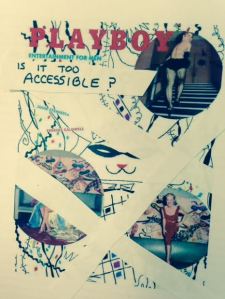
One of the greatest changes in the lifetimes of the over-50 set is the Internet. We were all adults when it first became available to us. We all spent our childhoods having to look things up in encyclopedias and almanacs. It’s truly been a blessing for the last two decades and I’m sure that few of us would want to go back to a time without it.
But there is one aspect of the instant gratification we now receive daily from the web that I fear may ultimately be unhealthy for us, particularly those of us of the male persuasion. It’s pornography. I am not talking about pornography in the legal sense. I am just using pornography as a shorthand here for pictures of unclothed people.
Men over 50 grew up in a sexually-repressed society where the only place we could regularly see pictures of naked women was in magazines like Playboy and Penthouse. Obtaining these usually involved getting hold of a copy purchased by an adult male because most newsstands would not sell them to minors. So adolescent boys had to work to see pornography. Today, on the Internet, young males have to work to avoid it. (Now I know that there are some women who enjoy viewing pornography as much as men, but that’s the exception rather than the rule in my experience. I think that the limited appeal of magazines like Playgirl among women is evidence of that.)
Back when we over 50s were teens, the most common way for boys to see pornography was if a friend found his father’s stash and invited you over to have a look. It happened rarely. And back then, Playboy showed only (in the words of the song from A Chorus Line) tits and ass. Today, the most graphic pictures are only a few clicks away from any 12-year-old with an Internet connection.
Is that a good thing or a bad thing? I truly don’t know. There is one school of thought that says viewing porn allows males to vent some sexual energy that might otherwise be visited upon women against their will. And then there are those who say that viewing porn teaches men to see women as sex objects rather than people.
I suppose the truth is somewhere in the middle as usual. Like all pleasures, it’s a matter of degree. Where an occasional trip to a porn website can satisfy the curiosity of a young male, constant exposure to exposed bodies is probably not healthy. Nudists will probably disagree. They will argue that constant exposure is just what we need to take the sexuality out of nakedness. But even if that is possible, do we really want to remove sexuality from nudism?
Anyway, like it or not, it is a fact of life in the 21st century that before a boy can hear about the “facts of life” he’s already seen what makes the opposite sex different. The Internet puts it all within reach of everyone. So we all have to deal with it.
We try to deal with it by restricting the access of minors to the Internet. But that is even less successful than the prohibitions of porn magazine sales to minors back when we were kids. The reason is that the Internet is everywhere, not just on computers, but on phones, on tablets, and now even on watches. A child who wants to see what his favorite movie star looks like naked will probably succeed despite his parents’ best efforts. Nude selfies are not going away anytime soon.
So given that our children will be viewing and even creating pornography, I think the best thing we can do is educate them about what they are doing. Parents and grandparents need to do the difficult work of talking about healthy sex. As with curtailing all potential vices, it’s better to work on decreasing demand rather than restricting supply.
At the end of it all, we may end up with a society with a healthier attitude about sex. Or we may witness the fall of the American Empire. I’m not sure which. Life was sure a lot simpler 50 years ago.
01 Wednesday Oct 2014
Posted in Confessional

Looking towards 60.
Birthdays are funny. How we relate to the day we are born changes with age. The year we turn one we are incognizant of the significance, but parents and grandparents are feasting on the fact that a year has passed since you entered the world. By the time you are six, birthdays have been converted into knowledge that this is a special day. Presents are bestowed and there is cake galore. Anticipation builds for the next year, which feels as if it will take FOREVER. Gaining age is a positive.
The milestone birthdays set in: 18 and the right to vote, 21 and the right to drink (albeit in 1973 the legal age in New Jersey was 18), 30 and the idea that this is “old,” and 40 brings the recognition that this is “young.” The big 5-0 feels momentous, but with time passage, it dawns that this is still the minor leagues. After 55 things seem to change slightly, because it is this new era of approaching “old” age, and yet it is always relative. Young and old are only comparison adjectives.
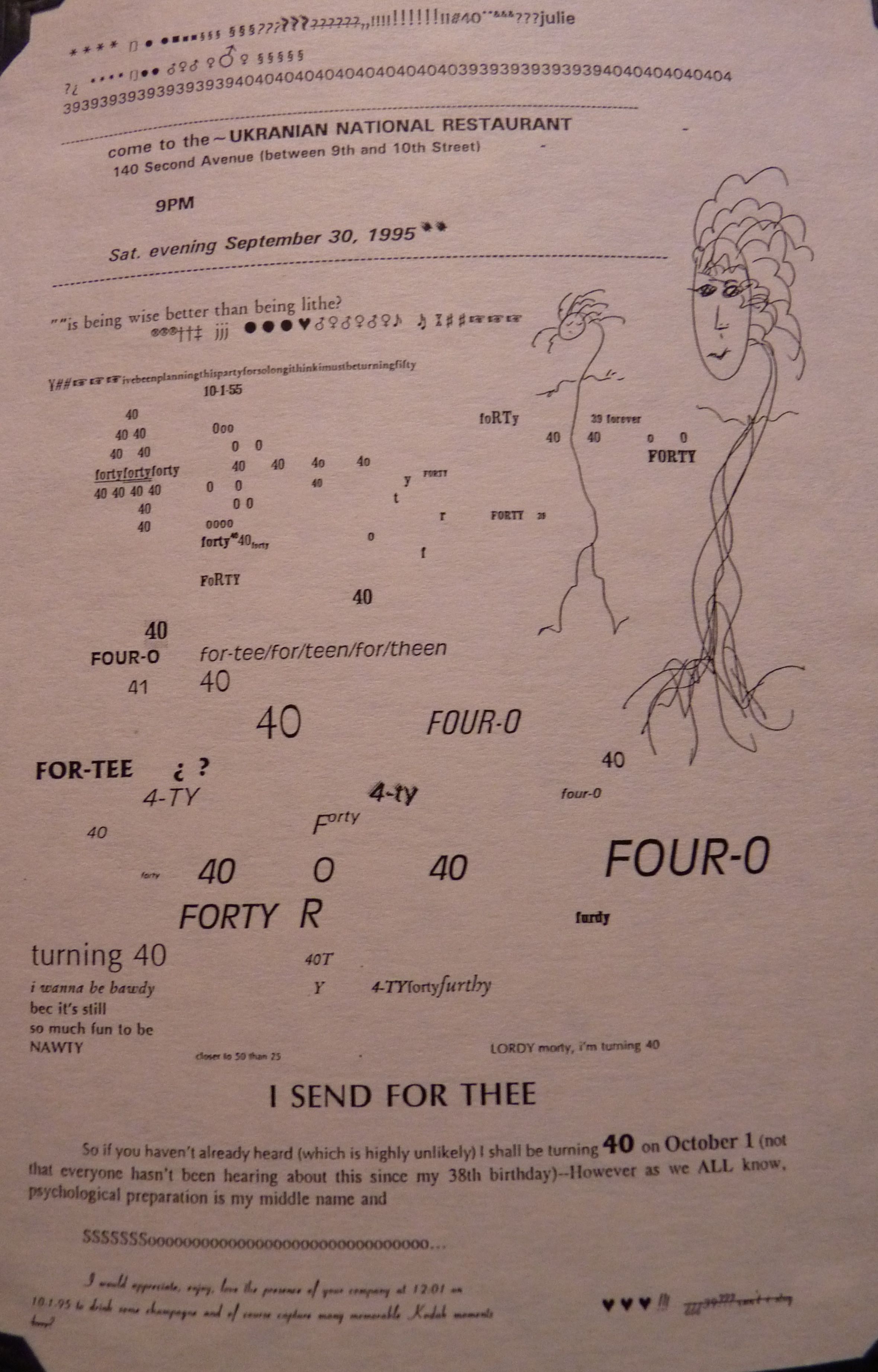
Today, I turn 59. Amongst my peers born in 1955, I am on the “younger” side. I have friends that will be turning 60 in four months. It is beyond comprehension that this is happening. I remember my “Sweet 16” (it was a surprise party), and I planned my 40th with assiduous care.

Lois and me at my 40th.
Nineteen years ago, and it seems like yesterday. But the reality exists: I shall soon be a woman of 60 years of age.
The cliche that time collapses as we age is proven as each year flies by. Twenty years is forever at six, and the blink of an eye at 60.
But I am going in with gusto, because while I may wither on the outside I am determined to take my Vitamin D and blossom on the inside.
With age comes wisdom, and knowing that the best and only defense to the right side of any age is staying active, curious, connected and laughing as much as possible.
29 Monday Sep 2014
Posted in Confessional, Men

The last time I managed to pass an eye test free of corrective lenses, I was a seventh grader in a Catholic grammar school in a smallish North Jersey suburb of New York City. Having taken the test soooo many times over the years, the E’s, the N’s and the T’s, et al, were somewhat engrained in my sub-conscious. I never had any problem whatsoever.
This year was different, though. I had recently been comparing my far-sightedness with one of my older brothers, who could hit a baseball a country mile in Little League, and then had trouble in Babe Ruth and high school. Come to find out, he needed glasses.
So I compared what he could see with what I was now having trouble seeing. I also had had a bout with conjunctivitis in sixth grade, which kept me home from school for the first time ever. Didn’t even feel sick. I always blamed the red eye for my eyesight degradation, and was not too happy about losing my perfect attendance record.
In those days, there was still a bit of stigma attached to those who wore glasses – “four eyes” people were called, and the weakling defensive cry, “you wouldn’t hit a guy with glasses would you?” was invoked when a playground left-jab lurked.
So I was relatively shy at the prospect of having to wear glasses. But I took the test, and passed. Seems that the school nurse used the same pattern with every student tested before me in line. I memorized the stupid chart. And passed. (Blurry as it really was.)
By eighth grade, the eye-scam had run its course. Wearing that first pair was quite depressing. I was even dizzy coming out of the optometrist’s office with my new brown, horn-rimmed specs. I was embarrassed. After all, I was lucky enough to be one of the smarter, and, dare I say, cooler guys in the class. How could I wear glasses and maintain?
Didn’t wear them all that much that year. Things had been blurry for some time so I was kind of used to it. Freshman year brought me to a private Catholic (still all-boys to this day), prep school. And it WAS preppy! And the glasses I needed to see now kind of fit with the blazer (sans any school emblem), white shirt and tie that were standard fare in those days.
Wearing those horn-rimmed suckers became an accessory, and since I was just another freshman face in the crowd, my cool was safe, despite being amidst a host of geeks and nerds. (Called them something different in those days but those terms seem to escape me at the moment.)
Later on in life, I began to wear contacts. I’ll never forget the first time I paddled out into the ocean to surf a bit, turned around and actually saw the beach! I saw the waves better as well. Were they always this big? Thought the lenses would bring a little relief from taking my glasses off to read, and then putting them back on to look at television, or whatever, but of course, I then fell prey to the macular degeneration so many of us are doomed to endure.
Working on a computer surely hasn’t helped the situation. Now I have umpteen readers – one on every level of my home, in my workshop, a pair or two in the car, one for work. All to wear while the contacts are in! I am rarely without some sort of specs – readers on the tip of my nose, regular glasses resting on top of my head or just on to see things when I’m not wearing contacts.
 And strangely enough, I often also find myself walking around and about without contacts, readers, or eyeglasses whatsoever. After all, I’m not all that blind. I do still enjoy wearing eyeglasses as an accessory (helps rationalize NOT getting Lasik surgery as well).
I have my dress-up pair, my good pair, and my back-up pair, which I allow myself, at times, to fall asleep in. Not sure life is ALL that clearer as a result, but I have been seeing things pretty good these last 50 years or so. Maybe I’ll see some of you sometime.
27 Saturday Sep 2014
Posted in Art

25 Thursday Sep 2014
Tags
Emma Sulkowicz, Emma Watson, Hannah Storm, Lois DeSocio, Misogyny, opinion, The Write Side of 50

I’ve been in a nest of men lately since my recent divorce after a 30-year marriage. Some of them are married to friends, or in a committed relationship. Some are single, and have never been married. Some are divorced. Some are friends. I’ve dated a few.
And more than a few are good men. But as a middle-aged woman who is single for the first time since her 20s, I’ve been reminded personally, all too often, that sexism is ageless. A few die-hard mysogynists have flown by.
But I’m now like a fine-grained whetstone. As an older woman, I’ve noticed that my feminist edge has been honed over the last three decades. My whittle-down skills are fine-tuned. And comparable to a 59-year-old slab of good old Wisconsin cheddar – I’m sharper with age.
It’s a given that men’s behavior towards women is as disparate as stone and cheese. But my little slice of change is that I have no use for the stinkers among them – to those who believe that masculinity means mysogyny. I no longer bother to slice through the bad parts to get to the good. I toss them – every bit of them – without pause.
It hasn’t always been this way. I would take the verbal, physical and emotional abuse personally when I was in my teens and my 20s. I had a what-did-I-do-wrong approach. Let me slice through your layers for you! I want to help you understand who I am – how smart I am.
To any man that would diminish me, whether in the workplace, or in my personal relationships, I figured it was smart to be coy. I would try to see his side. This hen didn’t want to ruffle any rooster feathers. I smiled. I played the game. I would give in. And eventually give up. I figured I must be doing something wrong. Let me fix me. Because that would fix them.
When one man in particular would yell “I am woman!” in a condescending, mocking voice, every time I spoke my mind, I would instinctively knock myself down a few pegs. My own in-my-head demand – Stop talking, Lois! – would shut me down.
And often, I fell right into the stereotype – I cried like a girl.
As for cat calls, hoots from men, and behavior from some that reduced me to body parts: Oh! They think I’m beautiful! That’s what I’m supposed to be.
I felt I had no tools to handle it any other way. It was uncomfortable. I knew I deserved better. But I took it as the norm.
Because, back then, to me, to survive as a girl meant to play with the boys. They ruled.
So, dare I write this – I’m feeling a change in attitude beyond my own. I see the tolerance meter towards sexism shrinking among women. And men.
There is a plethora of online platforms which allows women to reach a wide audience. They are standing up to the abuse, the misogyny, the dismissiveness, and the cluelessness in a way that I couldn’t. I didn’t know how.
So bravo to the female journalists, like ESPN anchor Hannah Storm (who is 52), who are “driving the story, providing a perspective that their male counterparts simply cannot” on the Ray Rice assault on Janay Palmer, and the N.F.L’s subsequent sloppy handling of it.
To quote Jonathan Mahler, in his article about Storm for The New York Times: “The proliferation of female broadcast voices covering this story is a testament to the progress women have made in a profession that was once a male bastion.”
He continues to ask if this is a “watershed moment,” or ” … just the temporary effect of a news cycle.”
No matter – a layer has been removed. More men are listening.
And kudos to the 20-somethings, like college student Emma Sulkowicz, who has tirelessly dragged a 50-pound mattress around the campus of Columbia University and has pledged to do so until her accused rapist is expelled from the same school. She has helped to blaze a path of awareness, straight to Washington, to legislate against, and shut down, the rape culture on our college campuses.
Thank you, Emma Watson, for your eloquent, “game-changing” speech to the United Nations that defined feminism as a theory, not a rally cry against men.
I have no doubt that every single woman, from 18 to 80, has experienced, at some point in her life, sexual harassment. She’s been diminished, groped, humiliated, physically abused, verbally bashed, emotionally dismissed, laughed at, or all of the above.
Every. Single. One.
And I have no doubt that, like me, many women of my generation felt it was amiss – wrong. But fell into line because that was the wisdom of the day for those of us who were less resolute, and were not as self-assertive, as the feminists of the 19th and 20th centuries, who cast that first stone, and whittled, piece by piece, through the mess that is mysogyny.
Because no matter how you slice it – it stinks.
23 Tuesday Sep 2014
Posted in Concepts
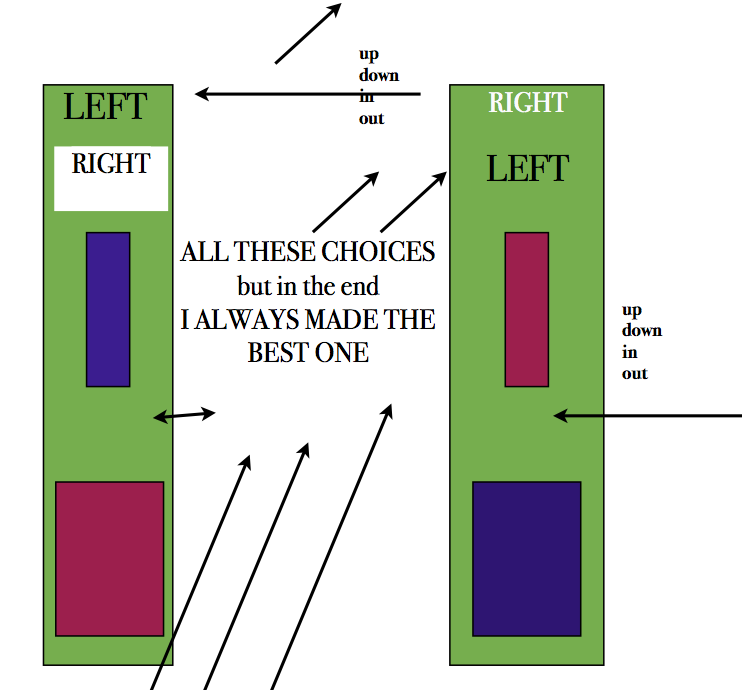
One thing about being over 50 is that you have made some choices in your life that have brought you to where you are. You have chosen where to live, how to make a living, who your friends are, who your significant other is, whether to have children with that significant other. Each of those choices represents a branch in your path, a fork in the road. And if you’re like most people, you’ve made some good choices and some bad choices in the last 50 years.
So here you are, on the right side of 50 and it’s only natural to look back and wonder, what if? That is the theme of a show currently playing on Broadway called “If/Then.” It stars Idina Menzel and was written by Tom Kitt and Brian Yorkey. The show is loosely based on a 1998 film called “Sliding Doors,” which starred Gwyneth Paltrow. The show explores the ramifications of one decision the main character makes. We follow the character down both paths to see the differences depending on whether she leaves a park with one friend or another. It’s quite a cerebral concept for a Broadway musical and while the show has not been a complete flop, it has not been a hit either. It was shut out at the Tonys.
Anyway, I found the idea intriguing to ponder. Every time we come to a fork in the road we alter our life trajectory slightly. That fact was never so poignant as when we read the stories of the 9/11 victims and survivors. In so many cases, seemingly minor decisions made the difference between life and death. Many people would call this fate. But that’s really a cop-out. It implies we have no control over our destiny, when in fact our decisions determine our fate, even if those decisions are made without knowledge of the consequences.
In the course of a 50-plus-year life, the number of decisions is staggering. But our life is the sum of all these choices. I think that just about everyone would like a do-over on some of those decisions. Of course, if you only live once, you’re out of luck. For the mathematically-minded, the formula is: IF YOLO THEN SOL.
But if you believe in reincarnation this is not such a big deal for you. There is one factor tempering the destructive effect of bad decisions. Sometimes two paths can lead to the same place. Often we take the long way around in life. How often do we hear about childhood sweethearts who go their separate ways only to be reunited after their spouses die. There are many paths to each destination so in many cases you can get there from here. That’s why most of us can agree with the sentiment of the Paul Anka song: “Regrets, I’ve had a few, but then again, too few to mention.” I call that the definition of a good life.
22 Monday Sep 2014
Posted in Concepts
Tags
dementia and Alzheimer's, nanomoles and nanograms, safe sun exposure, skin cancer, sun exposure, Vitamin D
I read an article that said Vitamin D levels below 50 are a predictor for Alzheimer’s:
The study, published online in the journal Neurology, controlled for many dementia risk factors — including age, education, sex, body mass index, smoking, alcohol use, diabetes and hypertension. It found that compared with those who had vitamin D levels of 50 or more nanomoles per liter, those with levels of 25 to 50 had a 53 percent increased risk for all-cause dementia and a 69 percent increased risk for Alzheimer’s disease. People with readings of 25 or less were more than twice as likely to have Alzheimer’s or another form of dementia.
I immediately began to worry, convinced I had insufficient Vitamin D consumption. I logged on to my doctor’s office website and based on the numbers from my physical in April, I decided I needed to up the ante. I was heading in the direction of increased risk. The question was what is the optimal and safe level of Vitamin D intake and how to get it?
Online sources give conflicting information. Mercola.com claims that most adults need about 8000 units of Vitamin D a day, The Mayo Clinic, and The National Institutes of Health weighed in with a daily dose of of 600 units, and the Vitamin D Council put the recommended daily allowance at 5000 units, but noted the upper safe limit is 10,000 units. So it seems one is on one’s own when deciding how much Vitamin D to imbibe on a daily basis because taking too much (like 40,000 units per day) can lead to Vitamin D toxicity.
Anyway, there was consensus that the best way to get Vitamin D was to expose your bare skin directly to the sun to absorb beneficial UVB rays, while at the same time avoiding UVA rays, the source of wrinkled skin and cell malfunction. To do this you need to aim your body into the sun for a short period of time “when the sun is above an angle of about 50° from the horizon.”. Geez Louise, but I think this is between the hours of 11:00 in the morning and 3:00 in the afternoon in the summer if you live in the northern hemisphere.
In addition, skin type definitely needs to be factored in. The lighter the skin the less roasting time required. The Vitamin D Council’s advice is that all you need is enough time for your skin to turn pink. Perhaps you should think that you are cooking a rare burger for lunch.
You don’t need to tan or to burn your skin in order to get the vitamin D you need. Exposing your skin for a short time will make all the vitamin D your body can produce in one day. In fact, your body can produce 10,000 to 25,000 IU of vitamin D in just a little under the time it takes for your skin to turn pink. You make the most vitamin D when you expose a large area of your skin, such as your back, rather than a small area such as your face or arms..
In other words if you cover your face and arms with sunscreen, but keep torso exposed for about 15 minutes around noon, you might perfect walking the fine line between not too much sun to get skin cancer, but enough to ward off dementia caused by Vitamin D deficiency.
Meanwhile amidst all this Vitamin D research, (and believe me there is alot more out there when you start trying to make sense of the litany of benefits that Vitamin D is supposed to provide), I rechecked my test results. It seems that my Vitamin D was measured in nanograms per milliliter, not nanomoles. Measured in nanograms, Vitamin D levels should fall between 30 to 74 which is the equivalent of 74 to 184 nanomoles per milliliter). With the conversion factored in, I think I may be skirting Vitamin D dementia at the moment, but who knows about the other risk factors that lurk in the new world of the right side of 60.
20 Saturday Sep 2014
Posted in Art

Ramen. MisoYa Second Ave. and 6th Street. NYC.
19 Friday Sep 2014
Posted in Concepts

Subway Station. 110th Street and Broadway. Manhattan.
… some of us are more than halfway to 110 years old.





 The Write Side of 59