It’s hot. We’ll Keep it short:
Sometimes she felt as if small pockets were opening up in her brain and she was draining fluid.


10 Thursday Jul 2014
Posted in Words
It’s hot. We’ll Keep it short:
Sometimes she felt as if small pockets were opening up in her brain and she was draining fluid.
09 Wednesday Jul 2014
Tags
BY JULIE SEYLER
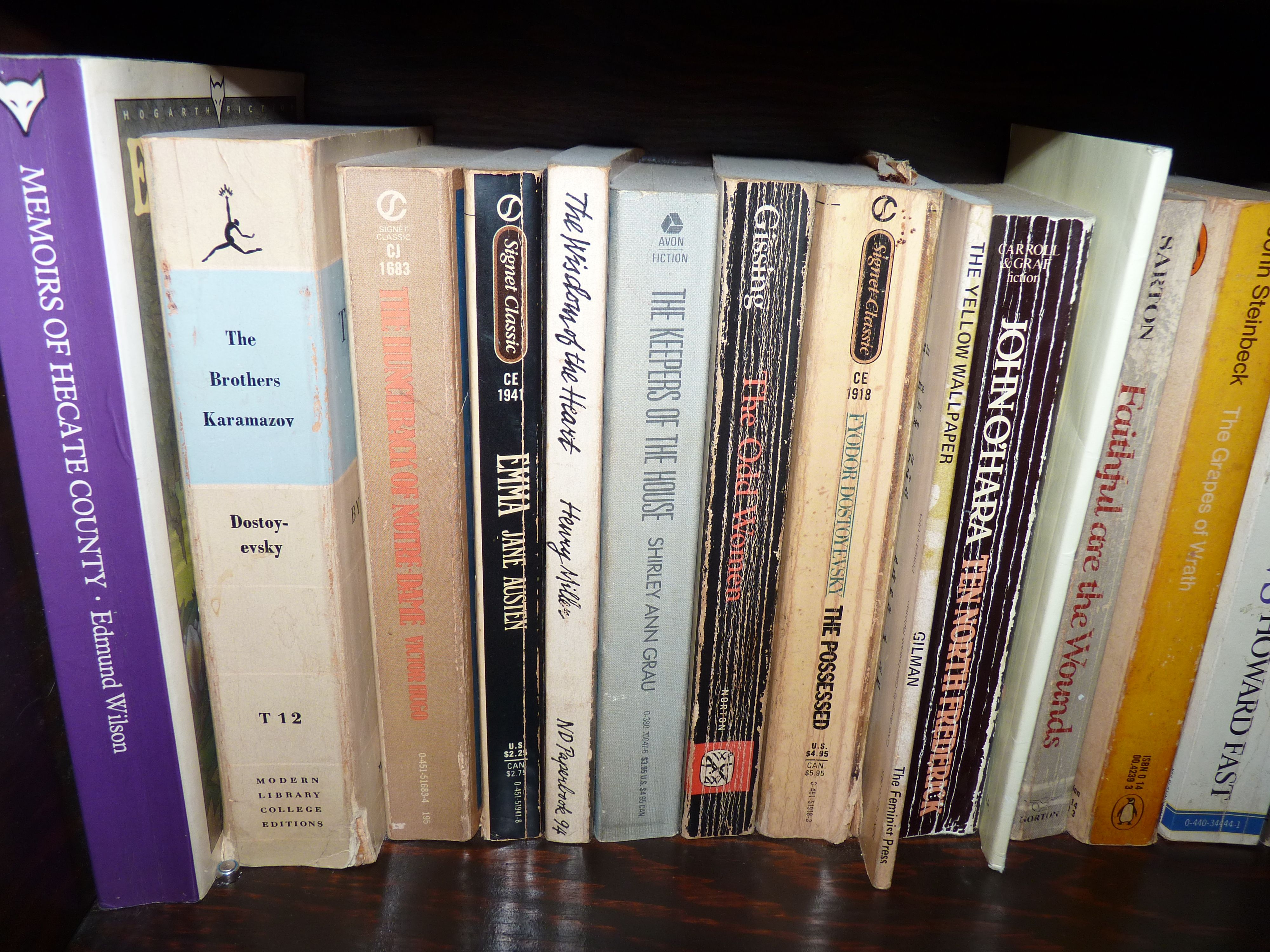
When I was a young girl, say between 8 and 18, I was a reader. I never didn’t have a book in my hand. I remember sleeping over my best friend’s house. She’d want to play and I’d want to read and I would plead with her “Just let me finish this chapter.” (In retrospect I think I wasn’t that much fun as a friend, except we did laugh alot).
A road trip meant curling up in the back seat of the car with a book. Summer was a string of endless days of devouring books. I opened Black Beauty on Saturday morning and finished it on Sunday afternoon. I gobbled up The Bobbsey Twins and Nancy Drew, and moved on to Valley of the Dolls, Jane Eyre and Crime and Punishment. I went on an F. Scott Fitzgerald kick and threw him over for Hemingway. Books were escape because back then the Internet was a glimmer in the eyes of the super-techies, but nowhere near ready for its close-up by the masses.
Then college happened, then law school, then work, then the computer did become a mainstay of life, and with each passing year the number of books I finished would dwindle. I don’t mean to imply that I don’t read. I do. I am always in the middle of reading a book and am surrounded by books. One of my favorite things to do is to wander into bookstores and peruse the shelves for new discoveries. They end up stacked in my bookshelves and layered on top of one another on my nightstand, patiently waiting to be cracked open.
These days I am more realistic about the prospect of actually finishing a book, I mean within a reasonable time period. So, instead of buying books, I download samples, thousands of them, onto my iBooks or Kindle.  It’s comforting to know they are there at the ready for a rainy day, even though I feel guilty because it makes me one of the countless contributors to the demise of the old-fashioned bookstore.
Still every night I curl up in bed with a book. But, before I can settle down to read, I must check email one more time, look at the latest FB posts, review the blog stats for the day, and tap on the Scrabble app to see if my online foe has made another 66 point Bingo word. Then I snuggle into read. Two pages later my eyes are drooping and the lights are out. So much for reading a book.
07 Monday Jul 2014
Posted in Confessional, Men
Tags

Family Gathering.
Family can surprise you sometimes. Just when you think that everyone is acting childish with their petty disputes and slights over nothing, they can come together and act like, well, a family!
This was brought home to me recently when my grandson, Bryce, was baptized. Members of the family who had not seen each other for years all showed up, and seemed to enjoy each other’s company. People who don’t talk to one another did. And I have to think that there is some magic in a baby‘s baptism.
Baptism is where a child is initiated into the family faith. The family gathers together for it, and celebrates the new family member. It’s sort of a Christian coming-out party. I think that every religion has an equivalent. The iconic image from “The Lion King,” with the child being held overhead, is of the same cloth.
Bryce seemed to enjoy all the attention and suffered the pouring of water over him with barely a peep. I think his only complaint was that he didn’t get his full bath. The boy loves his bath. Bryce also loves being held, and there was a whole room full of family members eager to accommodate him.
Bryce had another baptism of sorts the day before. He attended his first Yankees game. I think there is a religious aspect of that as well.
So now Bryce is all baptized and seems to be enjoying life at nearly five months. He was all smiles at his baptism. And his grandfather is enjoying the healing effect a baby has on a family. It seems that the innocence of a child can bring out in people what Lincoln called “the better angels of our nature.” It’s a wonderful thing to see.
05 Saturday Jul 2014
Posted in Art
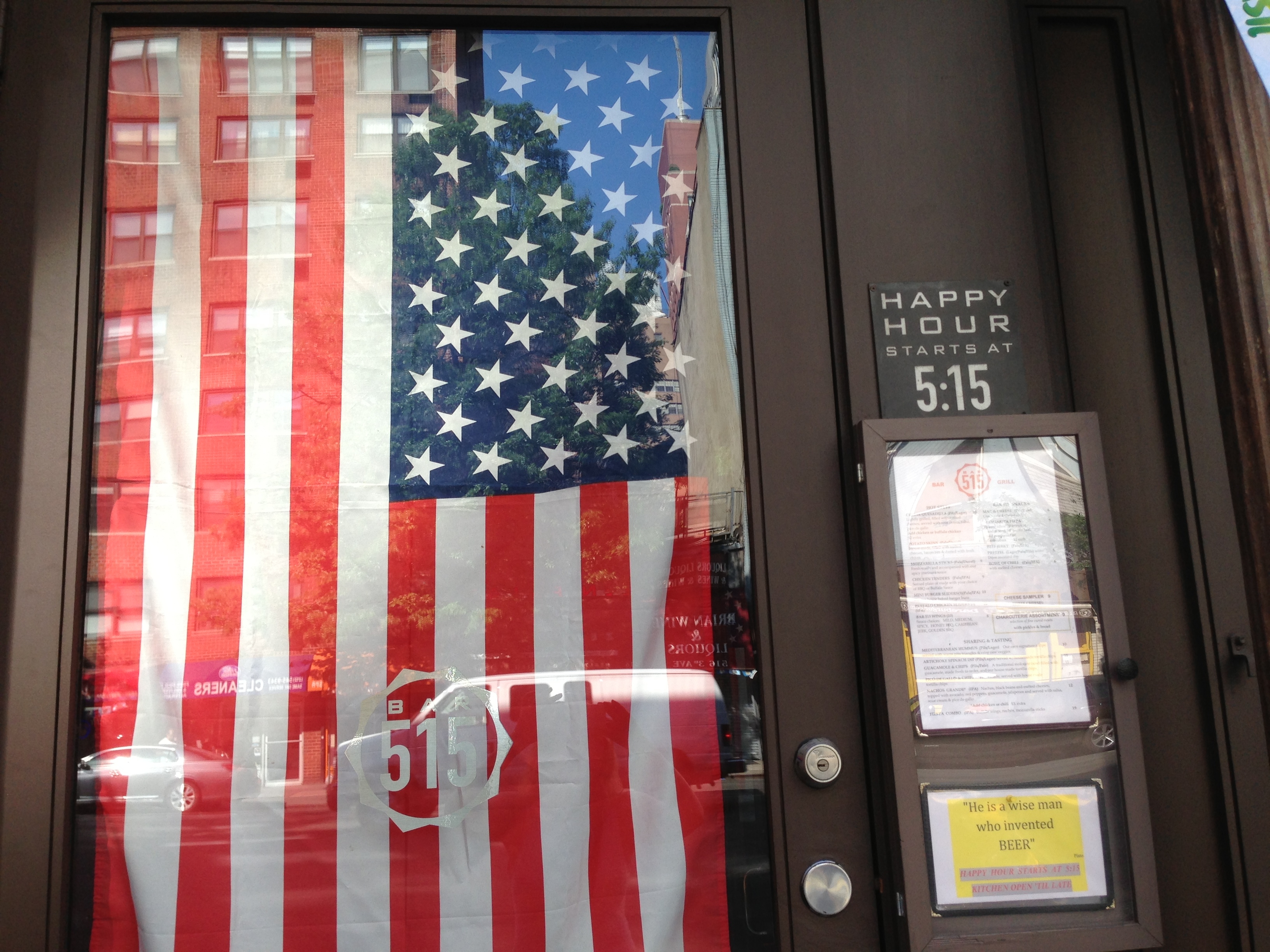
Enjoy the rest of the 4th of July weekend.
04 Friday Jul 2014
Posted in Concepts

Here’s to the Birthday of the USA. On Thursday July 4, 1776, the final draft of the document declaring the colonies’ independence from Great Britain was approved by the Continental Congress. Technically one could look at these founding fathers as a motley group of rebels, but they had a vision and it was beautifully laid out in the Declaration of Independence. Thomas Jefferson was only 33 years old when he wrote these words. (I am amused that I write “only 33” when I once thought 33 was “old”).
We hold these truths to be self-evident, that all men are created equal, that they are endowed by their Creator with certain unalienable Rights, that among these are Life, Liberty and the pursuit of Happiness.–
However yesterday’s New York Times turned the whole story upside down. There is a great debate about the period that appears after the phrase “life, liberty and the pursuit of happiness.” Some cognoscenti say that that period may be a HUGE mistake and to understand the real meaning of this phrase, it must be read in immediate conjunction with its follow-up sentence:
We hold these truths to be self-evident, that all men are created equal, that they are endowed by their Creator with certain unalienable Rights, that among these are Life, Liberty and the pursuit of Happiness — That to secure these rights, Governments are instituted among Men, deriving their just powers from the consent of the governed, —
Danielle Allen, a professor at the Institute for Advanced Study in Princeton, N.J. and a scholar of the Declaration of Independence, maintains that that dot of ink may not have been present on the original Declaration and if it was not, there is a shape shift in the message:
The logic of the sentence moves from the value of individual rights to the importance of government as a tool for protecting those rights,” Ms. Allen said. “You lose that connection when the period gets added.
How fascinating. With the period the individual is celebrated, without, these inalienable rights fall under government jurisdiction. Personally, I prefer the period.
So whether you’re a with-y or with-outy, enjoy this weekend where we celebrate the day we declared independence from the motherland. We are 238 years old. Let’s raise our first toast in honor of the groundbreakers of 1776 who struggled to write a paper setting forth their ideals and the second toast to us because it is true that while mistakes have been made, (and depending on one’s political stances, are being made today), the framework initiated by the drafting of the Declaration of Independence has steered us right these many years.
03 Thursday Jul 2014
Posted in Words

When the letters suck
Long before Words With Friends (WWF), there was its real-world ancestor Scrabble, which we’ve been playing in our family for as long as I can remember. At home we use a set with indentations that keep the letters in place, and a fancy turntable to spin the board to each player. We have one travel set we bring to the beach and another we take with us when we know we’ll be waiting on line at a restaurant for more than a half hour.
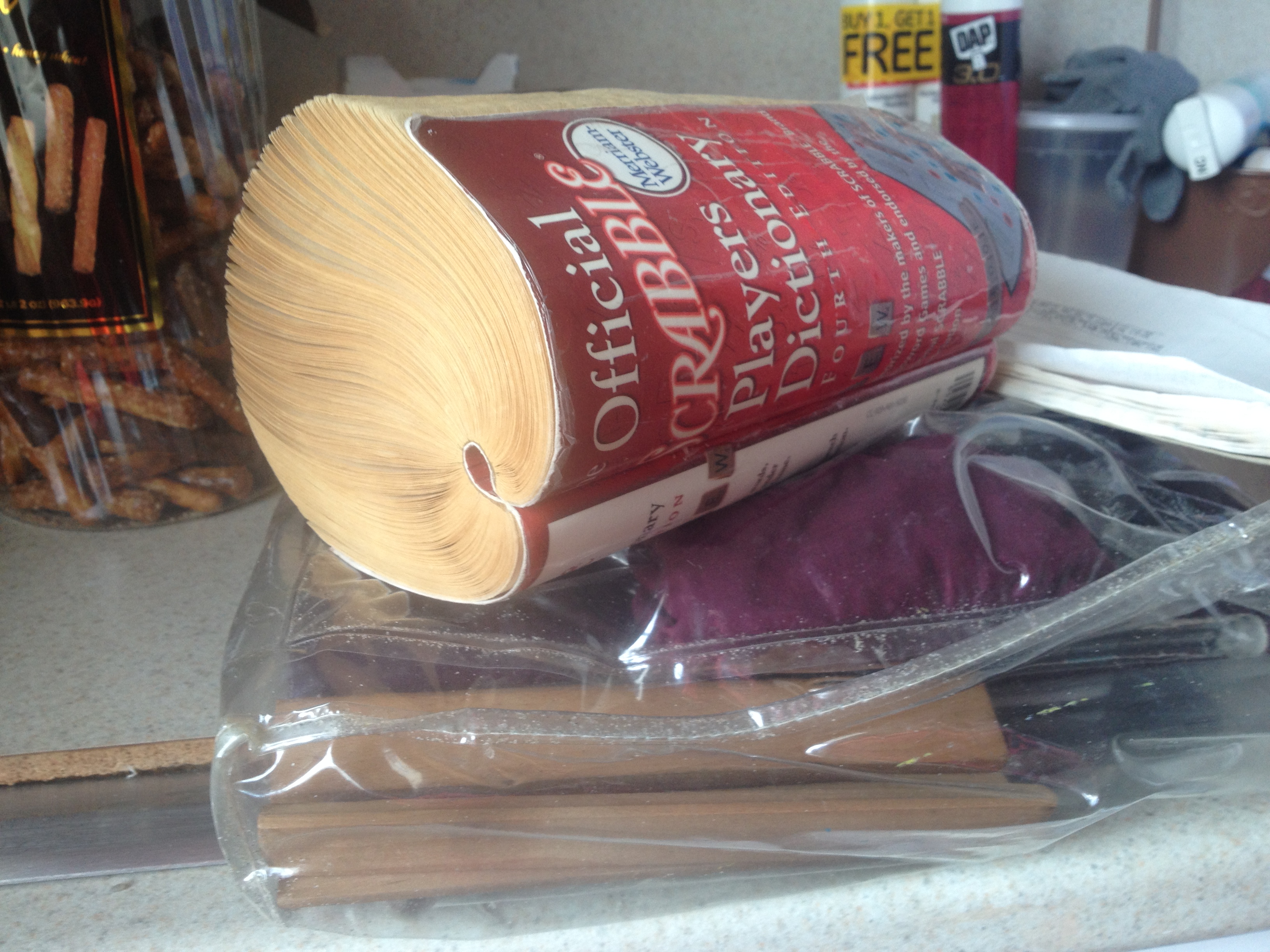 Our paperback Scrabble Dictionary for the beach is so warped from the humid ocean air, its spine has curled into a sharp u-shape. In fact, we’re on our second beach board because the first one partially melted from years in the hot sun and wouldn’t lay flat any more. Oh yeah; we’re total Scrabble geeks.
WWF is essentially the same game except that with Scrabble, you compete against human beings who are sitting beside you, in person, rather than communicating over the Internet. In WWF the program automatically decides which words are permissible, while in Scrabble the issue is open to discussion. To settle disputes about what words are acceptable, we always use an Official Scrabble Dictionary, which features “aa,” “mu,” “za,” “ae,” and similar obscure – but handy – language fragments.
Two weeks ago Maria and I played a game on the beach to a point where neither of us could build any more words, even though we both had letters left in our racks. I passed on my turn; she passed on hers. We’d never seen it before: the Scrabble stalemate.

What would you do with this board?
We shrugged and showed each other our letters (an interaction impossible in WWF). Mine were pretty crummy (U, R, R, E, and E), and Maria’s weren’t much better except for the high-value Z (accompanied by O, A, and I). Neither of us could come up with any words, so we declared it a tie and put the game away – but we were wrong.
Even though a stalemate is as rare as the elusive ai (a Venezuelan three-toed sloth), the Official Scrabble Rules clearly provide that if all players “pass” twice in a row, the game is over and the points must be tallied. You subtract from each player’s score the value of the tiles remaining in that person’s rack, and whoever has the highest score wins.
That person was Maria – again. She regularly beats me at WWF too, but those games are a lot less fun than our Scrabble matches, where we can squabble about the rules and whether or not a given word is acceptable. We (me, usually) grouse about having six vowels, taunt the other person for taking too much time, and share the excitement (or envy) when one of us gets a seven-letter word.
Despite its name, WWF is an impersonal electronic interaction that’s mostly about words. Scrabble, on the other hand, is all about gathering people together in the same place to match wits and share a few laughs – truly a game of words, with friends.
02 Wednesday Jul 2014
Posted in Concepts

It’s only Wednesday, but…it’s not raining…yet!
7:54pm- now it’s RAINING!
01 Tuesday Jul 2014
BY FRANK TERRANELLA
The newspapers are full of reports every day of people being indifferent to the plight of others. An example is the subway death about which my colleague Bob Smith wrote so eloquently on this blog a while ago. I have been thinking about our “urban solitude.” Why don’t we seem to care about one another? I think it’s because we lack opportunities to bond as a community. Television used to be able to help us have common experiences.
Everyone this side of 50 remembers where they were the day President Kennedy was shot. We watched the funeral as a community on television. In fact, my definition of a baby boomer is someone who remembers the day President Kennedy was shot but had not yet graduated from high school. It’s one of the defining community events of our generation. Another might be the night Neil Armstrong walked on the moon.
My children have 9/11 as their generation-defining event. My parents had Pearl Harbor. My grandparents had Lindbergh’s solo flight across the Atlantic and the 1929 stock market crash. The point is that there are events, often disasters, which cause us all to come together as one people and to experience an event together in community. This causes us to view others who share our grief or exhilaration as similar to us and to have empathy for them. Since the 1960s, we have had our common experiences by gathering around the television, but that’s changing.
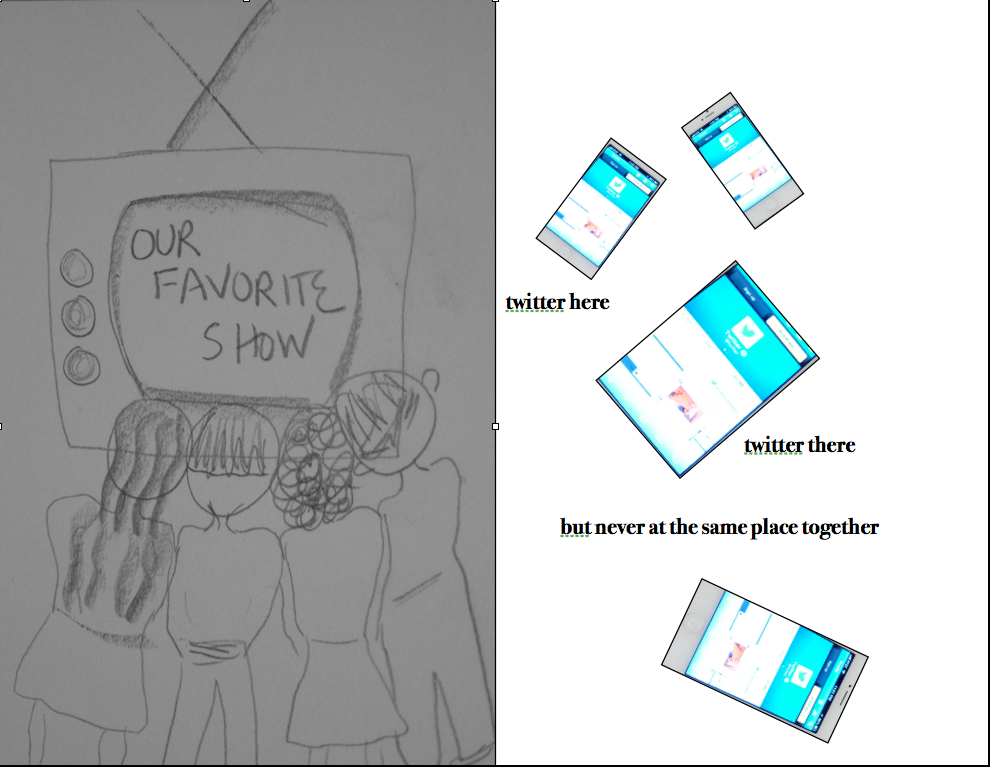
Twitter and other online locales are now becoming the places where we gather when something big is happening. Unlike television, these websites have the benefit of being interactive. But for me there’s something too impersonal about online gathering places. There’s no person like a Walter Cronkite to act as group facilitator for our collective feelings.
Everyone remembers the emotion that Cronkite expressed when reporting on both the Kennedy assassination and the moon landing just because he was expressing what we were all feeling. He made it OK to shed a tear. He validated our experience. It’s difficult to replicate that on the Internet because of its anarchic nature. On the Internet, no one’s in charge. So the most puerile comments get equal time with the most astute.
I bring this up because I am sure that the days of a shared television experience and the ensuing water cooler discussion are just about over. While in our youth a showing of the Wizard of Oz could draw a 50% share of the audience, today nothing short of the Super Bowl has that kind of mass appeal. We are becoming a more splintered society. The top-rated television shows now all draw less than 20 million viewers. Even football routinely draws less than 25 million viewers. That’s out of more than 300 million possible viewers. So clearly we are not gathering around the television the way we used to.
The Internet is surely a major reason. The water cooler conversations have fallen off, replaced by Facebook and Twitter. And that’s a shame because these communities are not ITRW (Internet speak for “in the real world”). A community on the Internet is a faux community because you will never meet these people. And it’s only when you meet people and interact with them face-to-face that you begin to care about them.
Anyone who was in New York in the days after 9/11 knows the difference that a sense of community makes. The city came together and people looked out for one another. People actually spoke to strangers on the subway! Within a month, that sense of community tapered off. And so now we have people dying in our subways because no one cares enough to get involved.
Perhaps the answer is less community in the online world and more in the real world. Friend someone who lives in your neighborhood, rather than on Facebook. Deliver a Tweet in person. Interact with flesh and blood people and not just their avatars. Soon we may actually learn to care for one another. And the next time someone needs help in a public place, they may actually get it.
30 Monday Jun 2014

Me, my sister Liz and my brother-in-law Phil (1943).
Fifty years ago, my brother-in-law, Philip C. Lewis (pictured above), wrote and published a “playlet” called the “The American Dame”. It’s not a play with a plot, but a play with a singular theme that is read by different characters. His playlet traced an arc of how women have struggled for independence and recognition, respect and equal treatment over the course of history.
He even goes back to the Bible, referencing that within the story of Adam and Eve, Eve is set up because she is cast as the sinner; the temptress that causes Adam to fall from grace. He moves forward to the fight women waged to get the right to vote, and how the Equal Rights Amendment, first introduced in 1923, remained un-enacted in 1964 (and I might add is still un-enacted in 2014).
For some reason, my brother-in-law’s musings on the short shrift accorded women struck home when I read an article in The New York Times about how Dov Charney, the founder of American Apparel, was finally dismissed for treating his women employees like chattel. This 45-year-old man conducted an interview of a prospective employee wearing a towel. Would he have donned such attire if the prospective interviewee was a man? I highly doubt it. Would any woman CEO anywhere don a towel for an interview, male or female? No way!
Later, the DovMan forced his employee to perform various sexual acts, and there is no way anyone can say such behavior was consensual when the pressure to do as you are told is coming from the boss. That the DovMan is fighting to get his job back is laughable. Talk about a disconnect from reality.
But he is not the sole culprit. The article in the Times also referenced Dennis J. Wilson, the founder of the fitness clothing company Lululemon Athletica. He was attached to the following quote with respect to how his company’s yoga pants fit:
“Quite frankly, some women’s bodies just actually don’t work…”
It is fascinating to me, an octogenarian on my way to being a nonagenarian, that there are still corporate moguls running multi-million dollar companies who believe they have carte-blanche entitlement to treat women different than men, basically because they are not men. I am well aware that great gains have been made. Sheryl Sandberg of Facebook and Marissa Mayer of Yahoo are not oddities. Women have been and continue to break into the upper echelons in every field.
But the fact remains that the issue of women being seen for who they are, and not as objects for amusement has hardly been swept away. There remains a strain in society that still blames a woman when a man misbehaves. And that is not to dismiss the reality that there are also legions and legions of men who find the DovMen of the world abominable.
The Board at American Apparel did get around to ousting him The question of why it took so long is part of the issue and a different blog.
28 Saturday Jun 2014
Posted in Art

It’s definitely an acquired taste, but there is nothing like a bowl of cold red borscht on a sizzling summer evening.
 The Write Side of 59