Time Warp in Copenhagen: Counterculture Thrives in Christiania

Tags

, , , , ,

Frank Christiania

In Christiania, it’s 1973 all over again.

BY FRANK TERRANELLA

Back in the summer of 1973, I attended a concert in Jersey City that was my closest meet-up with the hippie counterculture of the time.  It was a double bill of The Band and the Grateful Dead. I remember thinking, as soon as I got to my seat in the old Roosevelt Stadium, that this was not a run-of-the-mill concert. The guy in the seat next to me had set up a small recording studio. He had a portable reel-to-reel tape recorder that he had lugged in, along with two microphones that he had on stands. You see, the Grateful Dead did not object to people recording their concerts. That’s why there are so many bootlegs around today.

Sirius/XM satellite radio has a whole channel devoted to the Grateful Dead, and features these “audience recordings.” The next thing that told me I wasn’t in Kansas anymore was the open sale of drugs and drug paraphernalia. It wasn’t just pot, which was the dominant smell at the concert. People were walking through the stands selling all sorts of pharmaceuticals from amphetamines to LSD and more. This, too, was done openly.

Fast forward 40 years to 2013. I am touring Copenhagen with my cousin and he takes me to a section of Copenhagen called Christiania.

Frank Christiania 3

Frank Chritiania 2
We walk in, and it’s 1973 all over again. There are peace signs on the buildings, clothing from another era and open sales of drugs. It’s a hippie time warp. Christiania is 84 acres of downtown Copenhagen founded in 1971 as a commune. The founders simply squatted on an abandoned military base and have never left. The relationship between Christiania and the people of Copenhagen has been tense at times, but much to the credit of the liberal Danish people, it has been allowed to survive for all these years. Christiania considers itself a separate city state from Denmark. They even have their own currency, the Løn.

As you walk around Christiania, and see the carpentry shops, bike shops, bakeries, restaurants and jazz clubs, you get a sense of what might have happened if our generation had held on to the spirit of Woodstock.  That’s not to say that everything in Christiania is peace and love. There have been some violent incidents in recent years arising out of the drug trade. But by and large, this small community, estimated at about 850 people, has managed to support itself, and live the spirit of the Age of Aquarius. How much longer the Danish people will allow this extremely valuable piece of prime, downtown Copenhagen real estate to be occupied by the residents of Christiania remains to be seen.  But let’s salute a group of dedicated people who have held off “The Man” for more than 40 years.

I’m a Birder Who Prefers to Fly Solo

Tags

, , , ,

One bird

Birding with a group has its perks, but I often stray from the crowd. Photo by Julie Seyler.

BY MARGO D. BELLER

I have always been pulled between being a loner and longing to be part of the crowd. As a child, I kept to myself. As I got older, I made friends along the way. One became my husband (MH). He, too, is a loner, but is not much troubled by that fact. Watching birds is an ideal activity for a loner, although it is often done in a group. I find groups have a tendency to rush along and talk, and I would rather go at my own pace and listen to the singing. Even with MH, I find I bird differently than when alone.

It is when birding the loner and the longer come together.

The other day, at a pond in the middle of a suburban NJ office park, a Pacific loon was discovered. It was publicized on the NJ bird list, which I read. The office park is on the outskirts of my town, which made it imperative for MH and me to see it as soon as we could.

What was it doing there? I don’t know, but weather conditions have been pretty strange this year. This loon is an unusual visitor east of the Continental Divide, but they’ve been reported before. The office park pond, which was not frozen, must have been an appealing sight.

Except in winter, loons are found on lakes and ponds. In winter, when those ponds freeze, they are usually found along the coast. The common loon and its smaller relative, the red-breasted loon, are the Eastern loons you’re likely to see at Barnegat Lighthouse, along the Jersey Shore, for instance.

In winter, they are all black and white and gray. What gave this one away were the shadings of gray and the bill – not as stout as the common loon; not as thin and upturned as the red-throated.

When we got there, we found ourselves in a crowd, but smaller than expected. We were all friendly, talking shop, field marks, or other birds recently seen in the state. As usual, for a while there, I felt I belonged.

And yet, when they started talking about people whose names I don’t know, but they see all the time in their travels, I knew I was not part of this group. I won’t be going south to Florida to see the birds heading north with them, or trekking to Belize or Mexico.

As this point I usually wonder, when does enjoyment of the birds become an obsession? If you spend your life doing nothing but running around to find and tick off birds every time one is reported, is it much of a life?

I admit, I daydream of dropping everything and doing nothing but bird. But bills have to be paid. The loner wins.

From the Left to the Right (of 50): Adjusting, Reversing, and Not Following, Directions

Tags

, , , ,

"directions. information. reversible."  Collage by Julie Seyler

“Directions. Information. Reversible.” Collage by Julie Seyler.

BY JULIE SEYLER

One thing I’ve noticed about my late 50s is: change is possible. Directions I slavishly followed because they had been cast in stone years ago are easily reversed if they are dragging me down. Rules I loyally adhered to are tossed when they become too burdensome. Trapped revolving, icky information that used to take days to sift through is discarded in three hours. I don’t have the time or the energy to waste dwelling on the wrong side of things.  I adjust if necessary, and that is a benefit to moving further from the left side of 50.

"adjust if necessary".  Collage by Julie Seyler

“Adjust if necessary.” Collage by Julie Seyler.

Of course, there is irony in the whole process.  Because as my inner psyche experiences this newfound freedom and liberation, my outer self is undergoing a cataclysm. It seems that the contours of my face and body are moving in a wildly different, quite unknown direction.  I guess there are always trade-offs.

The Saturday Blog: Clouds

Tags

, , ,

Above the clouds

Above the clouds. Photo by Julie Seyler.

These days, flying in an airplane, unless you can go Business or First Class, can be a deadening experience. Jam-packed planes, airport security, boxed meals, and tight seats, are just a sampling of why flying can be a chore. So, the trick is to find a silver lining. There’s one outside the window: the landscape of clouds. Always mesmerizing.

Before the Oil, There was an Olive

Tags

, , , , , ,

Spanish olives
BY LOIS DESOCIO

This post has been hijacked and hacked by me. Julie had been wondering if an olive has as much nutritional punch and the same, much-touted health benefits as olive oil. She started writing about it:

If olive oil is “good” for you, are olives equally good for you?  Is there a difference between oil-cured Provence olives, Sicilian green olives, and Greek Kalamata olives in terms of nutrition and health?  I always embellish fish, chicken and pasta with black olives, but never beef or lamb. Is it possible to combine such ingredients?  I have made chicken with green olives, but otherwise they only grace my martini glass.

I did some Internet research about olives, but not about recipes.  If anybody has any intriguing novel recipes, send them on please.  Here are some facts about olives:

They grow on trees and are classified in fruit family.
They cannot be eaten raw. They require some prodding after being picked – curing or brining are two options.
They may help prevent bone loss and may temper inflammation.
So, they are good for you, but don’t eat too many because they are fattening!

I had to weigh in, and take over, because I am olive-obsessed. “…don’t eat too many because they are fattening!” is bad advice. I am not an olive expert, just an expert consumer. I eat olives every day – by the spoonful; the cupful. As I’m filling my two or three huge containers at my local olive bar every week, my mouth is watering the whole time. What I do know about olives is that they are ripe in the “good,” monounsaturated fat. And they bear the anti-inflammatory phenolic phytochemical called hydroxytyrosol. It is this anti-inflammatory phenolic phytochemical that boosts the health benefits of olive oil. (There are studies as to the benefits of hydroxytyrosol.) But all the tongue-twisting scientific lingo, and exhaustive studies aside – the bottom line is, olive oil comes from the olive.

cracked olives

We’ve all heard about the benefits of the Mediterranean Diet. And, I agree with Julie that there’s minimal hype around the olive itself. The New England Journal of Medicine (NEJM) has recently release yet another study about the benefits of a diet rich in grains, fruit, fish, nuts and olive oil, and how it’s better than a low fat diet in preventing cardiovascular disease and strokes. To summarize a part of the new NEJM study: eat all the olive oil that you want (it recommends four tablespoons a day), and as many nuts as you want. I’ve added olives to that. An olive (or a truckload) can serve as a check on the list of the recommended five servings of fruit the experts tell us to eat each day. And get your daily nuts in with almond-stuffed olives.

Julie asks: “I always embellish fish, chicken and pasta with black olives, but never beef or lamb. Is it possible to combine such ingredients?”

Yes. The beauty of the olive when used with any meat is simply in the taste. It’s salty. (Add hot peppers for zing; raisins for sweet.)  And you can cook them with the meat, or add them after. The flavor remains steadfast. I cook with them; top with them. I heat them in the microwave when I’m feeling fancy. They are my go-to snack. And I ask for extra olives when ordering a martini.

Julie also asks: “If anybody has any intriguing novel recipes, send them on please.”

Here’s mine. I eat this at least twice a week for breakfast – it’s tweaked from a sardine recipe I found years ago. It gives a heap of superfoods in one fell swoop:

Spread a frozen slice of good rye bread with avocado and a smidgen of mayonnaise. Cover all the open space with halved olives. Cover with one slice of Swiss cheese, and broil (that’s why you want the bread to be frozen, otherwise it may char) until cheese is melted. Take it out, and cover it with a whole can of sardines packed in olive oil (packed in water is fine too), and sprinkle with pepper, and finely chopped almonds or pine nuts. Place on top of a layer of fresh spinach. You’re good to go. Send us your olive recipes in the comments below, or e-mail, and we’ll print them.

mixed olives

All olives shot by Julie Seyler.

Hollywood’s Premier Bawdy, Naughty “Golden” Girls: Get Out and See Them Sometime

Tags

, , , ,

Mae has all of the angles. Mixed media by Julie Seyler

Mae has all of the angles. Mixed media by Julie Seyler.

BY JULIE SEYLER

Every year the Film Forum runs a festival celebrating movies made in 1933 or earlier. Movies like “Babyface,” with Barbara Stanwyck as the heroine, who sleeps her way to the top, and “Bombshell,” starring Jean Harlow as Lola, the actress who keeps family and film crew afloat, are made available on the big screen. Unmarried women had sex. These movies tend to be, what we used to think of as, “bawdy,” perhaps a little naughty. But then along came the Hays Code and its edicts to enshrine chastity and separate the matrimonial bed.

We chose to watch a double feature. First up was “I’m No Angel,” an iconic early flick starring Mae West and Cary Grant. Mae also wrote and directed it, which meant she broke the glass ceiling in Hollywood 80 years ago. The other feature was a Czech movie called, “Ecstasy.” It starred Eva Hedgwick before she came to the U.S. and became Hedy Lamarr.

“I’m No Angel” is built on Mae West’s over the top pungency in dress and persona.  She was a zaftik dame with full thighs and hips, and her clothes accented every curve.  Frank would have loved her. Her ensembles belong on the Red Carpet of the Academy Awards, and she never used a stylist. She was provocative, but always in complete control.

The plot is about a woman who cops to being “no angel,” but she does so with such lust and joy, that it makes the alternative awfully unappealing.

Mae West: having fun by Julie Seyler.  Mixed media on paper

Mae West: having fun by Julie Seyler. Mixed media on paper.

The movie opens with Mae as Tira, the burlesque draw in a honky tonk road show. She is down and out in her luck, and consults the show’s astrologer to find out how to find the right man. After he reads her charts, she makes no move without consulting his predictions. To get some dough, and become rich and famous, Tira becomes a lion tamer, and sticks her head in the lion’s mouth. She befriends women who are nice and disses snobs. She convinces an engaged man to give her thousands of dollars worth of gifts with nothing but friendship in return. And when millionaire Cary Grant breaks their engagement, she sues him for breach of promise, and nothing else.  She has no interest in his money; she wants love. So romance wins out as we fade to Cary and Mae kissing. The End.

The second feature, “Ecstasy,” was about a young woman who marries a prig. Her marriage is never consummated, so she divorces him, and in her sadness and despair, hooks up with the virile brawny construction worker. Her pearls fling off and flowers bloom as she experiences ecstasy. Sex appeal – always in fashion.

Hedy Blooms.  Collage by Julie Seyler

Hedy blooms. Collage by Julie Seyler.

My 1964 Ford Galaxie: A “Great White Boat” of a Car

Tags

, , , ,

a Ford under a galaxy of stars

A Ford under a galaxy of stars. By Julie Seyler.

BY BOB SMITH

In 1973, when I was 18, I got my first car: a white 1964 four-door Ford Galaxie 500 sedan that weighed in at nearly 4000 pounds. My then-girlfriend’s uncle gave it to me for nothing, and expressed great regret at having to part with such a fine vehicle. Unca Cholly, as he was affectionately known, was moving up to something better – probably a Pontiac – but he wanted the Galaxie to have a good home.

I was your stereotypical rambunctious 18 year old, determined to define myself as boldly independent of my parents. However, as a college student living at home with only a part-time summer job, I wasn’t going to turn into James Bond overnight. So the Galaxie was my key to the world – given enough gas and time, that car could take me virtually anywhere, and in my feverish imaginings, it did. But the reality was somewhat different.

First, it rode like a monstrous marshmallow. After a couple of cushy trips around the block, my brother christened it The Great White Boat. But make no mistake – it had lots of positive features too:

Real chrome bumpers you could use to open a beer bottle (so I heard).

A back seat as big as a small sofa. Out of deference to her Unca Cholly my girlfriend refused to explore its potential with me, but it did serve the purpose with some of my friends, and their less restrained dates, as I played the discreetly aloof chauffeur.

Triangular side vent windows in front that were perfect for flicking the ash off the end of your cigarette without having to open the whole window and risk sending unwelcome sparks into the back seat.

A steering wheel the size of a hula hoop, and power steering so light you could make turns with one finger.

A cavernous trunk Goodfellas (or their acquaintances delinquent in payments on the vig) would die for.

Then there were the negatives:

Primitive sound – AM radio with one oval dashboard speaker. The “latest”- an eight track tape player – had not been installed in this vehicle.

Pointy chrome gear selector and turn signal stems that were puncture
wounds waiting to happen. (By 1973, the automakers had wised up, and started putting blunt plastic knobs at the ends so if you rammed into the windshield wiper control in an accident you’d get a nasty bruise but no perforation.)

Rudimentary lap belts (front seat only) that would tear your torso in half in any collision over 40 mph, but might spare you from being skewered by the turn signal.

Miles per gallon in the high single digits on the highway going downhill with a tailwind. Plus the seals were bad, so it took a quart of oil every week and trailed a bilious white cloud everywhere it went.
The transmission was starting to slip, and the brakes were so low you floored the pedal and prayed at every stop sign.
And the insurance on that nine-year-old tank was more than any part-time job could support.

I think it took me five months – one glorious summer and into the fall – before I realized I couldn’t afford the gas, oil, seals, brakes, transmission, or insurance needed to keep the boat afloat. It sat for a month on my parents’ front lawn, a monument to my hopes of freedom, while I scraped around trying to figure out a way to save it. No one wanted to buy it, not even Unca Cholly, despite his misty-eyed reminiscences about its former glory.

Actually I suspect he was glad to have unloaded it on me to spare him the pain of having to finally put the car to rest. Which I did, one chilly October day when I paid fifty bucks to have it towed away to be cannibalized for parts. My next car was a used Japanese econobox that was a lot easier on my wallet, but woefully short on dreams.

"Bob behind the wheel"  Mixed media drawing .

“Bob behind the wheel” Mixed media drawing by Julie Seyler.

Four Months In, and We’re Still Friends

Tags

, , , ,

LO and me

Julie (left) and Lois (right), in the ’70s.

BY LOIS DESOCIO

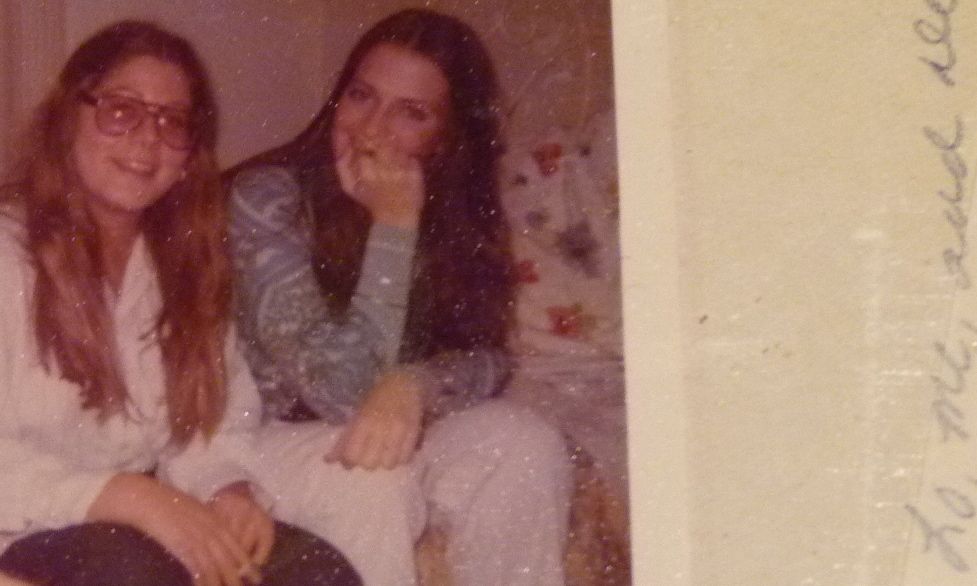
Today puts Julie and me into the four-month anniversary of our blogging collaboration. We are riding a tide counter to that conventional-wisdom wave that cautions friends against becoming business partners. We think we’ve made the perfect match. What makes it work is how different we are – different skills (I play with words, Julie points, shoots, and paints); different temperaments (Julie is super organized, I love a mess); different likes (Julie is a bit of a food-fussbudget, I’ve eaten days-old soggy Cheez Doodles that were left out overnight and were stuck together); different worries (she does, I don’t); and different viewpoints (she’s old, I’m not).

So please excuse the indulgence of our posting a picture of the two of us, as teens, sitting in Julie’s childhood bedroom. We mean for it to be a testament to all women, and the incalculable value of enduring female friendships. Girlfriends.

And thanks to all our contributors, fans, and followers (our guy friends, too), for your writing and reading.

Me, My Camera, and Some Favorite Photos

Tags

, , , , ,

Julie takes a photo. Palace Hotel. Madrid, 2012.

Julie takes a photo. Palace Hotel. Madrid, 2012.

BY JULIE SEYLER

I have always embraced a camera. Out of all my high school friends, I think I am the one with the most captured memories on film. It could be true for my college years, law school years, my Washington D.C years, and the last 24 years in Manhattan.

In the beginning, I used film because we only knew film. We built our camera knowledge on trademarks like Kodak, and the instant snapshot of the Polaroid. Remember Bob’s family had a Kodak Duaflex.

Then digital cameras began infiltrating. I railed against them. I swore my loyalty to film, and I managed to remain a hold-out until the near end, when it was impossible for an amateur to find film, let alone find anyone who could develop it, or would develop it at a reasonable price. Now I cop to the fact that I became a convert.  Nothing beats the ease of digital and its mechanics that allows for thousands of images with a click.

And not only did technology change, I changed. Where I used to only take photos of friends, anywhere at anytime, I have moved towards nature and buildings; city streets and sunflowers. I am mad about light and color and composition and beauty and ugliness. Here are three of my favorite photos:

This was taken from the (now battered) deck at Allenhurst Beach Club, about two or three years ago. It was early in the day, and I knew it was going to be a gorgeous one. The sky told the story. Every time I revisit this photo, I see space, freedom, tranquility, and the anticipation of a perfect day at the beach.

allenhurst beach-50?

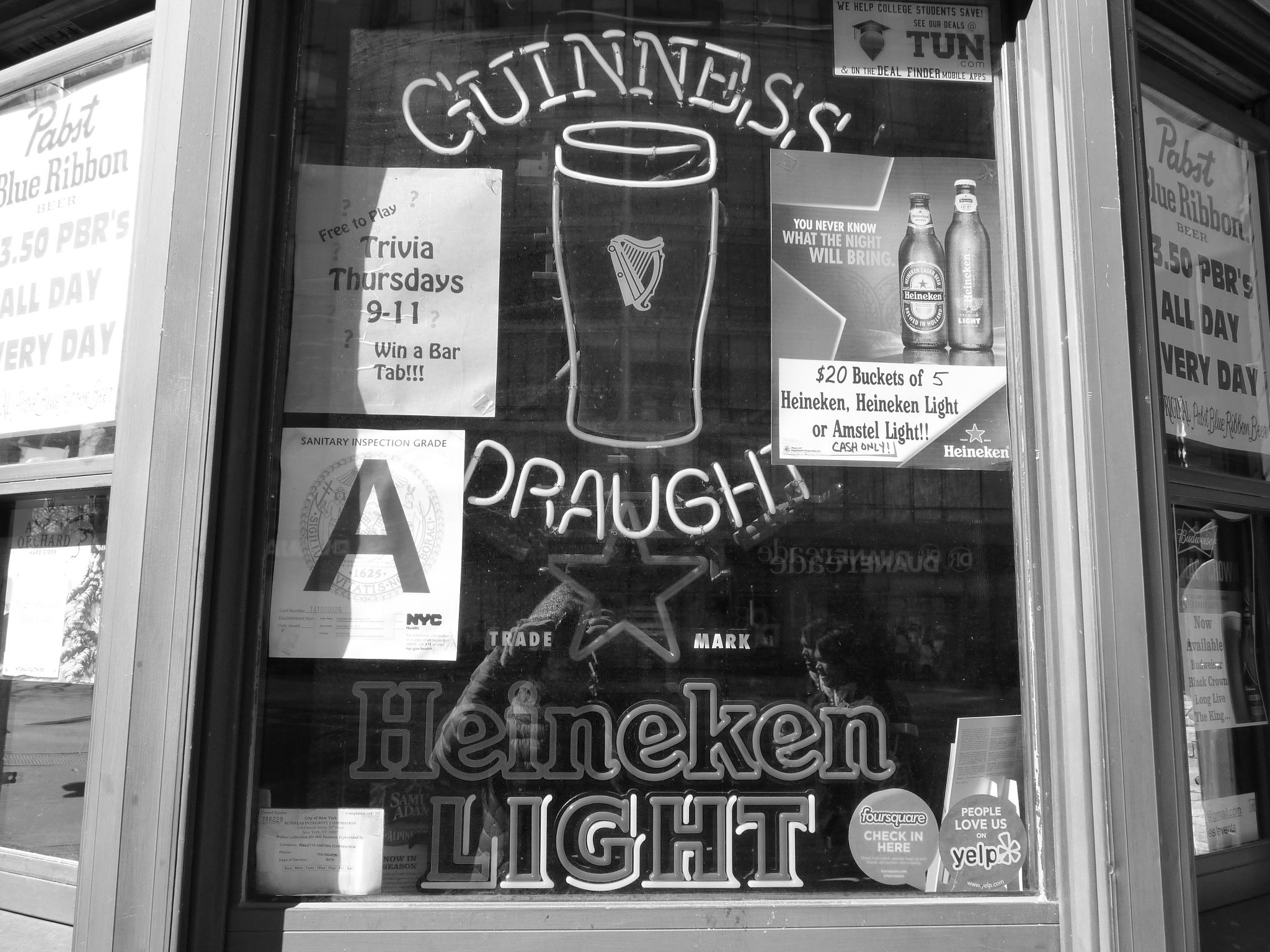
In the middle of February, I was waiting for a downtown bus in front of McSwiggans, a bar on 2nd Avenue. I was staring into the front bay window, and was struck by the antic energy created by the competing beer advertisements. Out came the camera. I had to try to nail it.

at McSwiggan's

I do not know why, but I have always been fascinated by old cemeteries – those where the tombstones are dated anywhere between 1600 and 1900. There is sculpture in the alleys lined with mausoleums – mansions to hold the dead. This was taken at Pere Lachaise Cemetery in Paris where Jim Morrison is buried. It was around 10 or so on a Sunday morning. I never did find Jim Morrison.Pere Lachaise Cemetery

The Saturday Blog: Bowling Green Subway Station

Tags

, , , ,

Bowling Green subway station 2.18.13

Bowling Green Subway Station in Lower Manhattan. Photo by Julie Seyler.

There is a magnificent piece of architecture in Lower Manhattan, quite close to the ferry terminal to Staten Island, that harks back to the turn of the century. The entrance to the Bowling Green subway, which takes you in and out of Brooklyn, opened in 1905, and is worth looking up to.