I Have a Doppelganger in Denmark

Tags

, , , , ,

Frank Copehnagen 2

My cousin Frank.

BY FRANK TERRANELLA

Thanks to an invitation to lecture in Copenhagen, I recently was reunited with my first cousin for the first time in 40 years. And here’s the kicker – his name is exactly the same as mine. Now, there are many people who have common names, and some with less common ones. I have a rare name. I don’t know of another person in the world alive today with the name Frank Terranella, except my cousin in Copenhagen. It was the name of our common grandfather, who died many years ago. I’m sure there are others, but I have never crossed paths with one.
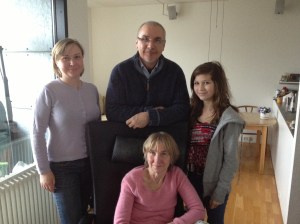
Frank - Denmark

The Gang.

So how did my doppelganger end up in Copenhagen for the last 40 years? Well it’s a wonderful love story. My cousin went on his college junior year abroad in Copenhagen in 1970. There he met and fell in love with a beautiful blonde Danish girl named Karin, who stole his heart. They were married soon afterward. My cousin finished his education in Denmark, and then found a job as a teacher. Their daughter, Anna, came along a year later. Frank never saw a reason to go home much after that. Of course, that’s because he was home. And Copenhagen has been his home for the last 40 years.

Frank would visit the United States occasionally, but those visits were never in the New York area, so we never connected. As time passed, Frank’s daughter Anna grew up and gave him a granddaughter, Lea. She’s a teenager now, and I’ll swear that the 25 percent of her that’s American is dominant. Or maybe that’s just a function of the Internet, or American television on European youth.

So all this was going on a continent away, while I resolved year after year, decade after decade, to get to Copenhagen to visit the other Frank Terranella. Finally, I was asked to lecture in Copenhagen on United States trademark law. It was an offer I couldn’t refuse (even though lecturing is not something I’ve ever done). I knew it would give me the chance to see my cousin.
So my wife and I flew over to Copenhagen, and I gave my lecture. All went well. As soon as I was done, I called Frank. He came over to our hotel, and there we had the historic 40-year reunion. Both of us have a lot less hair than the last time we saw each other, but the ties of family are strong. It wasn’t long before we were telling stories of our youth, and bringing each other up to date on our lives for the last 40 years. It made us both smile – a lot.

Frank walked us back to his apartment where we met Karin. Now, when Frank’s daughter, Anna, was about a year old, he and Karin came to New Jersey to visit my grandfather, and I met Karin and Anna there. Seeing her 40 years later, her eyes and smile were just as bright as they were all those years ago, despite the fact that multiple sclerosis has now taken away her ability to walk. I recognized her immediately. She’s like a ray of sunshine, a grown-up flower child. It’s not hard to see why Frank gave up his home country for her.

Seeing my cousin with his wife was a testament to the fact that true love conquers all – including multiple sclerosis. I know that it sounds corny, but Frank and Karin are as much in love in their 60s as they were in their 20s. All that’s changed is that Karin requires a little more assistance than she used to, and Frank is more than happy to provide it.

The next day, I got to meet the now grown-up Anna and her daughter Lea. As do most Danes, they both speak flawless English. I am so sorry I didn’t get to see Anna grow up, but maybe now I’ll get to see Lea from time to time. We invited her to stay with us if she comes to America. Family reunions can sometimes be dreadful, but my recent trip to Copenhagen couldn’t have been a better experience. Reconnecting with Frank and his family made us forget the cold and often-dreary Copenhagen weather. We all resolved that we won’t wait another 40 years to connect again.

The Saturday Blog: The Haircut

Tags

, , , ,

Forever Young Barber Shop. Placencia, Belize.

Forever Young Barber Shop. Placencia, Belize. Photo by Julie Seyler

We believe the right haircut can help keep us young – forever.

The Long, and the Short, of the Four-Day Trip

Tags

, , , , , , ,

Durham- C and A heads

Heading out on day one.

BY LOIS DESOCIO

I’ve just returned from a four-day trip to England and Scotland. My older son and I went to visit my younger son, who is studying and working at Durham University, just a stone’s throw from Edinburgh, Scotland, in Northeast England. But this is not about the flowing-amber-infused congeniality of the English pubs, nor the 1000-year-old castle that crowns the cobble-stoned city of Durham. It’s not about the massive, Romanesque, Durham Cathedral (it’s bigger than the castle), considered by Brits to be the “greatest Norman building in all of England.” (And was Hogwarts for the first two Harry Potter films.) Or the cool, kilted, Scotsmen of Edinburgh. No going on here about the bloody black pudding (oatmeal with pig’s blood), the sketchy haggis (oatmeal with sheep innards), the foot-long, fried fish, and the accompanying super-fried chips.

Fish and chips

I am not going to carry on about this amazing fish and its chips.

Nope – I won’t but mention how much fun it was to glom on to, throw back some pints with, and be on holiday alongside, my two most favorite people.

This is about the beauty of the four-day trip. Especially a four-day trip across the Atlantic. This is my second one in almost as many years (Julie and I traveled to Madrid, Spain last year for four days), and it’s shaping up to be my new way to go.

Both times, friends questioned:”Only four days?” And offered:”Fourteen makes more sense.”

I’ve also seen their heads tilt in a way that ponders the sanity of flying so far to spend only four days in one place. Therein lies the appeal: Only one place. Only four days.

This older me has come to love travel more than ever, but also loves staying home. So here’s the fix: Only four days. Only one place.

It’s long enough to be called a “trip.” There’s less heavy lifting (one suitcase, no checking), less groundwork (one hotel, one check-in). And numbers are crunched (that overnight flight to Europe gives you your fly-time back when you get there).

And perhaps best of all – the preplanning is simpler and bodes well for us 50-somethings, especially if, as I did, you spent decades arranging all the family vacations. (That was often a four-day commitment in itself.) To indulge in all things about one place affords no obligations to make the next train, plane, or inn. And the pre-prep is fun! There are less days packing, less list checking, so brain power is better spent on that anticipatory joy of counting the days until take-off. Actually, the planning becomes half the fun, because a four-day trip is half the planning. There’s little intrusion from that pre-trip dance around all the stress that comes from planning, planning, planning, and then hoping all goes as planned. And out of respect for our boomer-brain’s cognitive wind down, there’s less to remember.

And then there’s my fellow travelers’ assurance – my kids wanted to go. It was short. Because as much as my boys love their mom – a getaway with the 58 year old, who has boundless energy to do every little thing, only partly melds with a 23 year old, and a 27 year old, who are happy to do just some things, including sleeping through breakfast. Said my older son: “Actually a three day trip would have been fine.”

The Riddle of the Sphinx Gives a Leg Up on Aging

Tags

, , , ,

The Alabaster Sphinx.  Sculpted over 2500 years ago.  Memphis, Egypt.

The Alabaster Sphinx. Sculpted over 3000 years ago. Memphis, Egypt.

BY JULIE SEYLER

The Sphinx exists in the mythology of the ancient world, be it Egypt (1200 BC) or Greece (600 BC).  It is a hybrid creature with a human head, a lion’s body and wings for arms.  It is the catalyst that ignites the Oedipus saga chronicled by Homer, and dramatized by Sophocles.  Remember “The Odyssey” from sophomore year in high school: Oedipus answers the riddle, “What goes on four legs in the morning, on two legs at noon, and on three legs in the evening?”

Aging is a sphinx. It is mythologized. Our conversation is jammed with dramatic tales about what our bodies are doing these days – the duller and longer aches, the higher cholesterol count, and, my favorite of all – big toe arthritis.  Perhaps we know others who are suffering with more dire conditions. All of this weighs on us, because it used to be something that “happens to others.”

And yet it is a hybrid. There is good stuff going on. Wisdom, contentment; and self-awareness are hardly negatives and seemed unattainable to me when I was in my thirties. And since I am devotee of Facebook, there are tons of my peers getting the biggest kick and joy out of their grandkids. I love the photos. But none of this undermines the inevitable fact that we are moving on to the stage of three legs. So obviously, it’s time to throw caution to the wind, and head out for a cocktail and a schmooze-session with a great friend.

Many Boomer Crowds are Not for The Birds

Tags

, , ,

the birders and the boomers go birding

The birders and the boomers go birding. By Julie Seyler.

By Margo D. Beller

I enjoy a good walk in the woods with my binoculars. If my husband comes along, even better. But I get really annoyed when we find ourselves in a crowd.

We used to be considered unusual in our birding habit, but in recent years we’ve learned we are far from alone.

My husband and I, both a few years past 50, have been known to be the youngest people in an area looking for a particular bird when we go on vacation. That is thanks to having no children and being able to travel when people with kids can’t.

But that is very different on the weekends. We have found serious birders we can respect. More often we are forced to travel with flocks of families and less-respectful people around our age.atop the mountain

I can’t speak for why the families are out there. They may be trying to teach the kids about “nature“ but too often the kids are running ahead and screaming while their parents are hanging back on their phones.

As for the boomers, some, like me, may want to be challenged outdoors and look for something special that keeps them moving.

But more often it seems to be all about the cameras.

Either childless couples like us or whose children have left the nest – seem to have bought into the idea that we can use our money to do whatever we want now.

Want to tour Belize? There’s are lots of birder tours that will take you down there just as winter is coming on in the north. When you’re not snorkeling or lounging on the beach or checking out real estate you can be walked or driven through a rain forest, looking for birds you may or may not see back home. (Many northern birds, like these people, go south for the winter.)

Just as these “active adults” have bought into the idea of the large-screen TV and the computer-laden “crossover,” they want the smartphone and the point-and-shoot camera so they can travel the world capturing the birds, adding them to their life lists and displaying them on their Facebook or Flickr pages.

These are the people the medical companies love, the ones urged to replace their aching hips and their balky knees and take this pill so they can keep doing everything they did when they were younger.

These are the folks who will clamber over rocks and leave the trails to bushwack into tick-infested woods, eroding the eco-system. They can afford the expensive equipment, even if they don’t know how to use it.

I know, not every boomer is like this. Many just like to go to natural places where they can walk completely oblivious to the birds that are scattering in front of them because their dogs are running off the leash.

Then they wonder why people like me yell at them.

It’s why my husband and I do our best to avoid them.

Like That Old Fireplug I Found, I’m on Automatic

Tags

, , , ,

automatic fireplug.  west 20th street.

Automatic fireplug – West 20th Street.

BY JULIE SEYLER

There are certain things that stay the same, no matter which side of 50 you are on. Like a morning routine. The a.m. personality, and its peccadillos, gets fixed in stone at some point, and either you are a bright popper-outer or a groaning bear. Coffee must be imbibed ASAP, or it can wait until you get around to putting the water on the stove; or coffee is completely dispensed with because you only drink tea.

One of my morning routines is to swim. In 1980, I moved to Washington D.C., and promptly found a pool to do my morning laps in. When I moved to New York in 1988, I found a pool to swim in before I found my apartment, (which, for perspective sake, turned out to be a 4th floor walk-up studio with a sleeping alcove for $900/month. Cheap by today’s standards.) These days I swim at a pool which overlooks the Hudson River and Hoboken, NJ.

24 East 21st St.

24 East 21st St.

Sometimes I take the bus cross-town, and sometimes I walk.  If I walk, I travel the same three streets, cross the same 10 avenues, and have seen the same set of buildings for the past 16 years. Some are old, not old like Europe, but 19th century old. Some attempt to evoke a Greek-Roman essence.

Face on a building on West 21st Street

Face on a building on west 21st street

Faces are carved into the limestone facades; appear on portals above doors; adorn lintels.

Door portal on Gramercy Park East

Door portal on Gramercy Park East

Perhaps faces were the architectural rage of that moment the way glass buildings are the cultural rage of this moment.

Recently, I was doing my trek crosstown when something caught my eye. It was a white plaque nailed onto a wall of an apartment building on 20th street that read AUTOMATIC FIREPLUG, with the words A.F. A and E Co. written underneath.  I’d seen the sign a 1000 times, but this time I stopped to ponder what is an automatic fireplug and who was A.F. A and E Co. on 294 B’way.

The Internet was useless on A.F. A and E Co., but quite informative on fireplugs.  They plugged water.  In the 1800s, the best way to access water in case of a fire was to cut a hole in the main water pipe and insert a hose to direct the water to where needed to trounce the fire. The hole would then be plugged until next time it was needed. Ergo the fireplug. I just wonder when that sign was installed and when was the last time the fireplug was used?

I took the photo (at the top of the post) and kept on walking so I could complete the a.m. routine:

Get to pool; swim laps; shower; get ready for work; walk to bus stop; get back across town from the west side to east side; take
subway uptown; order iced green tea to go from Starbuck’s; turn on computer…

My Mom’s Dementia: Foggy Memory, Charred Pots, and a Cheshire Smile

Tags

, , , ,

Nana final

Art by Abby Smith.

BY BOB SMITH

Mom, now 86, is still physically robust. Granted, she’s unsteady on stairs and can’t lift anything heavier than a magazine or cup of tea, but her appetite is great. She even enjoys a glass or two of wine with dinner. Mom had always been cheerful and optimistic, too. And she still is. But her mind is slowly, but surely, fading away – lost in the encroaching fog of dementia.

When her short-term memory first started to fail, she would become agitated because she knew she had once remembered the name of that green stuff on her plate, and was frustrated at finding herself unable to identify it as broccoli. But as she slid deeper into decline, she found peace because the fact of how much she actually used to know was itself a lost memory.

We first noticed Mom’s dementia when she moved in with us a few years after Dad died. She insisted on cooking dinner, but routinely boiled vegetables until they were liquefied, and added so much butter to mashed potatoes that they were the color of daffodils. Once or twice every week, she would completely boil away all the water in the pot, and leave the vegetables cooking until they burnt onto the bottom of the pan.

Once it became clear she couldn’t handle cooking dinner anymore, we started telling her it was “cook’s day off,” and that we would prepare dinner for her – or buy takeout. Whatever. Just so she wasn’t tempted to put food in pots and fire up the burners.

But although we told her she couldn’t cook dinner, we figured it was O.K. for her to make her own tea. I would make sure the kettle was full of water before I left in the morning to ensure she wouldn’t put the flame under an empty pot. This worked reasonably well for a while, but then one Saturday I discovered her at the table drinking a glass of cold, whitish water.

“What are you doing, Ma?”

“Having a cup of tea, what do you think?”

“There’s no teabag. And it’s not hot.”

“Oh. Must’ve forgot,” she shrugged, and drank the milky water anyway.

Then one afternoon my son came downstairs, and the house reeked of gas. He discovered a full kettle on the stove with the burner turned on full blast, but no flame. He shut off the gas, opened all the windows, and found Nana in her room off the kitchen, fast asleep.

The next level: We taped a handwritten sign at eye level over the stove that read, “STOVE BROKEN, DO NOT USE.” We would reinstall the knobs in the evening so we could use the burners to make dinner, but leave the sign up for the next day to avoid having to re-tape it over and over. The combination of the missing knobs and the explicit sign convinced Mom that the stove was off limits.

After a few days, however, she grew impatient – and she wasn’t stupid.

“The sign says the stove’s broken,” Mom said as she watched me sauteing onions for
dinner.

“Yeah, Mom – it is. I just managed to get this burner working for now.”

“It’s been busted a while now.”

I silently stirred, hoping the conversation would end there.

“Public Service’ll fix that, you know. Give em a call.”

“I did call – they haven’t come yet,” I lied.

“Goddamn PSE&G. They make you pay enough. They can’t come when you call?”

“Damn those utility companies. Hey, how about a glass of wine?”

“I thought you’d never ask,” she laughed.

Mom is now living with my sister where she can be supervised all day, and her decline continues. Because of her good nature, she’s going cheerful into that good night. But like the Cheshire Cat, she’s fading out, and soon all that’s left will be her smile.

The Saturday Blog: The New Jersey Turnpike

Tags

, , ,

NJ Turnpike 1.19.13

Photos by Julie Seyler.

Mentioning the state of New Jersey to most people elicits either a groan or an eye-roll of of pity. Visions of endless traffic jams on the Garden State Parkway, coupled with memories of the redolence of sulfur around the Amboys, simply do not trigger fond memories of a great road trip. But we are here to proclaim that with the right eye, and mind, the scenery that dots the Turnpike has a poignant beauty. Perhaps you have to have a certain affection for the exoticism of the urban landscape. We do. So here’s to the industrial towers, telephone lines, train switches and smoke stacks that caress the New Jersey Turnpike.

turnpike 2

Some Tips (Bring Your Coins!) on New York Restaurant Week

Tags

, , ,

Is there enough there for dinner?

Take your coins out to dinner.

BY JULIE SEYLER

There is a phenomenon that takes place twice a year in New York City.  It’s called Restaurant Week, and many restaurants, including some top Zagat picks participate, which means that it is possible to nab delicious three-course lunches for $28, and dinners for $38, when normally it could run double the price for the identical meal. So the possibility exists to grab a bang-for-buck experience if you order wisely.

As soon as Restaurant Week restaurants are announced, I scan the list for special treat places that are not on my usual roster. This year, I made a reservation at Rouge Tomate, a 2012 Michelin choice on 60th Street, DBGB Bistro Moderne, a gem in the stable of the the Daniel Boulud empire on 44th Street, and Telepan, an Upper West Side place that I had heard had a cuisine kinship to Gramercy Tavern, but at lesser price points.

Each experience was different and memorable, but not because the meal ended in a deal. That was thrown out the window with the check.

At Rouge Tomate, where I had invited my mother and my sister to dinner, I found out, after we had ordered the wine, that they did participate, but only for lunch. I had forgotten to read the “fine” print and we were handed the regular menu, where some of the entrees are priced at $38.

I went with a friend to DBGB Bistro Moderne for lunch. Everything was perfect, from the appetizer of a winter salad to the braised beef paleron (actually a very tender wine infused brisket), to the cheese plate offerings for dessert. Of course I had to have a glass of wine, and of course, the cost of the wine was basically equal to half the cost of the prix fixe meal. With tax and tip, my prix fixe lunch came in at double the bargain. It was delicious and lovely and a treat because certainly, a three-course feast at lunch on a Wednesday afternoon is an excessive indulgence.

Then there was Telepan.

Everyone has said, “You must go.” I asked a friend of mine if he was available. He told me he was in the middle of a budgetary balancing act. But I am persistent, and repeatedly mentioned $38! For a three-course meal! At a great restaurant! I (and a menu featuring smoked brook trout, shrimp with grits and a medley of heritage pork cuts), wore him down. With a little creative financial juggling, including a raid on his coin stash, hoarded in a plastic food container, we had a yummy dinner at Telepan. But not for the amount we calculated based on the Restaurant Week special.

Rather, the bill was three times the amount of the $38 dinner per person.

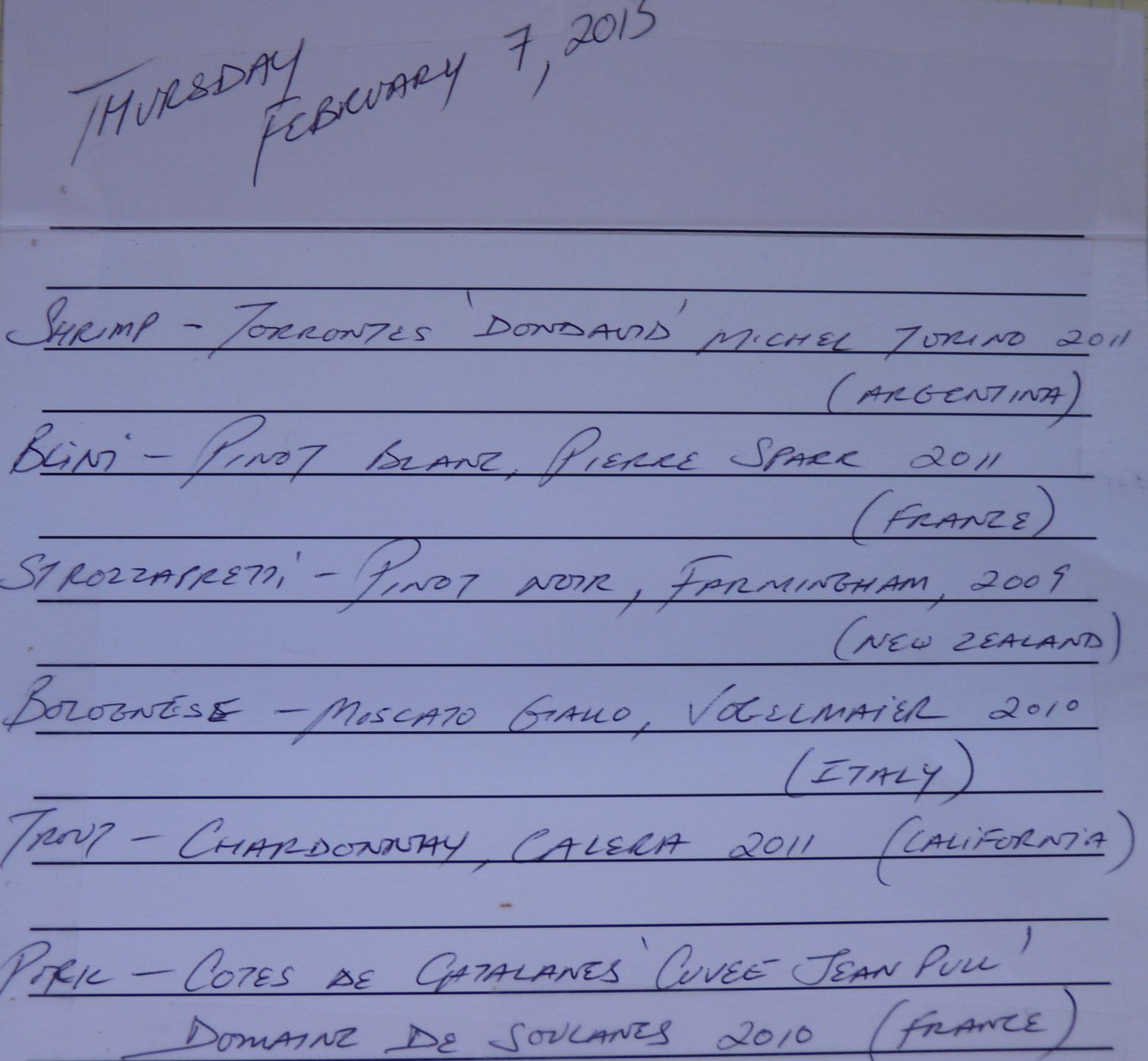
Telepan pairings 2.7.13

Telepan pairings 2.7.13


Willpower went out the door when we saw the wine pairing option. Who could resist? Each selection a perfect foil for the food, and even though we’d eaten three courses and were stuffed, we felt compelled to order dessert. So, throw in tax and tip, and there you have the killing of the bang-for-buck theory.

In any case, I would definitely return to this place. The impeccability of the way the food was prepared and presented, combined with the feeling that you are dining in a friend’s home conspire to make a wonderful experience. But you can have it all, and probably cheaper, if you decide to stay away during Restaurant Week.

My “Torch Song” to Sondheim

Tags

, , , ,

Sondhein with group

There’s Frank – second from right. Photo courtesy Frank Terranella.

BY FRANK TERRANELLA

Recently I attended one of those cultural events that only happen in New York. The New York Philharmonic played an entire evening of the music of Stephen Sondheim with the composer in attendance. We reveled to an orchestral music-only evening of selections from “Sweeney Todd,” “Sunday in the Park with George,” “Into the Woods,” and other less, well-known masterpieces like, “Pacific Overtures,” and “Stavisky.”

As I sat there listening to the concert, it occurred to me that I have been enjoying the music of Stephen Sondheim on New York stages my entire adult life. I saw the original productions of,” A Little Night Music,” “Pacific Overtures,” “Sweeney Todd,” “Merrily We Roll Along,” “Sunday in the Park With George,” and “Into the Woods.” This was as a result of being turned on to Sondheim by a college professor whose History of the American Musical course that I took in 1973 named Sondheim as the current torch carrier for the art form.

In the late 1970s, I started to correspond with Sondheim. I found him to be a most diligent correspondent. He never failed to answer every letter I sent him. I treasure those today. We conversed about his work on, “Do I Hear a Waltz?,” with Richard Rodgers, and his adaptation of George Kaufman and Moss Hart’s play, “Merrily We Roll Along.” He shared his feelings about collaborating with Leonard Bernstein on “West Side Story,” and about “Sweeney Todd” being performed by opera companies.

Over the course of the next 20 years I sometimes spied Sondheim on the streets of New York. I saw him outside the theater where a revival of “Follies” was being staged, and he sat behind me at a revival of “West Side Story.” Abiding by the unwritten code that New Yorkers have regarding celebrities in their midst, I did not try to engage with the musical master. Then, in 2007, I had a chance to meet Stephen Sondheim, and spend some time with him discussing his work. A good friend of mine, who teaches theater at a Midwest college, was leading a theater tour of students through New York and London.

Knowing what a big fan I am, he and his wife graciously invited me to join a small get-together they had arranged where the students would meet with Sondheim and get to ask him questions. And so on a spring day in 2007, I found myself shaking hands with Stephen Sondheim and sitting around a table asking the master questions. It was a delightful hour. It’s not often you get to meet someone who has given you so much cultural enjoyment over so many years. From the movie versions I saw of “West Side Story,” “Gypsy,” and “A Funny thing Happened on the Way to the Forum,” in the early 1960s, through “Assassins and Passion” in the 1990s, it has been a wonderful ride.

Unfortunately, with ticket prices now routinely more than $100, and nearing $150, Broadway has turned away from the Sondheim type of show in favor of spectacles like, “The Lion King,” and “Wicked.” These days, the master can only get revivals of his earlier work produced on Broadway. Sondheim ’s latest musical, “Road Show,” was seen only off-Broadway, and out of town. There has not been a new Sondheim show on Broadway in nearly 20 years.

However, the change in Broadway fashions has not reduced the respect that the New York theater community has for Stephen Sondheim. We know that we are not likely to ever again see such a talent writing for the musical theater. But we will always have his great works. And perhaps the master, who will be 83 on March 22, will give us a few more masterpieces in the years when most men are long-retired. After all, he’s been through “Phantom,” and he’s been though “Spiderman” too, and he’s here. He’s still here. And aren’t we lucky.