
Kissing gravestones, Trinity Church. Photo by Julie Seyler.
We see this photo of contingent gravestones as a metaphor for eternal love. They are leaning on each other, never to part.

13 Saturday Apr 2013
Posted in Concepts
Kissing gravestones, Trinity Church. Photo by Julie Seyler.
We see this photo of contingent gravestones as a metaphor for eternal love. They are leaning on each other, never to part.
06 Saturday Apr 2013
Posted in Art

Slatted boards and sunlight. Photo by Julie Seyler.
We have come through winter. Like a fresh coat of paint, we are, oh, so ready, for the renewal that spring brings.
05 Friday Apr 2013
Posted in Confessional
Tags
Bare arms over 50, bare backs over 50, Bare breasts over 50, bare legs over 50, confessional, Lois DeSocio, summer shorts, The Write Side of 50

Arms and the woman. Photocollage by Julie Seyler.
The first thing I’m going to bare, as summer approaches, is my soul. I’m having doubts about wearing my favorite orange (short) shorts this year.
I’ve always been a bit of a paradox when it comes to being bare. I love clothes, and I’m modest. I believe the more left to the imagination, the better – no matter what age. But I also love air on my skin. I’m barefoot more than shoe-ed. And I love bare legs, bare arms, and bare anything else that’s legal … or out of sight.
My doubt was fleeting, but it had crept in because of my age. Because, as we all know, ladies, it is incessantly hammered into us that we should burka-up once we hit 40. So says … just about everyone under 40. And just as tiresome, repetitious, and saluted (ad nauseum), is our generation’s mantra: “We-will-be-the-first-to-look-40-at-50-so-take-that-we-look-great-and-we-will-not-be-held-back-nor-told-what-to-do-nor-what-we-can-wear.”
Don’t listen, girls. To either hail. Instead, don a sense of delusion, and face this summer bare-backed, bare-bellied, bare-armed, bare-legged; bare breasted. Embrace this stratagem with aplomb, regardless of what you may look like, or what others may see.
Or create an allusion:
If you think you look better from the front in a bathing suit, than from the back (we all know how those lycra suits push everything that’s loose to the back), then never let anyone see your back while standing up. When taking that long walk to the ocean for a swim, you can bend over to pick up the most breathtaking seashell you’ve every seen. Don’t stand back up. Instead, cup the shell in one hand with the elbow inward, and at hip level. Your other hand meets your forehead to keep the sun out of your eyes. This allows you to remain bent over frontwards the whole way down the beach, and into the ocean.
At the pool, prepare for that perfect plunge with a stretch and a salute to the sun from chair to the pool’s edge, then dive in. And when surfacing from any body of water, it’s perfectly acceptable to elongate your whole torso, upper arms vertical, elbows bent, hands on your head, biceps flexed, while you are squeezing, fluffing, and tending to your wet hair. The four parts of your trapezius muscle, in back, will take it from there, beautifully.
Arms are tricky. Especially in broad daylight, or fluorescent lighting. No amount of planking or pumping can tone that free-flowing (sometimes flapping) underbelly of an aging, uncovered arm. If you’re lucky enough to have toned arms at 50-plus, believe me, in the wrong light, they, too, can look pocked and piebald.
So, when possible, especially when being photographed bare-armed – never, ever put your arms front and center, with the “No! Don’t take my picture!” pose. Always turn your inner arm towards the sky, palms secretly pressing down on the arms of a chair, chest out, head up, and a tad forward. This tightens your upper arm, and creates that dip in your neck, thanks to the much-underrated clavicle bone that will project and appear to be part of a toned, upper arm. And if this picture is taken on the beach: head to the beach chair. It’s low to the ground. So everything that’s falling down, will fall back when looking up to the picture snapper, who is looking down at you looking up.
Breasts never get “old.”
And my hat is off to any woman over 50 who bares her belly with verve. I only feel that verve when exposing my front while lying on my back. And buoyant. (Floating in water, palms down, arms up, head back, can give the allusion of a 25 year old from head to toe.)
Legs can hold their own, no matter what age. The question is, how much do you show? Show as much as you want. Especially if you are also baring your arms or belly. Because unless your derrière is sagging down through the bottom of the hem of your shorts, or short skirt, no one will be looking at your legs.
30 Saturday Mar 2013
Posted in Art

Ceiba tree. Tikal, Guatemala. Photo by Julie Seyler.
Tikal, Guatemala is a destination place for those who are intrigued and curious about the Mayans. But beyond the grand temples, stands nature. The Mayans believed that a great Ceiba tree stood at the center of the earth, and connected the terrestrial world to the spirit world above. Who doesn’t want a little connection to the spirit, wherever it is circulating?
22 Friday Mar 2013
Posted in Food
This post has been hijacked and hacked by me. Julie had been wondering if an olive has as much nutritional punch and the same, much-touted health benefits as olive oil. She started writing about it:
If olive oil is “good” for you, are olives equally good for you? Is there a difference between oil-cured Provence olives, Sicilian green olives, and Greek Kalamata olives in terms of nutrition and health? I always embellish fish, chicken and pasta with black olives, but never beef or lamb. Is it possible to combine such ingredients? I have made chicken with green olives, but otherwise they only grace my martini glass.
I did some Internet research about olives, but not about recipes. If anybody has any intriguing novel recipes, send them on please. Here are some facts about olives:
They grow on trees and are classified in fruit family.
They cannot be eaten raw. They require some prodding after being picked – curing or brining are two options.
They may help prevent bone loss and may temper inflammation.
So, they are good for you, but don’t eat too many because they are fattening!
I had to weigh in, and take over, because I am olive-obsessed. “…don’t eat too many because they are fattening!” is bad advice. I am not an olive expert, just an expert consumer. I eat olives every day – by the spoonful; the cupful. As I’m filling my two or three huge containers at my local olive bar every week, my mouth is watering the whole time. What I do know about olives is that they are ripe in the “good,” monounsaturated fat. And they bear the anti-inflammatory phenolic phytochemical called hydroxytyrosol. It is this anti-inflammatory phenolic phytochemical that boosts the health benefits of olive oil. (There are studies as to the benefits of hydroxytyrosol.) But all the tongue-twisting scientific lingo, and exhaustive studies aside – the bottom line is, olive oil comes from the olive.

We’ve all heard about the benefits of the Mediterranean Diet. And, I agree with Julie that there’s minimal hype around the olive itself. The New England Journal of Medicine (NEJM) has recently release yet another study about the benefits of a diet rich in grains, fruit, fish, nuts and olive oil, and how it’s better than a low fat diet in preventing cardiovascular disease and strokes. To summarize a part of the new NEJM study: eat all the olive oil that you want (it recommends four tablespoons a day), and as many nuts as you want. I’ve added olives to that. An olive (or a truckload) can serve as a check on the list of the recommended five servings of fruit the experts tell us to eat each day. And get your daily nuts in with almond-stuffed olives.
Julie asks: “I always embellish fish, chicken and pasta with black olives, but never beef or lamb. Is it possible to combine such ingredients?”
Yes. The beauty of the olive when used with any meat is simply in the taste. It’s salty. (Add hot peppers for zing; raisins for sweet.) And you can cook them with the meat, or add them after. The flavor remains steadfast. I cook with them; top with them. I heat them in the microwave when I’m feeling fancy. They are my go-to snack. And I ask for extra olives when ordering a martini.
Julie also asks: “If anybody has any intriguing novel recipes, send them on please.”
Here’s mine. I eat this at least twice a week for breakfast – it’s tweaked from a sardine recipe I found years ago. It gives a heap of superfoods in one fell swoop:
Spread a frozen slice of good rye bread with avocado and a smidgen of mayonnaise. Cover all the open space with halved olives. Cover with one slice of Swiss cheese, and broil (that’s why you want the bread to be frozen, otherwise it may char) until cheese is melted. Take it out, and cover it with a whole can of sardines packed in olive oil (packed in water is fine too), and sprinkle with pepper, and finely chopped almonds or pine nuts. Place on top of a layer of fresh spinach. You’re good to go. Send us your olive recipes in the comments below, or e-mail, and we’ll print them.

All olives shot by Julie Seyler.
19 Tuesday Mar 2013
Posted in Confessional
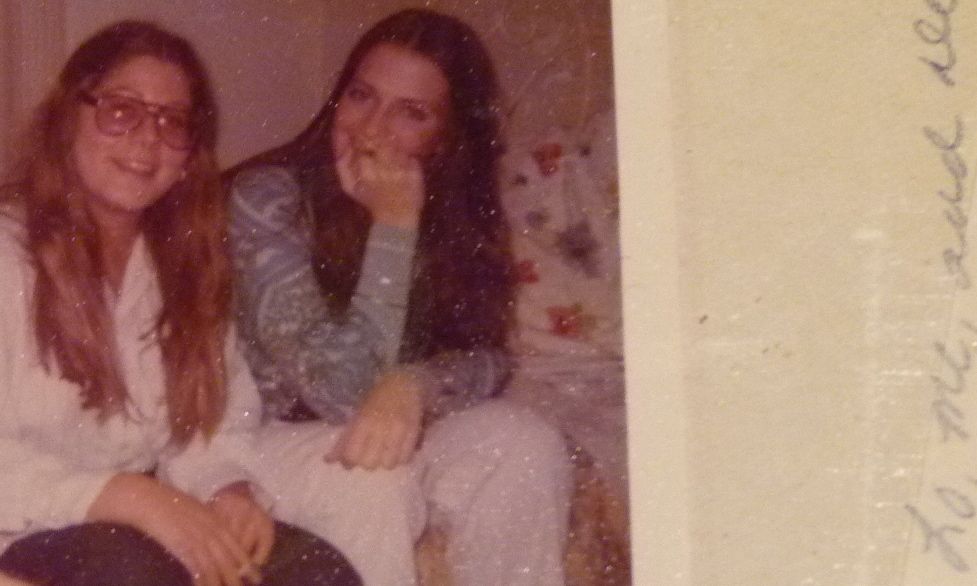
Julie (left) and Lois (right), in the ’70s.
Today puts Julie and me into the four-month anniversary of our blogging collaboration. We are riding a tide counter to that conventional-wisdom wave that cautions friends against becoming business partners. We think we’ve made the perfect match. What makes it work is how different we are – different skills (I play with words, Julie points, shoots, and paints); different temperaments (Julie is super organized, I love a mess); different likes (Julie is a bit of a food-fussbudget, I’ve eaten days-old soggy Cheez Doodles that were left out overnight and were stuck together); different worries (she does, I don’t); and different viewpoints (she’s old, I’m not).
So please excuse the indulgence of our posting a picture of the two of us, as teens, sitting in Julie’s childhood bedroom. We mean for it to be a testament to all women, and the incalculable value of enduring female friendships. Girlfriends.
And thanks to all our contributors, fans, and followers (our guy friends, too), for your writing and reading.
08 Friday Mar 2013
Posted in Food

Chicken, with lemon-aid.
I went through a semi-vegan period when I was younger, and when I came to my senses, the first craving I succumbed to was a cooked bird. Therefore, for years now, I’ve had a stack of chicken recipes – all of them ripped from the pages of newspapers and magazines – piled on top of my cookbooks. I’m methodically making every one of them, so I can respectfully lessen the pile, toss the unworthy, and store the good ones.
I think my tweak of a recipe for Roasted Chicken with Preserved Lemons from The New York Times Magazine, is worthy of a share. I’ll bet no one else has ever lined and stuffed a chicken with lemon curd. A whole 11 ounce jar. And four lemons. And a half pound of butter. (I’ve seen chicken recipes with a curd glaze, and in a sauce, but never stuffed with.) I did use two chickens, so the curd didn’t rule the roost. So, let me just do what I rarely do, and send along my most despised acronym to describe the finished product: “OMG.” It was extraordinary.

When life gives you lemons … line them with curd and stuff them in a chicken.

A lemon, lined with curd, in every pocket.

The bird on the right exploded.
Because it was already the zero hour for dinner when I decided to make this, I was crunched for time. I made a frenzied trip to the market for the short list of ingredients: a whole chicken, butter, cumin, honey, and preserved lemons. Ellusive preserved lemons, I should add. I couldn’t find them. And in my impatience, grabbed a jar of lemon curd. I’ve never used it before, and knew nothing about it. But “curd,” kind of sounded like it could be in the “preserved” family – so why not? Plus I love the word.
But no. Lemon curd is traditionally served with desserts, and in tarts, puddings, or as a topping, and is basically sugar, lemon zest, lemons, butter, and eggs – very sweet. Preserved lemons are a whole different animal. Recipes have a Middle Eastern slant, and they are salty. You can easily make a jar in your kitchen with lemon insides rubbed with salt, smooshed into a jar and then covered with lemon juice. You can add other spices as desired. It’s recommended that the jar sit for up to a year. Nothing like the curd.
As I was prepping each bird (my face scrunched in lament at the butchery, while whispering, “I’m so sorry, baby.”) – pulling bones, ripping skin, and plying cavities – I realized I had too many lemons. They were already cut into quarters, and the pulp was scooped out, so I figured I’d just increase the curd, and the butter, to match.
I filled each lemon rind quarter with a heaping spoonful of curd, and tucked them (16 quarters in all) into every inch of space between the skin and the meat of each chicken, and filled the cavities. I rubbed the outsides with butter, as directed by the original recipe, and then shoved the leftover butter in with the lemons. (My own addition.) I sprinkled both with salt, pepper, and cumin, and roasted them for an hour. I then drizzled them with honey, and then back in the oven for another hour of roasting.
The finished product was an oozy, lemony, salty, sweet, chickeny-curd-pooled feast. You can even cut up the cooked lemon rinds into tiny pieces and sprinkle them on top. Extraordinary.
01 Friday Mar 2013
Posted in Travel
Tags
Durham Castle, Durham Cathedral, Durham England, Edinburgh, Lois DeSocio, Scotland, The Write Side of 50, Travel

Heading out on day one.
I’ve just returned from a four-day trip to England and Scotland. My older son and I went to visit my younger son, who is studying and working at Durham University, just a stone’s throw from Edinburgh, Scotland, in Northeast England. But this is not about the flowing-amber-infused congeniality of the English pubs, nor the 1000-year-old castle that crowns the cobble-stoned city of Durham. It’s not about the massive, Romanesque, Durham Cathedral (it’s bigger than the castle), considered by Brits to be the “greatest Norman building in all of England.” (And was Hogwarts for the first two Harry Potter films.) Or the cool, kilted, Scotsmen of Edinburgh. No going on here about the bloody black pudding (oatmeal with pig’s blood), the sketchy haggis (oatmeal with sheep innards), the foot-long, fried fish, and the accompanying super-fried chips.

I am not going to carry on about this amazing fish and its chips.
Nope – I won’t but mention how much fun it was to glom on to, throw back some pints with, and be on holiday alongside, my two most favorite people.
This is about the beauty of the four-day trip. Especially a four-day trip across the Atlantic. This is my second one in almost as many years (Julie and I traveled to Madrid, Spain last year for four days), and it’s shaping up to be my new way to go.
Both times, friends questioned:”Only four days?” And offered:”Fourteen makes more sense.”
I’ve also seen their heads tilt in a way that ponders the sanity of flying so far to spend only four days in one place. Therein lies the appeal: Only one place. Only four days.
This older me has come to love travel more than ever, but also loves staying home. So here’s the fix: Only four days. Only one place.
It’s long enough to be called a “trip.” There’s less heavy lifting (one suitcase, no checking), less groundwork (one hotel, one check-in). And numbers are crunched (that overnight flight to Europe gives you your fly-time back when you get there).
And perhaps best of all – the preplanning is simpler and bodes well for us 50-somethings, especially if, as I did, you spent decades arranging all the family vacations. (That was often a four-day commitment in itself.) To indulge in all things about one place affords no obligations to make the next train, plane, or inn. And the pre-prep is fun! There are less days packing, less list checking, so brain power is better spent on that anticipatory joy of counting the days until take-off. Actually, the planning becomes half the fun, because a four-day trip is half the planning. There’s little intrusion from that pre-trip dance around all the stress that comes from planning, planning, planning, and then hoping all goes as planned. And out of respect for our boomer-brain’s cognitive wind down, there’s less to remember.
And then there’s my fellow travelers’ assurance – my kids wanted to go. It was short. Because as much as my boys love their mom – a getaway with the 58 year old, who has boundless energy to do every little thing, only partly melds with a 23 year old, and a 27 year old, who are happy to do just some things, including sleeping through breakfast. Said my older son: “Actually a three day trip would have been fine.”
15 Friday Feb 2013
Posted in Confessional

A masterful mess of man and nature. Photo by Julie Seyler.
I’ve noticed that a lot of my writing lately is under the umbrella of an ever-growing proclivity towards clutter. And that a number of my headlines contain the word, “mess.” It seems everywhere I go in my house, I leave behind a little bit (or a heap) of me. I don’t mean that I’m dirty, or sloppy, or don’t ever pick up after myself. I would never leave a mess in someone else’s house. I just love clutter. More than ever. While I’ve always loved the feeling of being snug and surrounded, and am a life-long fan of small rooms; big chairs (a favorite feeling is to be wedged between two people that I love in a big chair in a small room), as I get older, I’m becoming a downright master of the neat mess. A maestro. Many of my friends have stated that they, “Couldn’t live like that.” I say: Try it. Why spend half your life picking up and putting away things that you need everyday? It’s not natural, and not fun, to constantly pursue tidy and trim. The world outside our windows certainly isn’t orderly.
This doesn’t mean I’m not organized. And my love of clutter does not mean that I need a lot of stuff. I’m not a collector. I hate shopping. And I’m definitely not a hoarder. I have no problem purging my home annually of things that I no longer need or use. (Just look out my back door at the perpetual pile of things I don’t want that live next to the garbage cans.)
But a little self-study kicked an after I read an interview with Peter Walsh, an “organizing authority” (he’s been on Oprah!), in an article by Mary Beth Breckenridge, which was picked up by the February 14 Star Ledger. Apparently, “untidy spaces can mess with your head.” Says Mr. Walsh: there’s an “emotional component to disorganization.” He was also the organizational expert on the TLC series, “Clean Sweep,” a makeover show for people who are messed up by clutter. Another quote: “… that when people eliminate clutter, they become less depressed and more energetic.”
So I pursued this theory further. A little research produced a Web site called, the Institute for Challenging Disorganization, whose mission is to educate professional organizers and related professionals on the issues relating to Chronic Disorganization.
It has a free clutter-hoarding scale on their Web site – “an assessment measurement tool” … “to give professional organizers and related professionals definitive parameters. These parameters relate to health and safety.”
So, it seems, according to some experts out there – I’m sick. Chronically ill. Specifically: depressed, anxious, and I have a misplaced love of things over people. Wrong: I love a pile of people just as much as I love dirty dishes in the morning.
At least I’ve proudly come out of the closet with my mess. And my closets, by the way, (and kitchen cabinets, dresser drawers) are downright pristine – neat and tidy all of them. I always hang up my coat. I make my bed in the morning, and fold my clothes (sometimes I even put them in their respective drawers) at night. But that’s it. It’s what people see (on my floors, on the tables and desks) that they don’t seem to get. To me, compulsive neatness means you must be rigid, controlling, predictable. Isn’t that less desirable than: Untamed! Effulgent! And just beautifully messy.
I’d rather walk over and around myself all day, than pick up after. Really, at the heart of all this musing, is perspective:
I don’t see this as a pile of recyclables. I see it as, “Wow I love newspapers, and look how many I got through this week.”
 .
.
I get to be awash in my work:

You’ve seen my wall:

I’m having a party!:
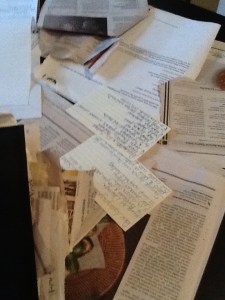
My own special morning-after party:

Look at all the extra space I have to throw things!:

My best friend is a mess too:
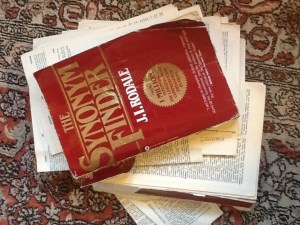
So I have no worries that I will turn into that little old lady who is surrounded by decades of stuff. I’ll be fine, because I will always see disarray as creative chaos. I would be depressed and less energetic otherwise.
04 Monday Feb 2013
Posted in Confessional
Tags
Asbury Park Boardwalk, Casino Coffee Shop, confessional, Convention Hall, Lois DeSocio, Long Branch, Planters Peanuts, The Write Side of 50, Yvonne's Rhapsody in Blue and Rendevous Lounge

I believe the truisms (“share,” be “fair,” be “aware of wonder,” and “don’t hit people,” to name a few), as noted in Robert L. Fulghum’s book, “All I Really Need to Know I Learned in Kindergarten,” to be spot-on advice on how to grow into a decent, content, and essentially happy human being.
Add to these, the scholarship that comes with those early working years. Those first jobs. They not only may help you pinpoint what you want, or don’t want, to do when you grow up, but if you pay attention, they are also ripe with opportunities that can grant you what we all need to be decent at, content with, and essentially happy with our career choices.
For me, I knew in third grade that I wanted to be a writer. But I worked my way towards today through more jobs than I can count.
So here’s my short list of the basics on working as a writer, and how I got them:
Low wage: Those of us who grew up in Asbury Park in the 1960s and 1970s spent summers working on the Boardwalk. I did it for 10 years, starting at 14 years old as a counter girl at The Miramar Grill in Convention Hall. This was my induction into hard work at low pay. But it was also my premier tutelage in how to make my pennies count and get more for my money. After work, I would glom on to the 16 and 17 year old employees that would sneak through the secret tunnel alongside the restaurant and got us into neighboring Convention Hall during Led Zeppelin and Janis Joplin concerts for free.
Check your ego at the door: The next summer I moved across the hall and was Mr. Peanut at Planters Peanuts. I spent hours waving people in to the store with my unwieldy peanut head. Everyone who worked there started out this way, and if you were a cracker at being a peanut, you were eventually promoted to selling them inside the store.
Don’t cry when your editor yells at you: My three summers at the other end of the Boardwalk as a waitress at the Casino Coffee Shop is where I learned to be nice to people who weren’t nice to me. I would suck it up when the cook yelled that the food was getting cold, when the customers yelled that the food was cold, and when the boss yelled if I forgot to drip those three partially-used ketchup bottles into one at the end of the day.
Be honest: And it was also at the Casino Coffee Shop where I switched from concert-sneaker to concert-companion by treating the rock stars that performed at the Casino across the way, and regularly came in to eat, like rocks stars, so they would put me on their guest lists. (Leslie West, from Mountain, gave me a plastic, “World’s Best Waitress” trophy.)
Pay attention to details: After college, I moved down Ocean Avenue and worked as a waitress at Yvonne’s Rhapsody in Blue and Rendevous Lounge in Long Branch. Yvonne – owner, chanteuse, and drummer – would bang the drums set up in the corner of the dining room, and would throw her drumsticks into the crowd when she was done. Patrons that were upset with the near-miss-to-the-head would have been more unnerved had they known that the chef’s cigar ashes that would continuously bend towards, and then garnish the food, were accompanied by Yvonne’s fingers poking through every plate before it left the kitchen. I noticed that the clientel that hung out in the lounge under the restaurant had deeper pockets, and therefore tipped well. And there were no drums, no food, no Yvonne. I asked to work there, where I learned to chat up the mobsters that were regulars, like Anthony “Little Pussy” Russo, who took a liking to me, tipped up to 40 percent on his bills, and gave me an extra $20 bill if I would get him cigarettes from the machine.
Give people what they want, and deliver it reliably: I spent a summer as a bartender at a huge club – The Fountain Casino – where my constant attention in both mixing the drinks (a little extra booze), remembering what the regulars wanted (had it ready when they walked through the door), and smiling and winking at the inebriated, had them coming back for more, and made me more money in tips than I had made in any other job before that.
Work on deadline. Accept heaps of rejection. Be clear. And just say it already!: Short on length, but long on lessons learned – I sold encyclopedias door-to-door for one month in Hackensack. I had seconds to sell myself, and those books that nobody wanted. What began as a five-minute, carefully-chosen, beautiful, wordy spiel, turned into a one-minute, bordering-on-begging sales pitch, because people were slamming the door in my face.
Interviewing chops: I worked my way up to credit manager for a contractors supply company in my mid-20s. I spent the bulk of my day on the phone asking big wigs to pay us, please.
And sage instruction, no matter what:
Throw yourself out there, no matter your age, and do things that are really hard : I went back to school at 54 years old.
Learn how to move on when the best job in the world ends: My kids grew up.

 The Write Side of 59