It’s Been a Year (Yup, We’re Still Here), and …
19 Tuesday Nov 2013
Posted in Words

19 Tuesday Nov 2013
Posted in Words
18 Monday Nov 2013

Downtown Wilmington, Delaware, 2013.
I do not know anyone who would describe Wilmington, Delaware as a knock-out city one should visit before one passes away. It is depressing and drab – albeit perhaps poised to be revived:
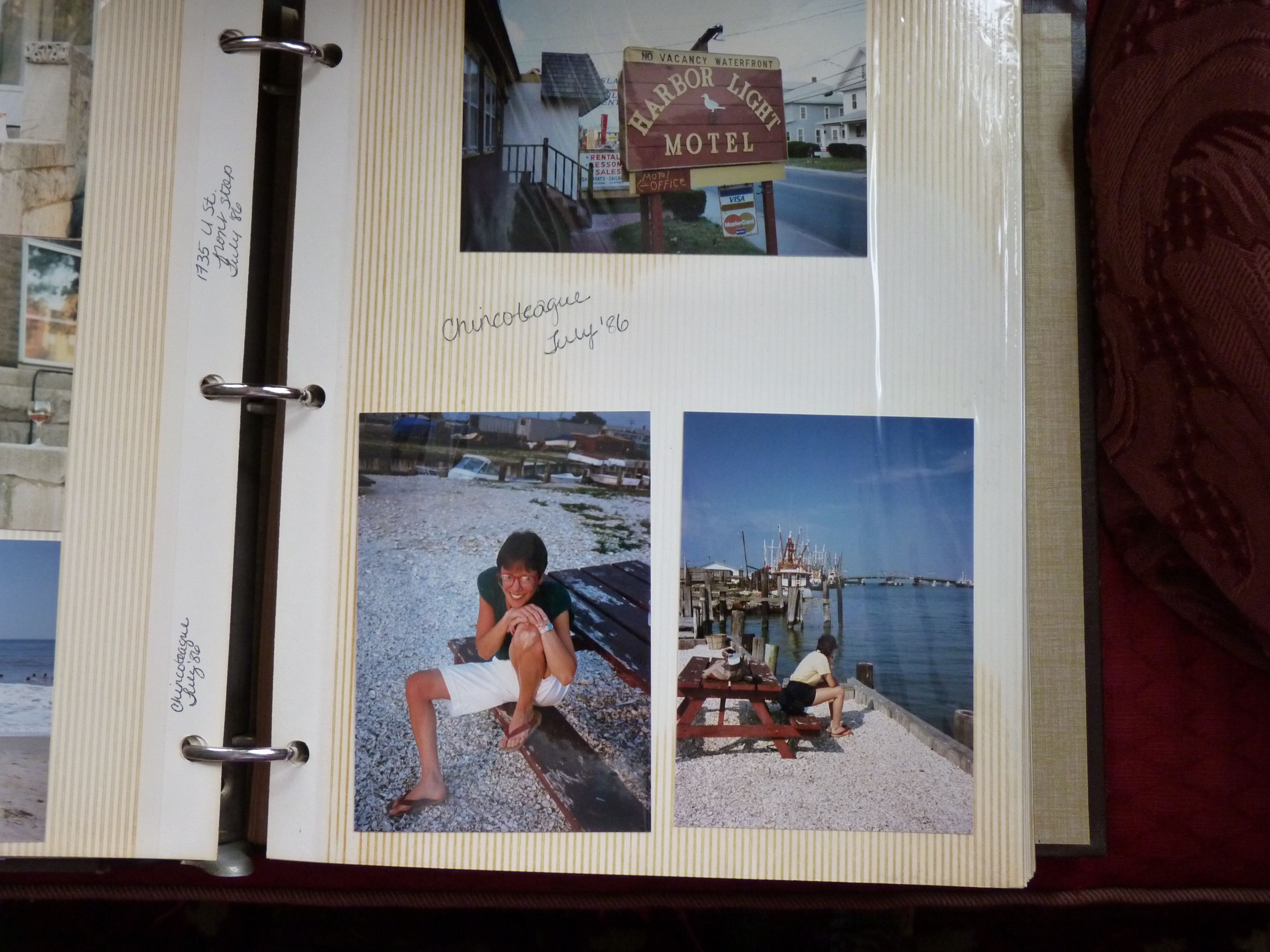
 But once a year, I make a point of getting to Wilmington. It is halfway between New York City, where I live, and the environs of the District of Columbia, and therefore is the ideal place to meet for lunch with my friend, Liz, whom I met 31 years ago when we both lived in the District, and swam laps at the YMCA on 17th Street. We engaged in enough lightweight locker room chit-chat that when she ran into me around Dupont Circle one night, she spontaneously invited me to a party. She mentioned there would be a guy there I might like. The guy didn’t work out, but Liz and I struck up a conversation that hasn’t stopped. On Fridays we would meet for a glass of wine on the front stoop of my apartment on U Street; we had countless dinners at Lauriol Plaza, a favorite because it was sooo good and cheap; and made sure we had at least one weekend every summer in Chincoteaque at the Harbor Light Motel – long since demolished:
 We took a three-week trip to Italy, where we hiked along the Cinque Terre, climbed the Tower of Pisa and took the night ferry to Sardinia. Wilmington is a perfect place to rehash and renew.
 Usually we meet at Harry’s Seafood Grill. This year, to break up the routine, I did research and found Vinoteca 902 at 902 N. Market Street. The website menu appealed to both of us and we planned to meet there at 12:00. The game plan went awry at 11:42 when Liz called to tell me Vinoteca 902 was no more. Given that midday restaurant choices in Wilmington are limited, we ended up back at Harry’s, which was perfectly fine. At 12:15, we were seated in a booth, and started to talk. And then it was 3:30 and time to go. We’ll be back next year to pick up where we left off this year.

Same time, same place – next year.
16 Saturday Nov 2013
Posted in Art

Gone. But not forgotten.
15 Friday Nov 2013
Posted in Confessional

Hippie me.

My girls.
My 20s were wild and crazy: Drugs, sex, and of course rock and roll. Why then, when my 25-year-old daughter dumps her loyal, loving accountant boyfriend for some loser 34-year-old waiter, and then my 22-year-old daughter follows suit two months later, am I crying myself to sleep?
The new guys have tattoos and no health insurance. How will they make a living? How will they be able to give my daughters all they deserve? (Did I just say that?) Yes, I the feminist, ex-hippie want someone for them who will “provide” for my Rachel and my Leah. Never mind that I have worked my whole adult life as an educator. Never mind that I married an educator and, therefore, had to work.
But I love my career and I want to work. Don’t I want the same things for the girls? And in here lies my dilemma. I want them to have the choice to stay home with their kids one day if they want. The choice I didn’t have. Maybe this is a choice they, themselves, would never make. But somehow, remembering four-year-old Rachel telling me that she wanted to be a stay-at-home mom when she grew up, as I dressed for work, makes me think they just might.
14 Thursday Nov 2013
Posted in Confessional, Men

In the last month, I have had three experiences with Holocaust-based stories (a movie, a book and a play) that have deeply affected me. In all three cases, it was serendipitous that I came upon these stories. I did not seek them out; they found me. The fact that I was presented with three different stories within a few weeks, all dealing on a very personal level with the Holocaust, is beyond coincidence for me. Whatever the psychic cause, it gave me, someone who was born after World War II, and is not Jewish, the chance to understand better one of the great tragedies of the 20th century.
I was on a cruise last month, and one evening, rather than attend the on-board entertainment in the ship’s theater, my wife and I just relaxed in our cabin and turned on the television. The ship had only a couple of English-language entertainment channels. But one of them was playing the 1997 film, “Life in Beautiful,” starring Roberto Benigni. It’s a touching story about a Jewish man who shields his son from the horrors of Nazi oppression, even when he and the child are sent to a concentration camp. I had not seen the film when it first came out more than a decade ago, and I was moved by its simple themes of love and survival in perilous times.
Later in the cruise, I was looking for a book to read, and I opened my Kindle app and found Jodi Picoult’s, “The Storyteller.” When I started reading it, I had no idea about its content. I bought it simply on the basis of the fact that I love Picoult’s books and have read them all. I soon found out that the book was about a young woman who has a grandmother who is a Holocaust survivor. The young woman is a baker, and one of her customers is an old man who used to teach German in the local high school. The man reveals to the young woman that he was a Nazi during World War II. It turns out that the man was an officer in the very camp where the young woman’s grandmother was a prisoner. The old man asks the young woman to kill him because he can no longer live with the guilt and wants to be killed by a Jew (even though the young woman is an atheist). The book explores the ethical dilemma the young woman faces. It does that by spending most of the book telling the grandmother’s story of life under Nazi domination. Picoult also tells the story of the old Nazi, and in doing so, makes us understand how good people can do terrible deeds. The book made the Holocaust more real and understandable to me than anything I have ever read.
Finally, just a week after we returned home from our cruise, we went to see a play called, “A Shayna Maidel,” performed by the Bergen County Players in Oradell, New Jersey. We have season tickets, and so again, I went to the play with no knowledge of what the subject matter was going to be. I knew it probably had a Jewish theme, but I had no idea what that might be.
It turned out that this play written by Barbara Lebow tells the story of a Jewish family in 1946 in New York. The family, living in Poland, was split up before the war with the father and younger daughter coming to America while the mother and older daughter stayed behind because the older daughter had scarlet fever at the time and could not travel. By the time arrangements could be made for the mother and older daughter to come to America, the Nazis had invaded Poland and they could not get out.
The play revolves around what happens when the older daughter finally comes to America in 1946 after having survived the Holocaust. I don’t want to give away any of the plot twists, but suffice it to say that this is a very emotional play that brought me to tears several times. I recommend seeking out, “A Shayna Maidel,” particularly if you are not Jewish, because it shows how Jewish families living in the United States were affected in the aftermath of the Nazi horror.
13 Wednesday Nov 2013

Blackboard of wines.
I milked a lot of blog mileage out of 17 days in Indonesia, but it’s time to move on. A couple of Saturdays ago, I made plans with a friend to see the Mike Kelley exhibition at PS 1, the public school converted into an extension of the Museum of Modern Art located in Queens. I was familiar with his stuffed animal sculptures, and was interested in seeing the full spectrum of his work.
The subway ride out there is not fully subterranean:

Emerging from Hunts. Pt. Av. on 7 train.
There is art to be seen as you emerge from the nether-regions of the underground to the rooftops of Queens. If you appreciate the grit of urban beauty expressed in colorfully decorated graffitied buildings and boxy industrial complexes, it’s nice to take it all in.
While the purpose of the excursion was to see “art,” we also wanted a meal at M Wells Dinette. I had heard about this restaurant when it opened in Long Island City about three years ago, and received over-the-top reviews for its celebration of the fattiest, lardiest parts of the pig. Then it closed. When I read that it had reopened as the cafe at PS1, I really wanted to go there, and see if it was as intriguing as the reviews had indicated.

In keeping with the whole public school theme, the dinette is a classroom. The students, i.e. us eaters, are seated at long tables facing the kitchen. The menu is printed on a page from a lined composition book, and the wine list is written in chalk on the blackboard. The selection that day included cavatelli with goat meatballs, blood pudding, oysters and tete de cochon. We opted for the rabbit and foie gras terrine, and the tart with escargots and bone marrow:  Paired with a glass of petit Chablis, the ensemble was the perfect meal to have in your stomach before wandering through a terrain of 40,000 square feet to view art. And great art at that:
The show was fabulous, albeit raw and sometimes too vulgar for my tastes, but absolutely honest. I stand in awe of someone whose width and depth of imagination, not to mention curiosity, led him to explore and master materials in every shape, size and texture to create sculptures, paintings, videos, performance, and installations that ranged from small to large. Each piece was infused with originality, intelligence and wit – wit that could be sardonic, sarcastic, skewering and tender. His work is both compassionate and enraged. There was a lot to take in, but the mad vividness and unique perception of the way this particular man expressed his ideas remains unforgettable.

From the Kandor Project.
There were stuffed animals, stuffed together and stuffing each other, and stuffed animals that gave the fleeting impression of being hung as disco balls, scatological posters and a classroom sized table top rendering of every school that Mike Kelley attended. There was a multi-room installation devoted to Superman’s hometown, Kandor, and this does not take in all the videos and paintings and and other pieces that filled the three floors of the museum.

Deodorized Central Mass with Satellites.” (1991-99).
Mike Kelley committed suicide in 2012. The only reference I read for an explanation was from The New York Times obituary, which indicated severe heartache. We will never know. He was only 57. He is immortal through his work.
12 Tuesday Nov 2013
Posted in Confessional, Men
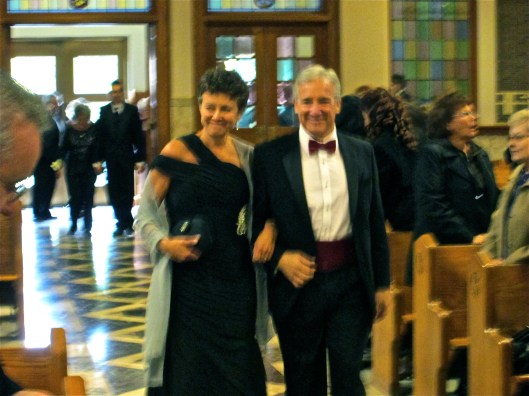
At my son’s wedding this past Saturday, I learned that very little is expected of the father of the groom. At least briefly, the father of the bride is a star – walking his daughter down the aisle, and wistfully handing her over to her new husband-to-be. It’s a touching moment – closely watched by the gathered churchgoers, hankies in hand.
By then the groom is already waiting at the altar – hopefully, thanks to the best man, sober enough to avoid claims of duress or insanity. But the father of the groom is merely a front-row spectator wearing a tuxedo. Aside from discreetly dabbing away tears as the ceremony progresses, he doesn’t have to do anything. 
The best man handles the rings. The maid of honor, like a fastidious footman, rearranges the bride’s train every time she moves. Inspirational readings during the ceremony are recited by a sibling, friend or favorite uncle. And, of course, the main speaking parts are reserved for the happy couple and the priest. There’s usually a receiving line, either as the guests leave the church, or as they arrive at the reception hall, to give the parents of the bride (who traditionally pay for the reception) the opportunity to personally thank each guest for stepping up with a respectable cash gift.
But my son and new daughter-in-law eschewed the traditional wedding format, so there was no receiving line at all. After the ceremony, and a few formal pictures on the altar with the newlyweds, I simply wiped my cheeks and got onto the “party bus” that took us to the hotel where the reception would be held. My only role on the party bus was to drink champagne with my wife, my new in-laws, and the humongous (six men and 10 women) bridal party. That was easy. But it was also only 3:30 p.m., and the reception was at 7, so my next challenge was staying awake after four glasses of party-bus bubbly.
Maria happily chatted with relatives and other guests in the hotel lobby as I fought to keep my chin off my chest. After a number of close calls with napper’s whiplash, I gave in, and went up to our room to nap. Forty five minutes later, I was a new (if slightly groggy) man, ready for the rigors of the cocktail hour and reception.
The cocktail hour was a blur of steamed dumplings, marinated vegetables, skewered fried things, and cheese enough to choke a cardiologist. Nothing to do there but gulp wine, greet and eat. At the reception itself, the father of the bride has another hankie-moment when he dances with his newly-married daughter. Then the mother of the groom does a similar sentimental turn when she dances with her son, accompanied by wistful sighs and sniffles from the audience. Again, the father of the groom merely watches, ready with a tissue and a warm absorbent shoulder for his wife to lean on when the dance with son is done. The rest of the night you spend enjoying the food, the music, the dancing, and the company of family and friends. No heavy lifting; no public displays of emotion.
We stayed in the reception hall, hugging last guests goodbye, until they turned up all the lights. Waxy-smelling smoke-trails rose from the centerpiece candles as the busboys snuffed them out. The staff banged the round wooden tables onto their sides, snapped the metal legs flat against the bottoms, and rolled them away. Two pairs of women’s shoes, discarded during a dance frenzy, stood by the door awaiting their owners’ sheepish return.
Although our son has been out of our house for years, there’s something transformative about the formality, and apparent finality, of the marriage ceremony. I have every hope, and no doubt, that his marriage will last. But regardless of what happens, I feel as if a bridge has been crossed, and there’s no going back.
Maria and I walked quietly back to our room. We were happy. But our bellies were full, our feet hurt, and we were looking forward to getting some sleep. Here, with her, my role was comfortable and clear. The day was ending where the whole process had begun over thirty years ago: with the two of us walking hand in hand, hopeful for the future.
11 Monday Nov 2013

Welcome to my world. Goa Gajah.
I have no way of knowing whether this is a fact, but I think everybody who plans a trip to Bali lands in Ubud at some point. Not just to walk through the inside of the 9th century cave known as Goa Gajah, “the elephant cave,” or to get pounced on by a monkey in the Monkey Jungle,
but because it is a village that packs a wallop. Ubud has everything.
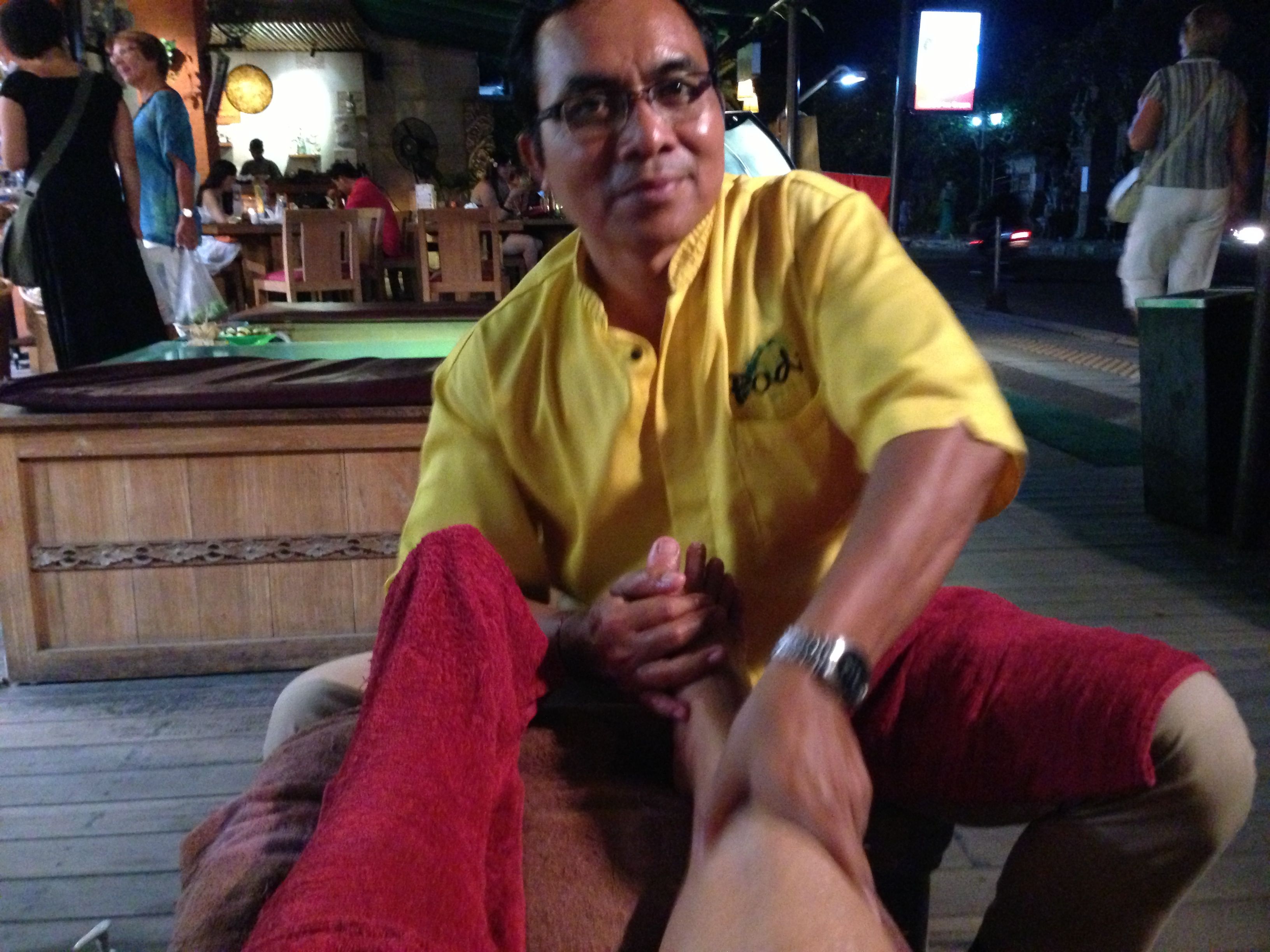
A foot massage after dinner on the street:
Daytime visits to museums and galleries that are set in lavish gardens, and festooned with welcoming marigolds where you can see a vast collection of paintings by artists, that I believe, are completely absent from the Met:

Museum Puri Lukisan.

“Punished Souls in Hell” (1932) by I Gusti Nyoman Lempad.
There was nightly, live, entertainment: dance performances under the stars, folk music in local cafes, and shadow puppet shows. We opted for two different danced versions of the tale of how Sita is abducted by Ravana from the Ramayana tale. The Legong, which is performed with the gamelan, was a bit more accessible than the Kecak, which has no music- only a group of men chanting, but the Kecak is more iconic and is performed with a fire on the stage:

There were restaurants galore, and thousands of shops. Shops that sold handcrafted soap and shops filled with Buddhas and shops devoted to paintings, sarongs, batiks, jewelry, and wind chimes:

 It was glorious.
But we didn’t just shop. Steve would have blown his brains out. In fact, he almost did after one full afternoon of walking in and out of every single store on the Ubud Main Road. (And a few side roads.) But he was saved because Ubud is also a central location to take in Pura Goa Lawah aka the Bat Cave Temple because there really are thousands and thousands of bats living in the cave: 
Neither the intense odiferousness of mounds of guano, nor flying, screeching bats deter the devoted from making offerings in this cave. In fact, it is a hugely important temple because it is situated close to the sea, and close to the mountains.
And we took a mighty fine, and easy, bike ride down around Mount Batur through the ever present verdant and plush rice fields: 
We visited the temple at Tirta Empul, with its baths that have been devoted to purification since the year 962. Still today, Hindus from all over Bali come here to be cleansed and blessed with good health: 
There was Pura Kehen, another temple dating from the 11th century, that may win the prize as the most ornate and delicately carved. Inside there were magnificent statues of Hindu gods and goddesses. It was mind-boggling just to take in the level of detailed design on every surface of the facade. Even the steps were incised with a motif of individually sculpted swirls: 
And there was Yeh Pelu, a 75-foot frieze carved into the rock face of a cliff that tells, in life-size renderings, the story of a heroic hunter warrior. It is not known who did it, or why he did it, but the pundits believe it was done sometime between the 10th and 13th centuries, and the hero may be the Hindu god Krisna:
And when the day was done, and we were hot and caked with sweat, there was the en suite infinity pool: 
There was so much more, and I have the 3,788 photos to prove it. I have shared a few, and have loved every minute of recounting some of the highlights of the trip. I guess it was made even sweeter because of the cancellation last year due to my hip. Thank goodness we canceled. I know now that I could never have done that trip with no cartilage. Anyway, this is the last official installment on Indonesia. No doubt I will periodically revisit, but in the meantime, I want to scream out loud THANK YOU to Diane Embree of Bali Barong Tours. She is the travel agent par excellent. She worked with us on every aspect of the itinerary, picked out all of the hotels, and was ALWAYS accesible. Anybody wanting to go to Indonesia, CALL HER. I did just last week, because I want to go back next year- Sulawesi, Sumba, Lombok and the Gili Islands beckon from across the sea! Not to mention more shopping in Ubud.
09 Saturday Nov 2013
Posted in Art

Photo by Julie Seyler.
Make your Saturday leisurely, and make room for a view from your favorite window.
08 Friday Nov 2013
Posted in Confessional, Men

Way-too-fat Bob.
My oldest son is getting married tomorrow. I am expected to wear a tuxedo. He and his fiancée are meticulous planners, so they told me months ago the name of the rental store where they were getting tuxedos for the bridal party. But I didn’t bother taking the name, because I assured them I had my own tuxedo.
In fact, I have three. Over the course of my 30-year career as a lawyer, I had to attend, each year, at least one or two formal events. After a couple of years of renting tuxedos (at $100 or more per rental), I realized that, in the long run, buying a tuxedo would be far cheaper. A decent tuxedo, after all, costs only between $300 and $500. It would pay for itself in a couple of years.
But you only realize the cost savings if you stay the same size, and can wear that tuxedo multiple times. I almost didn’t.
When I bought my first tuxedo I weighed close to 230 pounds, which for me (at barely 5’7″ tall) was gigantic. Because the pants came with a 40-inch waist, the jacket was made for a much taller, generally bigger man. Except for all the accumulated fat around my chest and midsection, I wasn’t that man.
So the tailor shortened the jacket, but left all the extra fabric around the middle, so it wouldn’t bind uncomfortably on my unseemly girth when I buttoned it up. I think that tuxedo cost $300, and I wore it for a couple of years – I got my money’s worth.

Fat Bob.
Then I decided to get healthy and lost 25 pounds. When the next formal dinner rolled around, the tuxedo in my closet was clearly too big. I was determined not to ever let myself get so fat that I would need that big tuxedo again, but I didn’t want the tailor to alter it, either. No – I wanted to keep the big tuxedo around to remind myself how bad things actually could be if I wasn’t careful. The second tuxedo, a size or two smaller than the first, again cost me $300 or $400. I wore that one for four or five years, maybe eight or nine times – an effective rental rate of about $40 per occasion. Not bad.
Time went by, and my attention to my health and weight slackened to the point where I weighed more than 220, and had to put on the jumbo tuxedo again. I was getting more mileage from the $300, but I was miserable. I decided to lose weight again.
This time, I went all the way – by the time I was through, I had lost nearly 50 pounds. But weighing in at 170, neither tuxedo would fit, and the difference in my size was too great for either one to be altered. I bought another.
The third tuxedo, like the others, cost $300 – $400. It’s a size 34 waist, and has a corresponding low 40’s size jacket. I wore that tuxedo to at least a half dozen events before my recent retirement from the law, so it too has paid for itself.

Fit Bob.
When my son’s wedding was a few weeks away, I went to the closet and pulled out all three sizes of tuxedo: the fit-Bob, the fat-Bob, and the I-can’t-believe-I-was-ever-that-fat Bob. As expected, the largest fit like a suit made for a circus clown. Even the intermediate size swam on me, as if I were wearing my older brother’s hand-me-down. I might get away with wearing that to the high school prom, but it won’t do for my son’s wedding.
I’m happy to say that the jacket for the fit-Bob tuxedo is still the perfect size. But the slacks, on the other hand, were a tad snug around the waist. Apparently, fit Bob is slipping a bit. So I finally gave in and took it to the tailor to let the waist out a couple of inches, which will make the pants fit comfortably.
When the wedding is over I’ll park it in the closet with my other two penguin suits to await the next formal occasion. Now that I’m retired, I don’t expect that many. But fit, fat, or far too fat, I’ll be ready.
 The Write Side of 59