
The Saturday Blog: Pulcinella
01 Saturday Mar 2014
Posted in Art

01 Saturday Mar 2014
Posted in Art
28 Friday Feb 2014
Posted in Travel

Delivering newspapers on an uncongested mini-street.
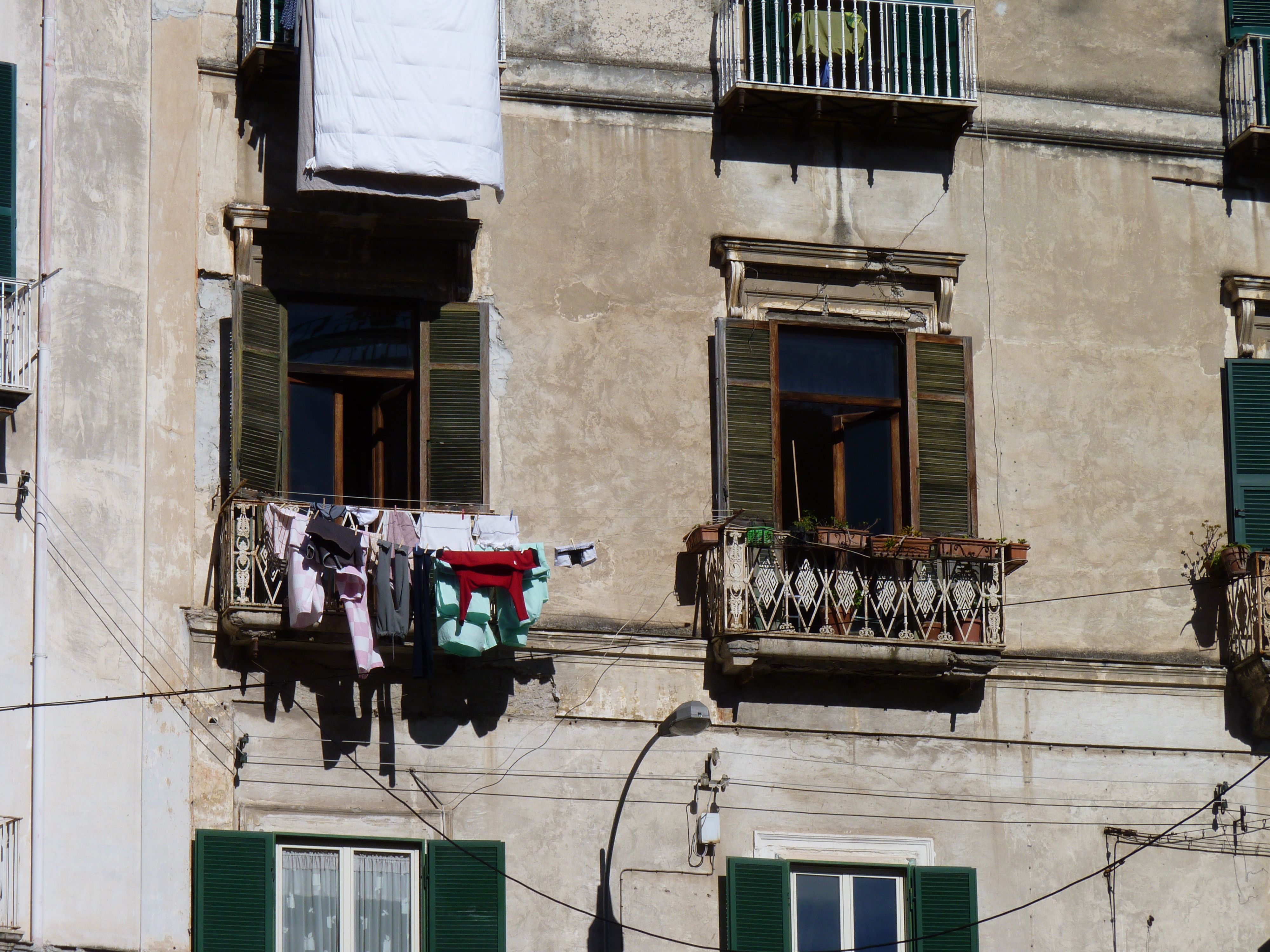
I loved Naples – everything from the congested traffic that strangles the city in dead-end stoppage to the graffiti-strewn buildings. But I am a romantic. When I travel, I put blinders on, and insist upon seeing the beauty and uniqueness of a world that, in some ways, is so different from mine, and in other ways, so parallel. Sheets and shirts blowing in the wind off the balconies is almost a trademark of the city. This, I do not see in Manhattan:
 On the other hand, a Farmers’ Market is a Farmers’ Market wherever the local growers set up shop. I felt right at home in the Piazza Dante, strolling among the locals ogling the sausages, cheese, honey and vegetables carted in for the day just like in Union Square on Saturday morning:
But underneath the red ripe tomatoes, lurks a dark side of Naples. Just before I left for my trip, I had read an article in The Times about 10 million tons of toxic waste that was buried near a region north of Naples, and the remains of the debris had likely leached into the soil. I arrived leery of fresh produce.
“The environment here is poisoned,” said Dr. Alfredo Mazza, a cardiologist who documented an alarming rise in local cancer cases in a 2004 study published in the British medical journal, The Lancet. “It’s impossible to clean it all up. The area is too vast.” He added, “We’re living on top of a bomb.”
With that kind of publicity, who needs a tomato? (Even though they looked so ripe and luscious.) Instead, besides the pizza, there was lots of delicious seafood:
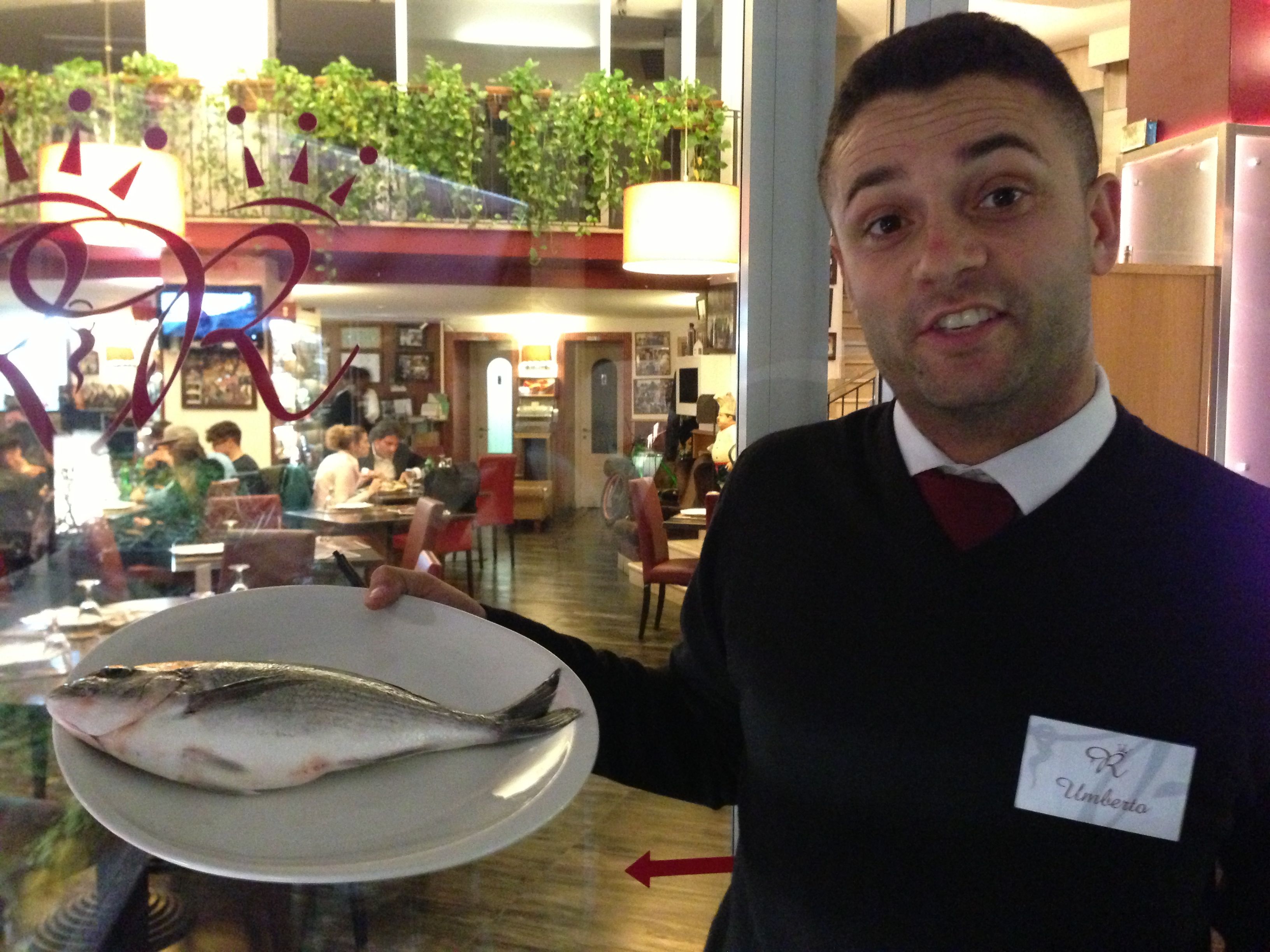
Here’s your orata!
And there was the issue of the dog poop. It is scattered everywhere. I cannot say how many times Marianne saved my shoe, but it seems that Naples is on the cutting edge of dog poop technology by actually using DNA to track offenders.
The idea is that every dog in the city will be given a blood test for DNA profiling in order to create a database of dogs and owners. When an offending pile is discovered, it will be scraped up and subjected to DNA testing. If a match is made in the database, the owner will face a fine of up to 500 euros, or about $685.
So who knows if and when I shall return to Naples. But perhaps next time, the streets will be pristine. In the meantime, nothing will dim my memories of a city where I saw the sun rise over Mt. Vesuvius every morning, and a short walk led me through streets lined with baroque palazzi, and into churches and museums stuffed with some of the most beautiful art in the world.
And then there was the 45-minute train ride to the archaeological time capsule of Pompeii, where the remains of the day tell us that 2000 years ago, like today, its citizens elected their politicians,

Apollo in the Forum in Pompeii.
relaxed in the gorgeously-ornate public baths,

Ceiling of the Indoor Bath.
attended regular sporting events, albeit gladiator matches, not soccer games, at the stadium,

Stadium
and last, but never least, always enjoyed a romp in the hay.

Fresco in the Hospitality House in Pompeii.
27 Thursday Feb 2014
Posted in Men

Frank and Karin.
As regular readers of this blog know, a few weeks ago my first grandchild was born. Bryce David is doing fine – gaining weight on mother’s milk. Life is new for him, and the long and winding road of life stretches out before him. I’m sure he will enjoy the ride. But as some sort of cosmic balance, on the very day that we gained a Terranella, we lost one.
You may recall last year that I visited by cousin in Copenhagen who shares the same name with me. While we were there, we got to spend some time with my cousin’s wife, Karin. Karin is the reason my American-born cousin has lived in Denmark for the past 40-odd years. Frank was seduced by the charms of a free-spirited Danish girl, and gave up a life in America to enjoy a long and happy marriage with her.
However, on the evening of the day (our time) that Bryce was born, Karin lost her battle with cancer. She was barely into her 60s. She was diagnosed just a few weeks before, and the end came rapidly. Perhaps that is a blessing. Frank was spared having to watch his mate for the better part of five decades suffer for months. She went quickly.
Frank and Karin’s story is full of memorable years together. And so it was more than appropriate that a memorable recording was played at her funeral. A Danish singer called Kira recorded a soulful version of “I’ll Be Seeing You,” in the style of Billie Holiday. That recording was played at Karin’s funeral. If you have never heard this recording I recommend that you download it immediately, particularly if you are a fan of jazz.
The words of the song are so poignant that I will never be able to listen to it again without thinking of Karin. And it seems to me that this song expresses universally the longing for a lost mate that is so much a part of life for many of us over 50.
The song by Sammy Fain and Irving Kahal begins:
I’ll be seeing you
In all the old familiar places
That this heart of mine embraces
All day and throughIn that small cafe
The park across the way
The children’s carousel
The chestnut trees, the wishing well
While the song became popular during World War II as GIs went off to war in Europe and the Pacific, what widow or widower cannot embrace these words? The lives of married folk are filled with little moments like this – a cappuccino at a small café, a picnic in the park. How could we not see our loved one after they are gone in all those old familiar places? The song continues:
I’ll be seeing you
In every lovely summer’s day
In everything that’s light and gay
I’ll always think of you that wayI’ll find you in the morning sun
And when the night is new
I’ll be looking at the moon
But I’ll be seeing you
Morning, noon and night we constantly remember a lost loved one, and live with the pain of separation. But the beautiful memories of a life together can bring us through. So, farewell Karin. You were taken from us much too early. But we’ll be seeing you in all the old familiar places, and we’ll smile.
26 Wednesday Feb 2014
Posted in Travel
25 Tuesday Feb 2014
Posted in Confessional

Dead center outside my window.
Cheers! to the 100-plus-year-old Eisenhower Tree that was removed from its golf course in Augusta, Georgia last week because of damage from a Georgia ice storm.
The old pine held up (and was held together with cables for years) in spite of an attempt by President Dwight D. Eisenhower to have it removed in 1956 because his golf balls often couldn’t find their way around it. The Augusta National Golf Club stood up for the tree, and refused to take it down.
I’ve known a few good trees in my lifetime. I’m currently cheering for the mostly-dead, spindle-topped maple just outside my bedroom window in my new home. For the most part, I’ve always had a tree outside my bedroom window – a mimosa, a weeping willow, an apple blossom – so I expect to see a tree when I first wake up.
This maple is my only tree. At least the only tree close enough to my window to allow me to call it mine.
Having recently moved from property that was hemmed-in by an apple blossom that traversed up three floors and touched a window on each floor, a no-holds-barred, unbridled riot of wisteria that rained purple every spring (and came back full-force after the occasional gardener’s hacking), great big elms, ever-green junipers, and woody pines that held buckets-full of snow on their branches, I am especially grateful that the one tree in the back of my new building happens to be right outside my window. It’s solitary, unexceptional; a misplaced tree that you don’t necessarily feel drawn to look up at from below. Its branches are gangly, and offer no resplendent outreaching pattern. It grows out of a black-topped-and-yellow-lined section of the fire zone of a driveway.
And like the Eisenhower Tree, it’s in the way. It’s pushing on the fence between neighboring buildings. But unlike the powers that be at the Augusta National Golf Club that supported a tree over a president, I fear my tree’s days may be numbered.
I’m especially rooting for my maple because tree-loss is fresh on my mind. Trees were taken down by the new owners of my old house for aesthetic reasons – better curb appeal. Apparently better for them to see the house through the trees, than the trees through the house.
And right before I moved out, I watched my favorite juniper tree (seen here being tree-hugged by its much younger, but no less-doomed buddy) fall victim to a chainsaw because it had rooted itself on top of an old oil tank that had to be removed.
So I will knock on wood that my new tree will remain for as long as I live here. Because from the vantage point of my bedroom window, those gangly branches make for a black and blue sky. And, for the past month, those branches have been “painted” snow-white. Its matte-brown facade is looking downright glossy these days. I applaud it as one would applaud anything that still stands tall, despite physical ravages; devoid of its former sinewy youth and dewy vibrancy.
24 Monday Feb 2014
Posted in Travel

It is possible to see one third of the city of Naples, Italy in four days if you start at 7 a.m., and keep walking with an occasional pit stop for pizza and a glass of wine. That will allow for an excursion to Pompeii and Herculaneum, the ancient cities felled by the eruption of Mount Vesuvius on August 25, 79. The point being, Naples, renowned for its three Caravaggios and the Farnese Collection, is a treasure chest of found wonders. The pizza is as delicious as everyone says; frozen calamari is non-existent:

Fresh octopus.
The art and architecture is mind-boggling:

Apartment building door.
The people are incredibly nice. And safety is never an issue. At least it wasn’t for Marianne (Steve’s sister) and me on our four-day jaunt over Washington’s Birthday weekend. From the minute we arrived on Thursday morning, until we were seated on the plane Monday afternoon, we did not stop.
Naples was founded in 470 B.C., and therefore is older than Rome. Its name derives from Neapolis (new city) because its initial residents were Greek. The oldest part, known as the Decumani, is a labyrinth of streets teaming with churches, stores, book shops, archaelogical excavation sites, pizza stands, restaurants, palazzi converted into apartments, where freshly-laundered clothes hang from balconies, and throngs of people. It has the vibrancy and bustle of 42nd Street on a smaller, neon-less scale:

We walked and walked and crammed in as much as we could, including the day trip to the scavi of Pompeii and Herculaneum, where you can still see the remnants of the ancient brothels, restaurants with vats for serving hot and cold food, the baths, the training field for the gladiators, the theatre, and houses decorated with detailed wall mosaics:

Wall mosaic from Herculaneum from the Casa di Nettuno and Anfitrite.
So after landing in Rome, and taking the train to Naples, we decided that day one would be spent looking for the Pio Monte della Misericordia, a petite church whose founders commissioned Caravaggio to do a painting for the altar depicting the seven acts of corporal mercy. Through light and dark and graphic realism, mixed with the ethereality of angels, Caravaggio’s 1607 painting, “The Seven Works of Mercy,” portrays the compassion, and kindness, of humanity.
Then we ate pizza from a street vendor, and decided we needed more pizza. We went to a restaurant, so we could sit and have a glass of wine. We walked over to the National Archaeological Museum to buy our Arte Card. This is an incredible deal. For $30, you get half-price admission to museums, and free transportation on the city buses, funiculars, and trains, including the suburban train to Pompeii. By this point, we were sort of done-in, and decided to head back to the hotel. And thanks to my inverted sense of direction, a 45-minute walk became a two-hour-and-45-minute walk, and therefore required another sit-down wine moment.

The Crypto-portico under San Lorenzo Maggiore church, 1st-2d c. A.D.
Day two started at the archaeological ruins underneath the Church of San Lorenzo Maggiore. This flipped us because the excavations reveal the foundations of a Greek city dating back to the 4th century B.C. The Romans came next, and it is possible to tour the grid-like complex of ancient streets that once pulsed with a laundromat, meat market and bakery. About 1236, French friars laid the bricks for a church that has been an active place of worship for about 900 years.
Then, after much circuitous meandering, we found The Sansevero Chapel. The floor is an optical illusion of protruding and receding space. The underground chamber houses a testament of medical learning in the 18th century: a male and female skeleton that depicts the circulatory system of the human body (including the heart and lungs), known as the anatomical machines. Every vein and artery that pulses inside our body to make the blood flow is accurately depicted:

Floor. Sansevero Chapel.

The Anatomical Machines.
But truly the piece de résistance chapel is Giuseppe Sanmartino’s Veiled Christ. You cannot take pictures in the chapel and it is likely that a photograph, while capturing the essential elements of the sculpture, Jesus Christ lying down with a piece of cloth draped over him, could never capture the humanity, sensitivity, compassion, and vulnerability imbued in the marble.
Then it was time for some catacombs. Naples has three different venues for catacomb viewing, but the only one that was still open by this time were The Catacombs of San Gennaro. I assumed it would be filled with skulls, but due to the Black Death in the late 1300s, a city ordinance had ordered that they be removed to a cemetery on the outskirts of the city. No skulls, but in those dark underground passageways, many remnants of early saints and apostles from the 1st and 2nd centuries, when Christianity was first taking hold:

Inside the catacombs of San Gennaro.
After we left the Catacombs, we headed over to the Capodimonte, a Bourbon Palace, converted into a museum of fine art. Getting there was no easy feat because Naples, like Rome, has no traffic lights. You sort of put your hand up into oncoming traffic and hope that the cars stop, and let you cross the street. By the time we left the museum, there were no more buses running. We hailed a cab, and sat in the typical bumper-to-bumper traffic, but finally got back to the hotel to go to sleep so we could wake up at 6 a.m. to head to Pompeii. Naples is not a relaxing vacation.
22 Saturday Feb 2014
Posted in Art

Dry pilings on the West Side Highway.
21 Friday Feb 2014
Tags

We recently visited Sarasota, Florida to shop for a condominium near the Gulf of Mexico. Now that both of us are retired, there seems little point to hunkering down all winter in frigid New Jersey when we could just as easily be spending those ugly eight weeks called January and February on a powdery beach drinking Coronas at sunset. Given the particular nastiness of winter in the Northeast this year, that seems like an ideal plan.
Still, I’m a bit reluctant, at the relatively early age of 59, to take on the role of full-fledged “snowbird.” What’s next – hitching my pants up to my nipples and shuffling into deserted restaurants for early bird dinners? Wearing loafers and black socks with baggy golf shorts? Surreptitiously shoveling sugar packets, fruit, and rolls from the all-you-can-eat buffet into my voluminous old geezer pants pockets?
Maybe someday, I suppose. But for now, we’ll be the “cool” and “younger” retirees enjoying the “Florida lifestyle.” We’ll boldly stride into the early bird dinner without walkers, and “go commando” That’s right – no incontinence underwear at all. Woo-hoo!
We stayed at a friend’s condominium, located in Bradenton. The complex is tucked into a lush green enclave hidden in a tract of land between two nondescript Florida four-lane roads. The bordering streets are lined with drugstores, strip malls, movie theaters and, of course, a Publix and a Wal-Mart. Inside the complex, however, you’re in a mini tropical forest dotted with exotic colorful flowers, vines, and broad-leafed plants and trees. Oh yeah, and nine million tiny lizards. Walk anywhere, and three or four of these two-inch critters will scurry across your path, scrambling frantically to get out of the way. They’ll stop, look around, then dart away again, peripatetic refugees from a Geico commercial.
We went to the pool, and my heart sank as I overheard the conversations around me. One slim, older, gentleman in the hot tub was explaining to two women on the patio nearby the difference between wet and dry macular degeneration (Apparently, in addition to the obvious moisture-related distinction, one is far more threatening to the eyesight and harder to treat.) While he droned on about the potential total loss of central vision, and the relatively benign need to treat it by taking a prophylactic needle to the eyeball every couple of weeks, one of the women (a spry mid-60’s type) noted that the other woman was now using a cane – which she had carefully set aside before starting her gingerly descent into the bubbling whirlpool.
“Yeah, I don’t really need it, but it makes me feel better,” Ms. Cane sighed as she slowly settled into the swirling bubbles. “That feels good – not too hot.”
“They were talking about raising the temperature in the hot tubs at the board meeting the other night,” wet/dry Mack pointed out, with only his chin jutting above the surface. “I’m glad they didn’t. This is just right.”
“Not too hot, not too cold,” Ms. Cane agreed, her bathing suit skirt coyly rippling above semi-submerged tree-trunk thighs. “Come on in, Grace, the water’s fine.”
“I don’t think you’re using that cane right, though,” said Grace, picking it up and twirling it a-la-Charlie Chaplin before setting the black rubberized end down on the concrete.
She proceeded to explain that a cane is intended to support the weak side, but only temporarily, and only lightly, and that you can develop a rhythm and really walk at quite a smart pace with your aluminum third leg. She demonstrated by taking a couple of relatively nimble, aided circuits around the hot tub, with wet/dry Mack and Ms. Cane expressing approval amidst the bubbles.
Blah, blah, blah.
My eyes glazed over as I dozed on the lounge chair eight feet away. I had intended to soak in the hot tub, but demurred for fear of getting drawn into the gang-of-three’s scintillating discussion of degradation and decay. I thought about taking a swim instead. At the low end of the pool a straw-thin guy with a floppy hat, wraparound visor sunglasses, and a zinc-white nose, was doing ultra-slow laps – walking, not swimming – while three bulbous older women, their backs supported by buoyant neon noodles, kicked their way down the length of the pool, chatting chummily. That didn’t seem like the place for me either.
I read my newspaper, and dozed in the warm sun, imagining myself on a beach with people who didn’t appear to be on the verge of death. Young, supple, energetic folks with muscular bodies, firm butts, high-proud breasts, and vibrant manes of non-blue hair. The only problem with that fantasy is that, to those fictional nymphs and Greek gods, I’m as decrepit as Ms. Cane and wet/dry Mack.
I read my newspaper by the pool. I dozed. I daydreamed. I exchanged innocuous pleasantries with the hard-core retirees around me, hoping perhaps that if I refused to participate in their conversations, or acknowledged our shared concerns, I could delay the inevitable.
Who am I kidding? I have met the enemy, and he is me.
20 Thursday Feb 2014
Posted in Art
Tags

BY WS50
A small window into the passage so far, midway to 100:
Breathing, crying, separation, family, learning, playing, growing, spirit, school, sports, friends, parties, puberty, sex, college, work, studying, disappointment, fear, enthusiasm, joy, apathy, drinking, drugs, freedom, fun, travel, independence, decisions, passion, money, marriage, no-marriage, no-kids, kids, responsibility, exhaustion, love, standards, scrimping, saving, pride, toiling, debt, windfalls, goodbyes, letting-go, crises, beginnings, changes, moving, buying, selling, weddings, births, grandma, grandpa, divorced, thinking, loss, arthritis, wisdom, cancer, heart, satisfaction, acceptance, astuteness, focused, happy, scared, Botox, fillers, wrinkles, flab, exercise, doctors, death, betrayal, beauty, parent-less, appreciation, pain, care-giving, chance-taking, don’t-give-a-damn, determination, unknown, reality, anticipation, unbridled, unchartered, burdened, alive, breathe …
19 Wednesday Feb 2014
Posted in Concepts
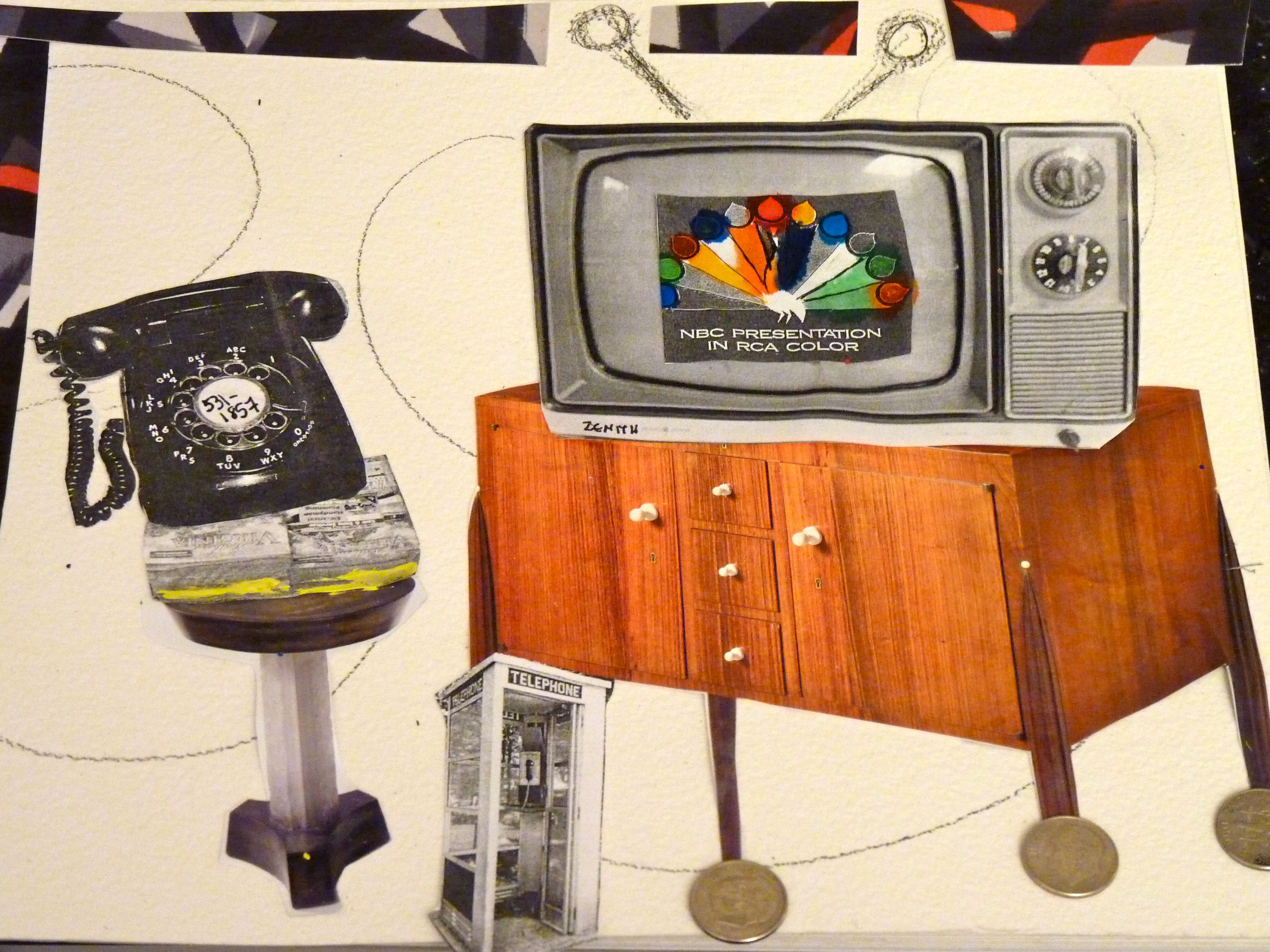
There are many signs that scream that I have left the left side of 50, or as Rod Serling, would say, I have “entered the Twilight Zone,” the brave new world of “I am no longer young.” I know, because my list of “the way things were” gets longer, and more dated with each passing year.
I was born in a world of rotary phones. By adolescence, the push-button had made its entrance. There was a lot of commotion over its ease and convenience. Done and gone. Quaint artifacts of the olden days.
Telephone directories, those bi-colored books, with white pages for a people search, and yellow pages for a business search, would appear on the doorstep once a year, free of charge. Done and gone. Never to be contemplated again.
While color TVs became ubiquitous in the ’70s, I grew up with a black and white TV. The screen was maybe 24 inches, and there were only about seven stations to choose from. At some point, we got a remote control, but I don’t recall it having a presumed presence in the house.
The NBC peacock used to spread its feathers to announce that the upcoming show would be a color presentation.
Dimes were critical because they were needed to make telephone calls, which meant telephone phone booths appeared on almost every other corner.
The only thing we could imagine piercing were ears- not bellybuttons, noses, cheeks or lips.
It seemed as if only sailors got tattoos.
Dress codes were fought over. We staged protests to be allowed to wear jeans to school.
Age 50 was ancient. It was never going to happen! And now, even 50 is becoming a number in the distant past. How weird and rapid the march of time is, and we know it by how we remember the way it used to be.


 The Write Side of 59