My Buddy, His Birds, and Appreciation from the Sidelines

Tags

, , , , ,

Birdland

Birdland. Photos by Julie Seyler.

BY JULIE SEYLER

I have a friend who is a birder.  When he first told me that he took excursions to Central Park every Saturday morning during spring migration season to catch what was coming up from down South, I was baffled.  But over the course of our 20-year friendship, I have come to appreciate the mystery of birdwatching.  So while I have never become a bird groupie, I thoroughly understand the pleasure that comes from a successful sighting; the thrill of spying the bird that seemed to get away. And the overall satisfaction of a day spent with warm-blooded creatures that have the power of flight.

And because I know the excitement of seeing something rare and unexpected, I no longer blink an eye if we are driving along, and come to a sudden stop because he spots something in the sky, on the road or in a tree. As a result, I have picked up minimal knowledge of being able to distinguish terns from gulls, and plovers from sandpipers. But basically, I’m a rube.

Nonetheless, if I’m going on vacation to someplace that is known for some exotic, colorful bird species, I most definitely pack my binoculars.  I know I have been very lucky to have seen lilac-breasted rollers, spoonbill cranes, secretary birds, and malachite kingfishers.

Lilacbreasted roller.  Botswana

Lilac-breasted roller. Botswana.

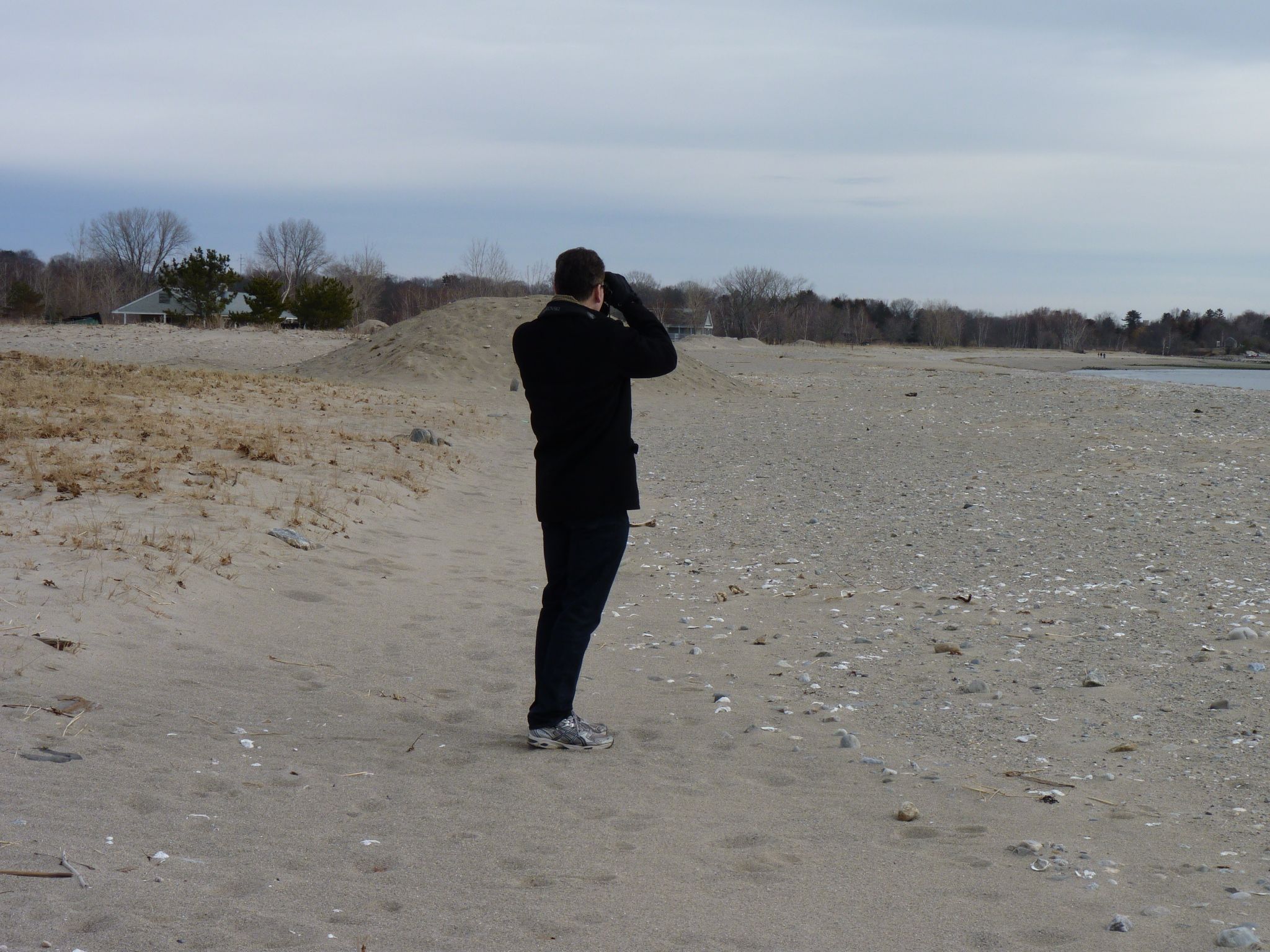
So on a recent trip to Sherwood Island State Park in Connecticut, my friend brought the car to a sudden roadside stop to check out bufflehead ducks.  On the walk to the beach, he pointed out Canada geese and coots, and then off he went with his binoculars to see what else he could find.

seeking shore birds

Seeking shore birds.

He came back with a report that he had seen a few more buffleheads, some mergansers and long-tailed ducks. For a 30-minute stop in 30-degree weather, it was definitely gratifying.  Meanwhile, I had ended up walking along the beach checking out the shells. I guess nature calls differently to each of us.

me holding a shell

Me, holding a shell.

The Saturday Blog: Renewal

Tags

, , , , ,

slatted boards and sunlight

Slatted boards and sunlight. Photo by Julie Seyler.

We have come through winter.  Like a fresh coat of paint, we are, oh, so ready, for the renewal that spring brings.

The Right to Bare Arms, and Everything Else, at 50

Tags

, , , , , , ,

arms and the woman.  photocollage by Julie Seyler

Arms and the woman. Photocollage by Julie Seyler.

BY LOIS DESOCIO

The first thing I’m going to bare, as summer approaches, is my soul. I’m having doubts about wearing my favorite orange (short) shorts this year.

I’ve always been a bit of a paradox when it comes to being bare. I love clothes, and I’m modest. I believe the more left to the imagination, the better – no matter what age. But I also love air on my skin. I’m barefoot more than shoe-ed. And I love bare legs, bare arms, and bare anything else that’s legal … or out of sight.

My doubt was fleeting, but it had crept in because of my age. Because, as we all know, ladies, it is incessantly hammered into us that we should burka-up once we hit 40. So says … just about everyone under 40. And just as tiresome, repetitious, and saluted (ad nauseum), is our generation’s mantra: “We-will-be-the-first-to-look-40-at-50-so-take-that-we-look-great-and-we-will-not-be-held-back-nor-told-what-to-do-nor-what-we-can-wear.”

Don’t listen, girls. To either hail. Instead, don a sense of delusion, and face this summer bare-backed, bare-bellied, bare-armed, bare-legged; bare breasted. Embrace this stratagem with aplomb, regardless of what you may look like, or what others may see.

Or create an allusion:

If you think you look better from the front in a bathing suit, than from the back (we all know how those lycra suits push everything that’s loose to the back), then never let anyone see your back while standing up. When taking that long walk to the ocean for a swim, you can bend over to pick up the most breathtaking seashell you’ve every seen. Don’t stand back up. Instead, cup the shell in one hand with the elbow inward, and at hip level. Your other hand meets your forehead to keep the sun out of your eyes. This allows you to remain bent over frontwards the whole way down the beach, and into the ocean.

At the pool, prepare for that perfect plunge with a stretch and a salute to the sun from chair to the pool’s edge, then dive in. And when surfacing from any body of water, it’s perfectly acceptable to elongate your whole torso, upper arms vertical, elbows bent, hands on your head, biceps flexed, while you are squeezing, fluffing, and tending to your wet hair. The four parts of your trapezius muscle, in back, will take it from there, beautifully.

Arms are tricky. Especially in broad daylight, or fluorescent lighting. No amount of planking or pumping can tone that free-flowing (sometimes flapping) underbelly of an aging, uncovered arm. If you’re lucky enough to have toned arms at 50-plus, believe me, in the wrong light, they, too, can look pocked and piebald.

So, when possible, especially when being photographed bare-armed – never, ever put your arms front and center, with the “No! Don’t take my picture!” pose. Always turn your inner arm towards the sky, palms secretly pressing down on the arms of a chair, chest out, head up, and a tad forward. This tightens your upper arm, and creates that dip in your neck, thanks to the much-underrated clavicle bone that will project and appear to be part of a toned, upper arm. And if this picture is taken on the beach: head to the beach chair. It’s low to the ground. So everything that’s falling down, will fall back when looking up to the picture snapper, who is looking down at you looking up.

Breasts never get “old.”

And my hat is off to any woman over 50 who bares her belly with verve. I only feel that verve when exposing my front while lying on my back. And buoyant. (Floating in water, palms down, arms up, head back, can give the allusion of a 25 year old from head to toe.)

Legs can hold their own, no matter what age. The question is, how much do you show? Show as much as you want. Especially if you are also baring your arms or belly. Because unless your derrière is sagging down through the bottom of the hem of your shorts, or short skirt, no one will be looking at your legs.

Before Cineplexes, and Multi-Screens, There Were Movie Palaces

Tags

, , , , , , ,

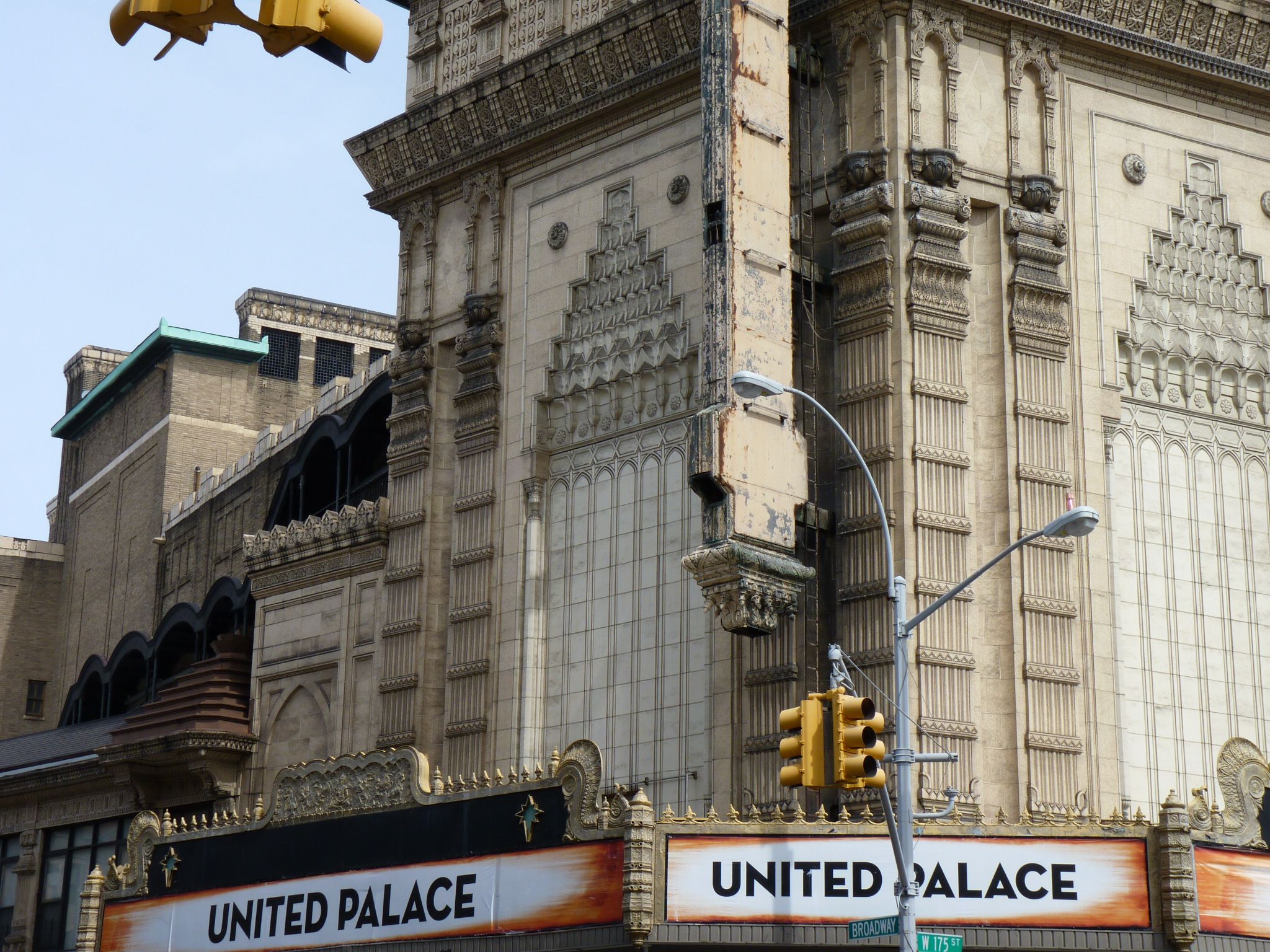
Movie theatre at 175th St and Broadway

Movie theatre at 175th St. and Broadway in Manhattan. Photo by Julie Seyler.

Mayfair Theater

The Mayfair Theater in Asbury Park in its prime. Photo courtesy of noweverthen.com

BY JULIE SEYLER

When I started going to the movies as a “grown-up,” i.e. without parent chaperones, my friends and I went to Saturday matinees at the St. James, Mayfair or Lyric Theatre in Asbury Park.  Big old carnival-like palladiums that were demolished – now it seems pointlessly.  Probably the riots that sparked in Asbury Park in the summer of 1970 initiated the slow demise of each of the grand old palaces.  One of our parents would drop us off and we would walk through the lobby into a cavernous auditorium, where a heavy, red-velvet curtain protected the mile-wide screen. The curtain would part, and the movie, sans any commercials, would begin. The first time I saw “Gone with the Wind” (falling crazy for Clark Gable), was at one of those baroque confections, so different from the modern seven-screen cineplex.

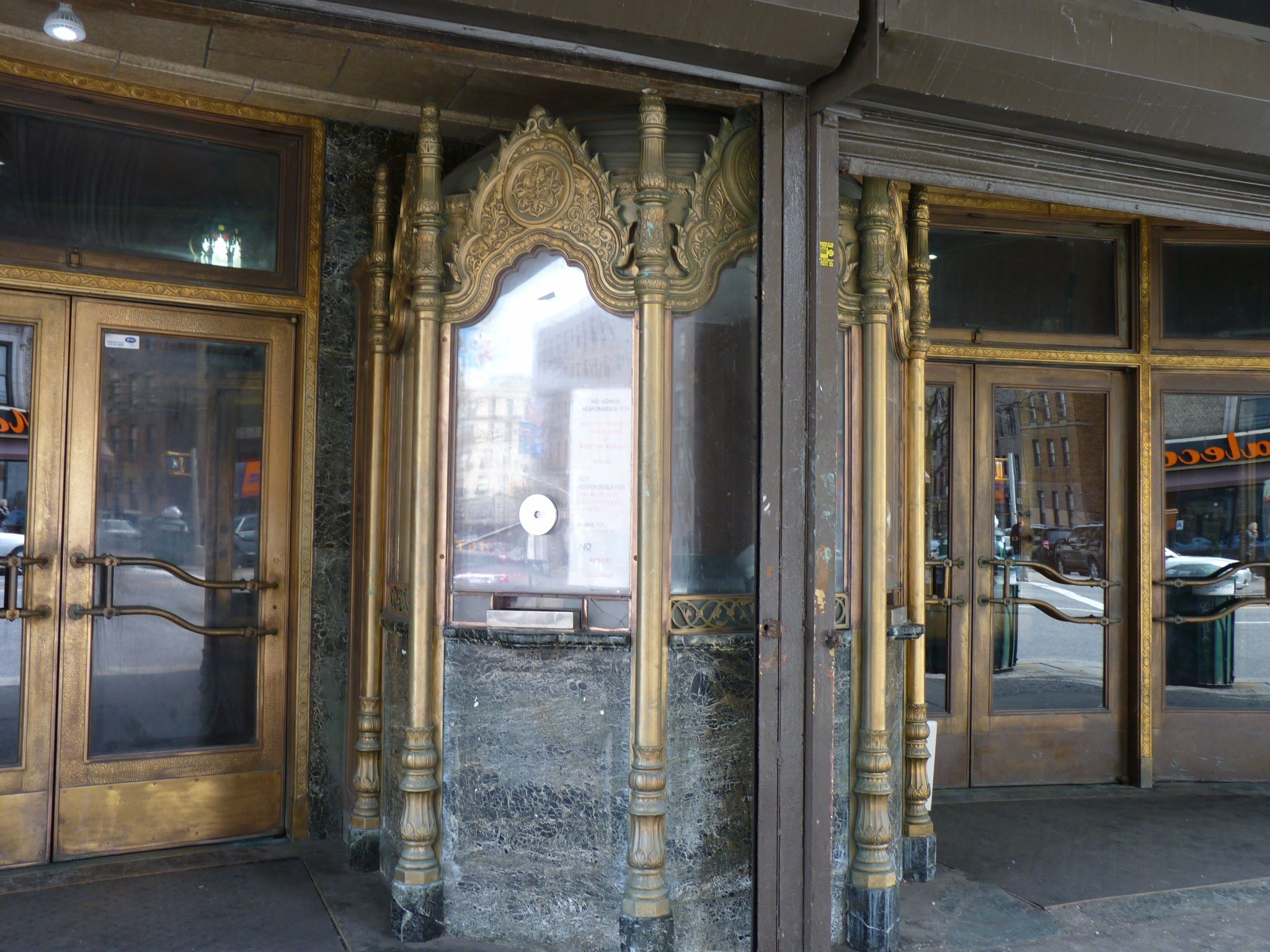
So, it was with great glee when, a couple of weeks ago, I found myself on the corner of Broadway and 175th Street staring up at a magnificent, albeit broken-looking, movie palace.  I could only guess it was built in the late ’20s, early ’30s.  It was a city-block wide; the original box office in place. And the entire facade of the building was decorated with intricately carved fretwork. What looked to be a Hindu god graced the marquee high above the street.  It is now the United Church, but I closed my eyes and imagined what glory it must have commanded in its day, especially since its architectural splendors still dazzle.

Fretwork

Fretwork.

Ticket booth at the old Loew's on 175th Street and Broadway

Ticket booth at the old Loew’s on 175th Street and Broadway.

the marquee

The marquee.

the marquee in situ

The marquee today.

In the back of the theatre, facing Wadsworth Avenue, a balcony had been built on the second floor.  I couldn’t figure out if the stars used that space to come out and bow to their fans, or if it was just a place to cool off on a hot summer night because the theatre was built way before air conditioning.

When I got home I called my mother, because she grew up in that neighborhood. I thought she might know what the mystery building was before it became a church. “Of course.  It’s the Old Loew’s Palace where I saw ‘Gone with the Wind’ when it first came out in 1939.  I was 11.”

It’s All Relative: I’m Counting the Ways I Can Die

Tags

, , , ,

here and then there

Some of my relatives were here. And then there. Photo by Julie Seyler.

BY BOB SMITH

As I approach 60, I can’t help but speculate about how I’m going to leave this world. It’s not a morbid preoccupation, but a simple fact of life. As my generation grows older, more and more of us will die.

I’m fortunate to have been born into a large family. My father was one of nine children, and my mother, incredibly, was one of 21. Of course, there were two mothers in that family – my maternal grandfather had 10 or 11 children with his first wife, who was the oldest in a family of five girls. When she died (in childbirth, of course), he went back to Italy, married her youngest sister, and brought his new wife back to the United States where she bore him 10 or 11 more kids.

As Dad used to say: “He shoulda bought a TV.”

So now, as my aunts and uncles reach their 80s, and beyond, I’m learning what tends to kill my closest relatives. My generation’s on deck, and barring a catastrophic accident, there’s a pretty good chance that what’s killing them will also kill me.

First, my father’s side: Claiming primarily Irish lineage, they were talkers and jokers and partiers. True to stereotype, there seem to be an inordinate number of heavy drinkers among his siblings.

Take Dad’s older brother, Uncle Warren, a barrel-chested career cop who chain-smoked unfiltered Camel cigarettes, and drank Boilermakers (a shot of rye whiskey with a beer chaser). In his 60s, he got cancer of the larynx, and they removed his voicebox. The summer after his operation, Warren got an electrolarynx, a battery-operated device that resembles a microphone. You hold it up under your chin, and it vibrates to allow you to form robotic, but discernible words. Uncle Warren came to a backyard barbeque with Aunt Margie, a conservative ultra-religious woman, and used the electrolarynx to alternately tell jokes and goose his mortified wife.

About a year later, he developed cancer of everything and died at 68.

Dad’s youngest sister, Madeline, was diagnosed with liver cancer at age 64. The disease was swift and merciless, and she wasted to a frail shadow of herself before she died six months later. Dad died at 76 of congestive heart failure after a failed operation to repair a faulty valve. Uncle Bob, Dad’s younger brother and my namesake, died of lung cancer at 79. He briefly went through lung removal, and the indignity of chemotherapy, but still died within two summers of being diagnosed. Decades of heavy smoking, and heavier drinking, didn’t help any of them.

Dad’s oldest brother, Artie, died in his late 70s in a head-on collision as he drove the wrong way on a one-way street leaving an airport. There was no indication that drugs or alcohol were involved in the crash. Uncle Artie, the sweetest guy in the world, had spent years as a commercial pilot on transatlantic flights without a single incident. Uncle Norton, the next oldest brother and a heavy drinker for years, died of heart failure at 81.

So the score on my Dad’s side of the family: One brother, 80, and two sisters, in their late 60s/early 70s, still living and in good health. Cause of death for the six deceased siblings: Cancer (3), heart disease (2), accident (1).

My Mom’s side of the family is a different story. At 86, Mom thankfully has no serious life-threatening ailments. She does have creeping dementia, and takes medication for blood pressure and whatnot, but physically, she’s pretty much fine. Her older sister, Louise, died at age 90-something of old-age onset breast cancer. Her brother, Billy, died at 80-something of old-age onset kidney failure. Her father died in his 80s of old-age-onset diabetes. Another sister died of old-age-onset, period – at 98 or so, she just stopped breathing. Lots of them are still around, and getting older all the time. You get the picture.

So from my Dad’s side it looks like cancer or heart disease are good bets, but I don’t smoke or drink heavily so maybe I’m improving those odds. Thankfully, I look more like my mother’s side of the family. In fact, Mom says I look a lot like her dad (of the two wives and kids in litters), which gives me hope. If it weren’t for menopause, I suppose that might also give my wife (or her younger sister) jitters, but they’ll get over it.

My Mid-50’s Layoff: Good, Bad, or Ugly?

Tags

, , , ,

I work

I work …

BY JEANNETTE GOBEL

On July 16, 2012, my position had been eliminated. Not just mine, but 125 other employees who, just like me, loved their speaking jobs in the local high schools. Yep, the company was “ending” this side of its operations after 35 years. It was a bolt out of the blue. Or maybe a zing. It was coming for some time, but I loved my job, so tried not to dwell. Then it dropped – the weight. Clunk. Right there in front of me.

My heart was in my throat for most of the conference call. Little flashes of catastrophe were clouding my vision. Do I get severance? What about health insurance? What about vacation pay? References? My livelihood? And … my sanity. I was 55. Who would hire me?

So, herein lies my eight-month journey:

The Good
Fortunately, I am an eternal optimist. My first thoughts: my husband and I will be fine. The severance package was decent, plus all vacation pay should carry us through at this income level for about four months. I saved a tidy sum through the company’s 401k plan. That will be rolled over into our investment fund. Oh, and unemployment! I must sign up for that immediately, I was told. I’d have the rest of the summer free, basically, and can help with my daughter’s upcoming wedding. (An iota of glee there.) And, oh yay! I could hang out at our cabin as much as I please for the summer.

Hey, is this such bad karma, I thought? And lest I forget – I have a Washington State teaching certificate. I’ll renew it, and substitute teach until I find permanent employment. (Do I really want permanent employment again?) Unemployment prorates my wages while I substitute teach because it’s not permanent work with benefits. I could get used to this. I had time for lunch with friends, my workouts did not suffer, and I had time to visit my aging parents. Life was good.

The Possible Bad
It’s been eight months since the layoff, and we haven’t had to touch the severance fund. The economy in Seattle, where I live, is robust. We have some of the nation’s best companies headquartered right here. Amazon just contacted me for an interview for an awesome position developing business relationships. But, who will hire someone who is five or so years away from retirement? And I haven’t had a ton of interviews. But this subbing gig is working out. And I must not let the age thing get me down. It’s time to demonstrate energetic interview enthusiasm. (Yay! I love your company, and I want to be part of the team!)

The Ugly
I’ve since sent out 300 resumes, and I’ve had only three interviews so far. I’m a straight-A student – what’s happened here? I’m technologically with-it: LinkedIn, Facebook, and electronic submissions of resumes and cover letters. I’ve been out of permanent work for  so long now, that I just qualified for the Emergency Unemployment Compensation through the Federal Government. I hope it doesn’t get so ugly that this runs out. If so, I can continue to substitute, as I don’t really want a permanent teaching gig. And, the optimist in me keeps reassuring me that I can do this until I really want to retire. (So, take that, ugly side.) I do have options.

Well, in retrospect, since the “Good” paragraph is the most lengthy, I guess this layoff thing isn’t so bad. Or ugly.

"outta work".  cut up watercolor by Julie Seyler

… outta work. Cut up watercolor by Julie Seyler.

Yale Art Gallery Yields Ancient Flip-Flops, Word Games, and a “David Yurman”

Tags

, , , , , ,

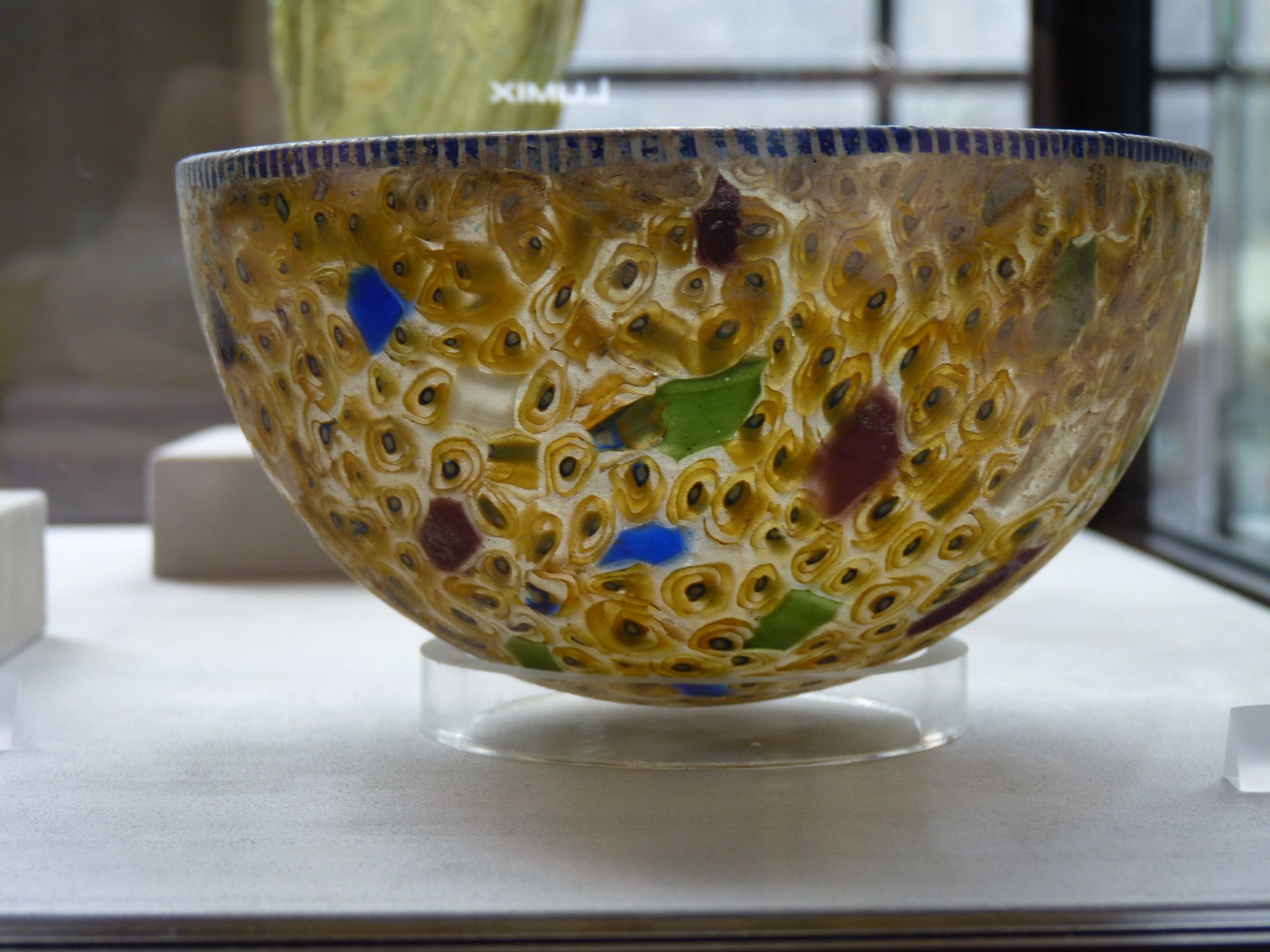
glass mosaic bowl 1st century B.C. to 2nd century A.D.

Glass mosaic bowl, 1st century B.C. to 2nd century A.D.

BY JULIE SEYLER

I am passionate about ancient objects.  Vases, bowls, tables, and combs, when crafted by an artisan who might be 4000 years old today, blow my mind. So I scour the ancient art galleries of museums, and love to visit once-buried cities. Seeing old artifacts confirms the continuity of fashion; the practicality of drinking glasses; the fun of jewelry.

One bitter day in March, a friend and I drove up to the Yale Art Gallery. From the city, it’s  about 2 hours on I-95. I had heard that the recent renovation was spectacular, but had ignored reading about it, so I went with a blind eye. The minute we drove onto Chapel Street, and past the stately gothic buildings that comprise Yale University, I was enamored. The campus is not beautiful in the sense of rolling hills, but in the majesty of the architecture. It celebrates education with arches and steeples and marble and wrought iron gates. If ever I wanted to go back to being a student, this stroll around Yale made me long for youth in a way that was not familiar.

So when I entered the art gallery, I was already enchanted and became more so as we ambled through. The little I saw reflected the tip of an amazing collection – a mini- Metropolitan Museum of Art, but so much more accessible.  The info cards give the necessary details with simplicity, and it was crowded, but not jammed.

Within the Roman galleries was an exhibit devoted to the city of Dura-Europos, founded in 300 B.C. on the western bank of the Euphrates River, in what is now present-day Syria. The Romans dominated from about 165 A.D. until another invading army, the Sassanians, took over. The site was discovered by a team of Yale archaeologists in the 1920s, and the gallery is a showcase for their finds. I spotted a leather flip flop that could have been made by Rainbow; a David Yurman bracelet and Matisse-like terracotta female figures.

Leather flip flop Dura-Europos 2nd-3rd century A.D.

Leather flip flop Dura-Europos 2nd-3rd century A.D.

David Yurman bracelet circa 200-256 A.D.

“David Yurman” bracelet circa 200-256 A.D.

The zaktik torso. 1st century B.C.- 2nd century A.D.

The zaktik torso. 1st century B.C.- 2nd century A.D.

My favorite was the word puzzle. Each of the words (ROTAS, OPERA, TENET, AREPO, and SATOR), written on this plaster plaque, can be read right to left, or left to right, or up and down, or down and up, and end up spelling the same word. A master acrostic palindrome. The meaning remains an enigma, but not the pleasure of a word game, which is timeless.

word puzzle 165-256 A.D.

The Saturday Blog: The Ceiba Tree

Tags

, , , , , ,

Ceiba tree.  Tikal. Guatemala

Ceiba tree. Tikal, Guatemala. Photo by Julie Seyler.

Tikal, Guatemala is a destination place for those who are intrigued and curious about the Mayans. But beyond the grand temples, stands nature. The Mayans believed that a great Ceiba tree stood at the center of the earth, and connected the terrestrial world to the spirit world above. Who doesn’t want a little connection to the spirit, wherever it is circulating?

Easter: Pagans, Peeps, Good Eggs, and a Bad Bunny

Tags

, , , , , , , ,

EB 3

To me, the Easter Bunny is not a good egg.

BY BOB SMITH

The Bible, apparently, doesn’t discuss Easter in any detail. Or Christmas, for that matter. In fact, some believe the holiday is derived from a Pagan tradition that long predates Christ, and celebrates the spring equinox and gods or goddesses associated with that event (one of whom, apparently, was named “Eostre”). They say fertility symbols of eggs and rabbits (who reproduce like bunnies, because, duh, they are bunnies) are associated with Easter because of that pagan celebration of the renewal of life in the spring. And, of course, the Bible never mentions bunnies, baskets of chocolate, or hard-boiled colored eggs, either.

So who came first – the Christians or the eggs? Who knows. My problem is with the Easter Bunny, because for my kids, he (or she) killed Santa Claus. That’s right. There were three fictitious characters in our house: the tooth fairy, the Easter Bunny, and the big kahuna – Santa Claus himself. Our kids never really believed in the tooth fairy, who had no persona at all. There was just money appearing under their pillows in place of an icky tooth they didn’t want anyway. It was an easy fiction for ready cash. But we invested a bit more in the other two characters.

We had told our kids all about Santa, and his rich, phony background: a home (North Pole), a cool vehicle (flying sleigh), and a demanding, high-profile career (running the most sophisticated, well-hidden, toy manufacturing/distribution operation on the planet). But the Easter Bunny? No home, and no vehicle of any kind. The Easter Bunny just hops around looking cute. Unlike Santa, the Easter Bunny doesn’t make anything – it merely distributes store-bought chocolate and jelly beans provided, presumably, by Mom and Dad. Santa had an amazing posse – flying reindeer and a legion of devoted elves. But the Easter Bunny’s peeps? Peeps. Chunks of marshmallow-ish fluff, coated with gritty pink sugar, that masquerades as candy.

Because it had such a thin cover story, our kids quickly dismissed the Easter Bunny as a myth. And it wasn’t long before that suspicion tainted and finally toppled Santa, too. Thanks for nothing, Easter Bunny.

Just keep that chocolate coming.

In Praise of the Classic Car

Tags

, , , ,

me at a car show shooting the interior of a 1964 Chrysler

Double Shot: Julie shooting the interior of a 1964 Chrysler.

BY JULIE SEYLER

I’ve already walked down memory lane with why I get a kick out of convertibles, and Bob has reminisced about his grand old ’64 Ford Galaxie. So, staying on message with the automobile, here goes my passion for old cars. For example, I love watching White Heat, not just because it’s a great movie with one of the best movie quotes of all times – “Made it Ma! Top of the world!” [No. 18 on the AFI list] – but because of the cars the gangsters and the cops drive.

the Jarrett gang getaway

The Jarrett gang getaway.

These are late ’40s whales, but I am mesmerized while watching Ma, desperate to dodge the cops, downshift and screech around the corner. The good guys, determined to stop the Jarrett gang, have access to all of the latest technology – like a radio transmitter the size of a satellite dish strapped to the roof of their car. I am so entranced by these images, I end up taking photos of the cars as I watch the movie.

My mini-obsession doesn’t stop there. I also collect photos of old cars. I mean, I’ll never be able to afford to buy one, let alone maintain one, so I might as well have a facsimile collection. Newspaper photos may be archaic one day, which means my “collection” will have value on eBay. Ha Ha. Anyway, remember I wrote about that car auction of famous people’s cars in my convertible post and a purple 1919 Pierce-Arrow, owned by the silent film star, Fatty Arbuckle? Here’s Fatty Arbuckle’s Pierce Arrow. Even the dullness of newsprint can’t dull down the lines and contours of this grand baby:Fatty's 1919 Pierce_Arrow copy

And, of course, I like old car shows, because I can take photographs of the real thing.

There is just something sexy about the rounded long hoods of 1940 sedans. They may have weighed a ton, but the devil was in the detail, such as the ornaments that graced the hoods.

the lady
Nice contrast to the mega-headlight orbs.
1942 Ford1947 Hudson copy

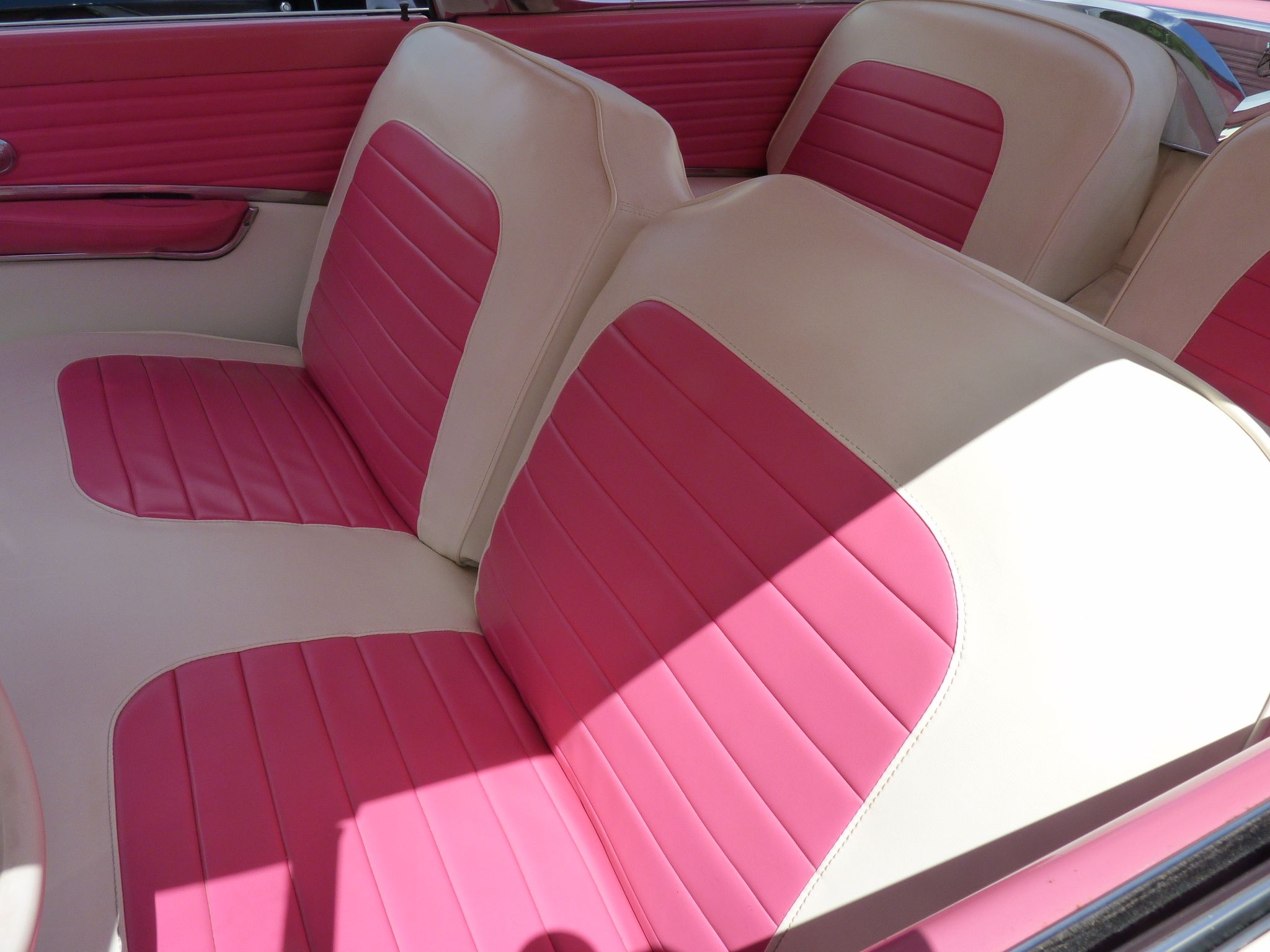
I am always discovering endearing features in old cars, like the massive steering wheels, or the the exotic boldness of the color option. It seems that by the late ’50s and early ’60s, car manufacturers found pastel. Pink seats, tri-color striped seats, and mustard yellow were quite coveted.blue interior car

pink seatsyellow steering wheel

Gas guzzlers they may have been, but the essential beauty of the design cannot be compared to the streamlined homogeneity of the modern car. There is just something aesthetically appealing, and intrinsically intriguing, about cars that were born between 1940 and 1963. (Sort of like us right-side-of-50ers.)

a cadillac