My Dish on Puerto Rico: Easy, Breezy, with Mojitos on the Side

Tags

, , , , ,

License Plate.  Photo by Julie Seyler

License Plate. All photos by Julie Seyler.

BY JULIE SEYLER

It is sometimes hard to swallow that I am approaching 60.  On the other hand, it is always great to know that I have had some friends for over 40 years.  We still manage to look like we are 13 years old to each other.  So I decided to see if I could entice one of these old-time buddies to come with me on a four-day getaway. (Yes, like Lois, I too, am a fan of the four-day trip.) I dangled Cardiff, Wales and Sofia, Bulgaria in front of her, and she jumped at all of them, but ultimately we opted for ease, which meant San Juan, Puerto Rico.

Beach and sea, San Juan.

Beach and sea, San Juan.

I have never been, but it is the perfect destination from New York City. It’s a four-hour flight. There is sun, sand and sea. And minimal time change. I did some research, found decent flights, a cute boutique hotel on the beach, and sent my girlfriend an e-mail with the info. Her reply: “Book it Dan-O.”

Our flight was scheduled to depart from JFK on March 6 at 7:00 p.m. Until it didn’t. When I got to work that morning American Airlines had graciously left me a voice mail that that flight had been canceled due to the coming snowstorm. I frantically got on the horn with them, and after an hour on hold, a lovely rep answered, and offered us the opportunity to fly out on the 3:50 flight. She was so nice. She waited while I called my friend, who was in the middle of a meeting, to see if she could scramble her fully-booked schedule so we could rendezvous three hours earlier than originally planned. So we found each other on the front end of the West 4th subway station at 1:00 pm to follow through with our plan of taking the train to the plane. It’s a great deal for $7.50.

We sailed onto that plane five minutes before the doors shut behind us. We were on our way to the land of mojitos!

Mojito 3.6.13

Mojito.

It was a perfect four-day trip, despite a weather pattern of sun every morning, with clouds rolling in religiously by 2 p.m. We were totally indolent on day one – never leaving the beach at the Water Beach Club Hotel; semi-indolent day two – taking a walk for massages, and heading into Old San Juan for dinner; and downright ambitious on day three, with renting a car from Charlie’s so we could check out the rain forest at El Yunque, the beach at Luquillo, and then a drive into Old San Juan for our final dinner. We even managed to change out of our bathing suits and into our clothes in the car.

Water Beach Club

Water Beach Club

A street in Old San Juan

A street in Old San Juan.

Sunday morning we were on the beach at 7:30 in the morning to max out on our last few hours before the 2:15 flight home.

a morning beer

A morning beer.

Serendipity: Don’t Look, and You Will Find It

Tags

, , , ,

road trip

Be open to the unexpected on the road ahead. Photo by Julie Seyler.

BY FRANK TERRANELLA

I believe in the power of serendipity.

The dictionary defines serendipity as, “the phenomenon of finding valuable or agreeable things not sought for.” Probably the most common form of serendipity these days is using an Internet search engine, and finding something great that was not what you were looking for. This is part of the attraction of “surfing the web” for many people.

But serendipity is not a new phenomenon. I first noticed its power back in the 1970s when I got my driver’s license. I would set out on a Sunday afternoon in a random direction from my house seeking an adventure. I would make turns on a whim. Sometimes, the reason for a turn would be simply to follow an interesting car like a Corvette or an Alfa Romeo. Sometimes, after the law allowing right on red was passed, it was simply a matter of making a right to keep moving. Most often, the turn was just a feeling drawing me off in that direction.

These trips (long before GPS) invariably ended in an intriguing new place. In addition to adventure, these trips served to familiarize a new driver with all the roads in a 50-mile radius of his home because I always had to find my way home. Then in college, I found serendipity in choosing college courses. My school had a system of registering for courses back then that was based on seniority. Juniors and seniors got first choice of their electives over sophomores and freshmen. I remember one year trying to get into a popular professor’s history course that was filled, and having to settle instead for a course with a professor I did not know. The course proved to be fascinating, and I went on to take two more courses with the professor.

And then there’s serendipity television. That’s when you turn on the television, and a great movie you’ve never seen is on the channel that the television happens to be tuned to. Back about 30 years ago, my wife and I turned on our television on a Saturday morning just to have something to watch while we woke up and ate our breakfast. Three hours later we finished watching “The Best Years of Our Lives.” The film pulled us in and never let go. We later found out that it was an Academy Award winner in 1947, but neither of us had ever heard of it, and probably would not have seen it for many years, if not for serendipity.

The Internet has increased exponentially the possibility of serendipity. Just about every time I go to Netflix to have a particular movie loaded into my queue, I come across another movie or two that I have never heard of that goes on to be a favorite. Companies like Netflix and Amazon have raised “we thought you also might like” to an art form. This is manufactured serendipity, but it still works if you go along with it.

And of course, that’s the secret to serendipity. You have to have a mindset that allows you to go off in an unexpected direction. I know people who have never had a serendipitous experience in their lives, because they simply opt not to. I feel sorry for them. Serendipity adds wonder to life.

A few years ago, my wife and I planned a trip to Colorado and nearby states. We had plotted a complete course for the 4,500-mile drive. Then, two days before we left, I happened upon a picture online that was just breathtaking. I found out that it was taken in Arches National Park near Moab, Utah. As a man who knows serendipity when he sees it, I knew that I had to re-plot my entire trip (including changing motel reservations) to fit in a swing into neighboring Utah. I did that, and the Utah detour proved to be one of the most enjoyable parts of our road trip.

So I am sold on serendipity. I think it adds spice to life in wondrous ways. It’s not knowing what’s around the next bend that makes life interesting. The great sage Yogi Berra would agree. After all, it was Yogi who said, “When you arrive at a fork in the road, take it.” That’s serendipity.

Our Life List: 338 Birds, and Counting

Tags

, , ,

Margo life list

BY MARGO D. BELLER

Many people keep a “bucket list” of things they want to do before they die.

Birders have a life list.

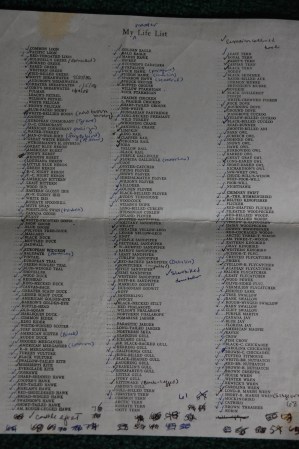
In the 1947 edition of his classic, “Field Guide to the Birds” of the Eastern U.S., Roger Tory Peterson included two pages with a list of birds covered in the volume. The idea was for a watcher to check off each bird when seen for the first time. He called it a “life list,” as in something seen for the first time in your life.

Birders have been rushing around to see and record new birds ever since.

My husband (MH) photocopied that list several times for me years ago, and I’ve used the copies to record birds from various places – my favorite birding spots in New Jersey and in New England, for instance – plus one to use as a master list. This list is so marked up it is hard to follow at times. I’ve had to add many birds as I traveled outside the East. Many birds Peterson considered accidentals, or rarities, in 1947, have become more common as their ranges expand, or as more birders go out in the field and find them.

MH and I have, in our combined life list, seen 338 types of birds in the years we’ve been birders. This may seem like a lot to non-birders, but it is an almost pathetically small number compared with others who are out in the field nearly every day, or who travel the world, the United States, even their neighborhoods in search of new birds. Many have the time and money to do this, and I envy them. MH and I have to fit in our bird activities when we can.

Still, we enjoy being together in our searching, sharing the successes and being wise enough to keep the failures in perspective.

Some “life” birds have come easier than others. The prothonotary warbler that walked out of the bushes in Central Park. The sandhill cranes that soared over the Indiana toll road on our drive back from a midwest wedding. The anhinga, limpkin and kites we saw during a trip to the Florida panhandle.

Our newest, the northern lapwing, came in March and we didn’t have to go too far. Three of these European visitors, with their distinctive crest and coloring, were found by others during the winter, hanging out in a cattle field on a farm in New Egypt, N.J. Like Alexis de Tocqueville, these old-world land plovers found favor with the new world, and were received enthusiastically.

We came after the initial crowd frenzy ended, and were lucky to find another couple watching the birds with a scope, which they allowed us to use. We were also lucky the birds decided to fly around the field, making it fun to study them with binoculars.

If travel broadens the mind, as the saying goes, we will have to do more traveling if we want to expand our life list, and our life.

A Snapshot of Mom’s Old Brown Box Camera

Tags

, , ,

Bob - camera

BY BOB SMITH

I remember as a boy, playing in the snow with my big brother. Bulky as astronauts, we wore heavy coats, wool hats, mittens and insulated boots. There was a foot of snow in our front yard and we were trying to roll up a ball big enough to form the base of a snowman. But the day was too cold; the snow too dry. And we couldn’t get anything that big to stick together. The most we could manage was snowballs, which broke apart as soon as we threw them at each other’s heads.

Mom came outside, and asked us to pose for a picture. Hanging from a strap around her neck was a Kodak Duaflex IV camera, which consisted of a brown cardboard box (with leather-textured surface) with two lenses on the front, facing the subject – one on top for framing the picture, and one below that, with the shutter behind it, where the film would be exposed to capture the image. You lined up a shot by looking straight down through the square viewfinder on top.

“Come on boys, let me get you!”

We paused our snowball war, panting puffy clouds, and faced Mom. When you looked at the camera you could see her upside-down image in the viewfinder lens. She smiled and, as she centered us, she also centered her face, topsy-turvy and fluid, in that rounded frame. Jimmy rested his snow-crusted mitten on my shoulder.

“Okay: 1…2…3…smile!”

She squeezed the button on the side of the box, the lens snicked, and it was done. Mom rolled the metal wheel on the side of the camera to advance the film for another shot, posing us side by side, with shovels jammed into the snow like soldiers with rifles at parade rest. We smiled again at inverted Mom as she snapped the picture, and she went back inside.

That camera came out for every holiday, too. My brothers and sisters and I would be grouped on the couch, giggling, with our hands folded politely in our laps. Someone at the last second (usually Jimmy) would raise two-finger rabbit ears behind someone’s head, or jab an elbow to give the shot extra pizzazz. Because it was indoors, Mom used the flash, which consisted of a silver saucer-like reflector on a plastic battery compartment that screwed onto the side of the camera. Each flashbulb, approximately the size of a ping-pong ball, had a fuzzy maze of blue filaments inside. You had to press and turn the bulb into the hole in the middle of the reflector and eject it so it could be replaced after each shot.

When Mom pushed the button, the flashbulb would explode with a sound like one of the last kernels in the pan turning into popcorn. The brilliant light blinded us briefly, and we would wander around the room in a happy daze, closing our eyes to relish the moonlike afterimage floating across our field of vision.

You never knew what the pictures looked like until they came back from the camera store after being developed, when Mom would paste them into albums. The prints had a scalloped edge with a quarter inch white border, where Mom would include notations like “Easter 1965,” or “Bobby three and a half, Barbara two,” written in careful script just like the “correct” examples in my penmanship textbook.

A few years later, Kodak came out with Instamatic cameras that didn’t have a viewfinder, and featured a built-in flash that didn’t require you to replace a bulb every time you took a shot. There was no popping noise, and the flash was more diffuse so we didn’t get the floating moon afterimage either. We still had to pose and smile but not having mom’s wobbly face in the lens facing you, inviting you inside, took some of the romance out of having our pictures taken.

That Duaflex IV may have been a cheap low-tech camera, but as they say in the credit card commercials – the memories are priceless.

Stored in My Memory Bank: The Pink Pig, Dad’s Silver “Washers”

Tags

, , , ,

il_fullxfull.244653389

Photo courtesy Etsy.com.

By Anthony Buccino

Dad was a carpenter, and each week he gave me the washers from his pay envelope. I’d plunk them onto my piggy bank. Yeah, that’s right, washers as in nuts, bolts and washers.

He told me washers weren’t money and I couldn’t spend them on candy or toys. When we filled the pink pig, we brought them to the big, boring stone bank. They said when I turned 16, I could take the money out.

Whatever they told me, it worked. Heck, I could barely read, and knew nothing about the nearly bald guy etched on my washers. Far from me to figure how worthless washers turned into money, but I accumulated the worthless washers regularly.

When I learned to count, I unscrewed the base, dumped the washers on my bedspread and piled them in five-high stacks. I cheered later as I slipped them back in the slot, clunk-clunk. This is probably how one-armed bandits got their start.

In my smart aleck teen years, I watched Dad when he brought home rolls and rolls of pennies, nickels and dimes. He needed glasses to read by now, and he wasn’t even 50. And there he’d be, with his coins scattered on the living room coffee table, his horn-rimmed reading glasses sliding down his nose, a hand-held magnifying glass in one hand as he tilted each coin to catch the light, date and mint.

He looked like Mr. Magoo. I laughed. “Dad, what are you doing with all these coins? Why aren’t you snoring through a John Wayne war movie?”

Looking at me over the top of his glasses, his grey eyes caught the light and yellow highlights glistened in his white-gray hair. Maybe he’d realize how much time he’s wasting and finish the basement where I could play.

“For you,” he said. “These are all for you.” He turned back to his clutter.

My wife likes to save pennies. Not in those cardboard collectors with the holes punched out and the year and mint pre-printed. And not only by buying bargains, or scouting a Rexall one-cent sale. She likes to save shiny pennies, and pay the change portion with dirty, gross old pennies. She sets aside wheat pennies for my out-of-date collection.

Perhaps she’ll get into the habit of saving dollars, too, when Congress changes from paper bills to coins. I have four of the president series (two Jeffersons, one J.Q. Adams and a Polk that came to me from an NJ Transit ticket vending machine). I keep those coins apart from my real money. NJ Transit says it’s converting those machines back to paper currency.

Those washers I saved were stamped with the image of Ike, and were mostly-silver fifty-cent pieces which we cashed in when Kennedy died. If only.

Forty-odd years later I’m shopping in Italy, struggling to tell a one-euro coin from a two-euro. I stop to don my horn-rimmed reading glasses. That’s when I see my father sorting coins. On my return I check out the washers in my attic.

How Did the Chicken Cross with Dessert?

Tags

, , , ,

IMG_0207

Chicken, with lemon-aid.

BY LOIS DESOCIO

I went through a semi-vegan period when I was younger, and when I came to my senses, the first craving I succumbed to was a cooked bird. Therefore, for years now, I’ve had a stack of chicken recipes – all of them ripped from the pages of newspapers and magazines – piled on top of my cookbooks. I’m methodically making every one of them, so I can respectfully lessen the pile, toss the unworthy, and store the good ones.

I think my tweak of a recipe for Roasted Chicken with Preserved Lemons from The New York Times Magazine, is worthy of a share. I’ll bet no one else has ever lined and stuffed a chicken with lemon curd. A whole 11 ounce jar. And four lemons. And a half pound of butter. (I’ve seen chicken recipes with a curd glaze, and in a sauce, but never stuffed with.) I did use two chickens, so the curd didn’t rule the roost. So, let me just do what I rarely do, and send along my most despised acronym to describe the finished product: “OMG.” It was extraordinary.

IMG_0204

When life gives you lemons … line them with curd and stuff them in a chicken.

IMG_0203

A lemon, lined with curd, in every pocket.

IMG_0206

The bird on the right exploded.

Because it was already the zero hour for dinner when I decided to make this, I was crunched for time. I made a frenzied trip to the market for the short list of ingredients: a whole chicken, butter, cumin, honey, and preserved lemons. Ellusive preserved lemons, I should add. I couldn’t find them. And in my impatience, grabbed a jar of lemon curd. I’ve never used it before, and knew nothing about it. But “curd,” kind of sounded like it could be in the “preserved” family – so why not? Plus I love the word.

But no. Lemon curd is traditionally served with desserts, and in tarts, puddings, or as a topping, and is basically sugar, lemon zest, lemons, butter, and eggs – very sweet. Preserved lemons are a whole different animal. Recipes have a Middle Eastern slant, and they are salty. You can easily make a jar in your kitchen with lemon insides rubbed with salt, smooshed into a jar and then covered with lemon juice. You can add other spices as desired. It’s recommended that the jar sit for up to a year. Nothing like the curd.

As I was prepping each bird (my face scrunched in lament at the butchery, while whispering, “I’m so sorry, baby.”) – pulling bones, ripping skin, and plying cavities – I realized I had too many lemons. They were already cut into quarters, and the pulp was scooped out, so I figured I’d just increase the curd, and the butter, to match.

I filled each lemon rind quarter with a heaping spoonful of curd, and tucked them (16 quarters in all) into every inch of space between the skin and the meat of each chicken, and filled the cavities. I rubbed the outsides with butter, as directed by the original recipe, and then shoved the leftover butter in with the lemons. (My own addition.) I sprinkled both with salt, pepper, and cumin, and roasted them for an hour. I then drizzled them with honey, and then back in the oven for another hour of roasting.

The finished product was an oozy, lemony, salty, sweet, chickeny-curd-pooled feast. You can even cut up the cooked lemon rinds into tiny pieces and sprinkle them on top. Extraordinary.

Beauty and the Beasts of its Burden

Tags

, , , ,

Is she beautiful?  Oil on canvas.  Julie Seyler

Is she beautiful?
Oil on canvas. Julie Seyler

BY JULIE SEYLER

I recently read an article in The Times about the ugliest woman in the world. According to the article, she was born with two genetic conditions: hypertrichosis lanuginosa and gingival hyperplasia, and as a result she was covered with hair and had super thick gums. This guy used her as a freak act in a traveling road show, and to secure her loyalty, and thereby a guaranteed income flow, he married her. They had a child together, but sadly it died at birth and she died five days later. The drawing of her confirms she was outside our concept of “beautiful.”

Then I remembered that classic 1960 Twilight Zone episode, where we watch the surgeon unwrap the bandages from a facial surgery.  The nurses chatter, discussing how many operations the patient has already had to try to correct her deformity of being ugly.  She can’t have any more. If this surgery failed, she will be deported to an island with others who look like her. The last bandage comes off; a unified gasp arises.  We know it has failed. Pan to the doctors and nurses with their pig snort noses and elephant ears. Pan to the patient – a “beautiful” blonde.

So what is beauty? And definitely what is “beautiful,” as we age, and live in a society that disdains the signs of age. What do we do when our peers look younger than us because of Botox, collagen fillers, chemical peels, eyelifts and the ultimate alteration: the face lift?  Do we succumb?  Do we decide it’s worth the bucks to have a face stripped of wrinkles? At 40, I proclaimed, with superior conviction, “I shall never get a face lift.  My wrinkles are a testament to the life i have lived.”  But each new contour tests my “wrinkle pride.” I am certainly old enough now to know to never say, “never!”

Mother of (And as) the Bride

Tags

, , , ,

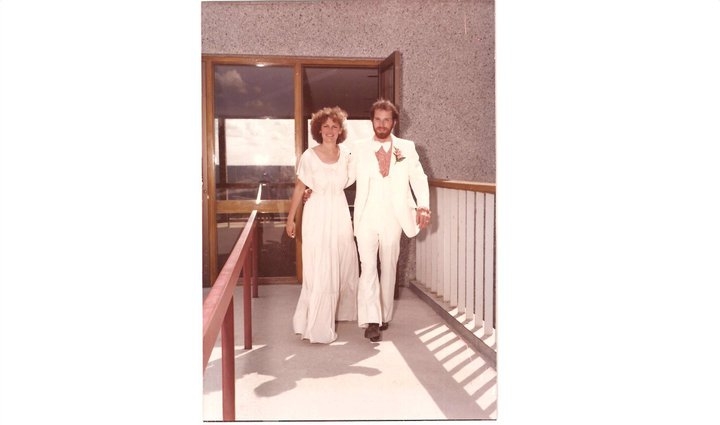
1978 Nuptials

The author’s wedding in 1978 …
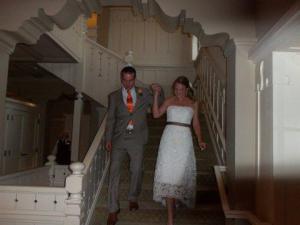
zandicewedding

… and her daughter’s in 2012.

BY JEANNETTE GOBEL

It’s my observation that an enormous chasm exists between the weddings and customs of my generation and current day. Nuptials have become a behemoth industry, with slick marketing that plumbs the depths of our emotions, insecurities, and expectations. No matter the size of the budget, it’s hard not to fall prey to the myriad of choices offered for the “big” day.

The engagement celebration of our daughter, Candice, and her boyfriend, Zac, was typical of their generation. On December 30, 2011, a romantic dinner was shared by the couple, followed by a stroll at Pike Place Market, then a surprise package left on a bench by a co-conspirator, and finally the genuflection and ensuing question. She blubbered through happy tears, a resounding, “Yes!” Moments after, both families joined the newly affianced couple for drinks and revelry at Etta’s Seafood restaurant. We were all involved in the night’s logistics and keeping the secret for three painful days, as Zac had asked for our blessing a couple weeks earlier.

When Kevin and I, the bride’s parents, decided to marry, we were alone in the car on the way to my parents’ home in November of 1977. We tersely agreed that, yes, we were ready to marry. I was 21 and Kevin was 23. I hadn’t finished college and Kevin was a newly employed computer programmer at the Boeing Company. We thought parental blessing was something out of the dark ages. Candice and Zac were older, and out of college by several years. They had also known each other since year one at the university. Kevin and I knew each other for 11 months. We knew it was right, and forged ahead with wedding plans. Our parents wished us well. No engagement party, or celebration was expected in 1977.

I was now the mother of the bride! From several sources, I learned that it was nearly required to attend the Seattle Wedding Show, which was the very next weekend. Immediately, I ordered four tickets, as we included Candice’s new mother-in-law and sister-in-law to be. The wedding show was an adventure, and Candice acquired way too much info. Who thought you could have a cake that resembled an oak tree for $3,600.00? Venues, dresses, jewelry, spa packages, linens, flowers, honeymoon destinations – all too overwhelming. Did these wedding shows even exist in 1978?

Dress shopping for me in early 1978 consisted of an afternoon at one bridal shop with my cousin. One basic dress, tried on, and that was it. It cost less than the bridesmaids’ dresses. And it wasn’t insanely frumpy – considering most wedding dresses from the ’70s.

For Candice, we assumed that we’d set an appointment for an afternoon at I Do Bridal in the Wallingford neighborhood of Seattle. I would not dream of missing this excursion with my daughter. At the conclusion of the expo, the four of us sauntered over to where dress vendors had set up. The third dress booth in, Candice and I reached for the same sweet dress. It fit her like a dream. “The” dress had been found. Even though we didn’t have our big dress shopping day, mother and daughter were together for the big purchase. I found it fascinating that both our dresses were simple, and neither of us desired a veil.

There was no question as to where Kevin and I would be married. I was confirmed in the Episcopal Church, and that was our venue. Religion thereafter was never a part of our lives, thus our little heathens were not baptized or affiliated with any organized religion. Needless to say, a church would not be the spot. Choosing a venue today is akin to deciding where to vacation – too many choices, say I. Candice loved the idea of getting married at the Woodland Park Zoo. After investigating several options, it was settled that the event would be held at the Seattle Golf Club, since the groom is a golf pro at a club affiliated with the Seattle Golf Club.

The next question was, “Who will perform the non-religious ceremony?” There were no less than one thousand names when I Googled: “Officiant, Seattle weddings.” Everyone knows someone today who can perform a wedding. An acquaintance of Candice’s was booked, and a personal ceremony was created by our young couple.

Thirty five years ago, we hadn’t heard of wedding planners. Our newly engaged pair had the tools and motivation to plan the entire event, as I happily wrote the checks. The kids made wise choices trying to stay within budget. My wedding was planned, and mostly paid for by myself. Both of our wedding days turned out perfectly.

The standard 1978 offering was cake, champagne, punch, and candy. Today you’d risk being called cheap with that menu. For my wedding, that is what I could afford. Fortunately in 2012, this bride’s parents could meet the expectations. Drinks, appetizers, and a plated dinner for two hundred filled the bill. There was a lovely wedding cake for dessert.

The photographs are the lasting memory of any nuptials. Costs for this service have risen just a tad since 1978. Our photographs were under three hundred dollars resulting in a nice photo album. In 2012, it’s the norm having all the day’s snapshots on a flash drive at about six times the price.

On the day of our daughter’s wedding, an eerie sense of déjà vu overcame me as a diverse mix of friends and family from all eras and aspects of our lives arrived at the club. As parents, Kevin and I were honored to witness such an audience, as I’m sure my parents were. This is what truly made both weddings special.

As the newly anointed Mr. and Mrs. Snedeker drove off in a mint-condition, 1965 orange Mustang, I pondered our two weddings, I see the generational differences, but both were wonderful days filled with loved ones celebrating the beginning of something special. After all, it really is the marriage that is paramount to the sturm and drang of expectations, customs and emotions.

Two months later, our only son became engaged to his lovely girlfriend. This wedding will differ vastly from our daughter’s. Mr. Gobel and I are most excited to participate from the “other side” this time, as parents of the groom.

2012 nuptials

Mr. and Mrs. Snedeker.

A Sneak Peek at Boy Scout Memories From a Non-Scout

Tags

, , , , ,

Boys checking out scouts.  Collage by Julie Seyler

Boys checking out scouts. Collage by Julie Seyler

BY BOB SMITH

Scouting made a big impression on me during grade school and high school, but not in the ways you might think. In the early 1960s, when we were about 10, my brother Jim and I wanted to join the Boy Scouts of America, but Dad wouldn’t allow it. He was convinced that once we joined, they would expect him to attend evening meetings, chaperone weekend trips, and generally participate in our lives in a personal, up-close way. He said it would force him to quit his part-time job (which the family could ill afford), but we suspected it was as much because spending quality time teaching us wilderness survival skills might cramp his drinking habit.

So my brother Jim and I would sneak around the church where they held the meetings, and peek in the windows to see if we could find out what the Boy Scouts were up to. One night, we saw a group of boys gathered around someone’s father in the meeting room behind the church. The scouts had pivoted open a stained glass half-window for air, leaving a wide five-inch gap that gave us a clear view of the floor. They all wore matching khaki shirts and dark shorts with kerchiefs around their necks fastened with a gold Boy Scout cinch. Some of them wore military-style cloth caps, and even the grownup wore a neckerchief. He was holding a length of nylon rope, and appeared to be demonstrating how to tie knots.

“That’s bullshit. They’re just tyin’ and untyin’ that rope,” Jimmy whispered, his nose on the stone sill.

“Yeah. Look at the scarf on that guy. Dad would never wear that.”

“No kiddin,” Jim agreed. “Buncha assholes.”

“Hey – what are you doing there?” The leader snapped as he walked briskly to the window, and slammed it shut.

Frantic, Jimmy and I scrambled out of the bushes and ran as fast as we could before a gang of scouts could pour out of the church like angry bees bent on testing their night tracking techniques. They never caught us, and we never went back. And we gave up asking for Dad’s permission to enlist. A few years later, the smartest girl in my high school class (let’s call her Eleanor) started wearing her Girl Scout uniform to school. This was a serious uniform – the kelly green beret with a pert nipple tip in the middle, starched matching denim shirt and sash festooned with handicrafts patches, and plaid pleated skirt. She rounded out the ensemble with clunky schoolmarm shoes, eyeglasses with pointed tips at the sides, and the coup de grace: white anklets with the day of the week script-stitched across the top. Crowds of sniggering kids, pointing and shaking their heads in amazement, would part like the Red Sea as Eleanor strode confidently down the hall, geek to the max. Apparently oblivious to the scorn and derision of the entire high school, she wore that outfit one day every week right through the end of twelfth grade. I secretly admired the incredible confidence it must’ve taken to do that, despite our relentless jeers. When I saw Eleanor at a recent reunion and mentioned her Girl Scout outfits with weekday anklets, she totally shrugged it off.

“Yeah. If you didn’t like it, you didn’t have to look,” she laughed. “Unless you weren’t sure what day it was.”

To this day, she remains a paragon of the I-don’t-give-a-crap-what-anyone-thinks merit badge, which is probably a sign of true genius. On the other hand, my brother and I still can’t tie a decent knot.