MH and Me: Love Birds

Tags

, , , ,

Birds flying over the Nile River, Egypt. December, 2009. Photo by Julie Seyler.

BY MARGO D. BELLER

Ever since my husband (MH), and I moved to our home and got a feeder for a housewarming present, I have been watching birds at my feeders and chasing them around fields, forests and seashores for over 10 years now.

The number of feeders has only increased with my desire to see more birds, which in turn, has led me to try and see even more farther afield.

There are many reasons I enjoy doing this. I like a challenge, particularly one that gets me out of the house and into the wood. I’m forced to sharpen my wits, use my eyes and remember many things, including field marks and songs. It gets me enjoyable exercise, walking long distances in new areas to at some very pretty (and sometimes not-so-pretty, birds), and it gets me away from the barking dogs and the noisy neighbors with their tech-savvy kids, who think I’m a strange old lady in this suburban neighborhood for going out in deep snow to shovel a path to the bird feeders.

MH also enjoys watching the feeder birds and going out with me to see what he can see, although he isn’t as gung-ho about rising at early hours and driving long distances. Our different ways of looking at things shape how we go birding.

I have a camera with a longish lens, and if we are in a place far from home that we don’t get to very often, I’ll take pictures to help me remember the scene. If there are birds I can photograph, so much the better. But generally, I rely on my binoculars for identification.

MH has binoculars and a smaller point-and-shoot camera – much more sophisticated than the old Kodaks we had as kids. When we go out I find something, call it out, and he’ll take many pictures from many angles, hoping at least one or two will come out good. (It helps these cameras make it easy to delete the bad shots without wasting film or photo paper.)

Another difference: Say I’m out in the field and I hear something I’ve never heard before. I will stand and wait and wait until I see what called. I’ll note the size, the color, where I am (habitat, state), note any field marks, then come home to start digging through the many field guides I’ve bought to identify it. If that doesn’t work, I go through my CDs of bird calls.

MH has a more scientific bent. He will look, too, and tell me what field marks he sees. He leaves the identifying to me, but once identified, he’ll go to a bookshelf and pull out a historical reference to learn when was the last time that bird was regularly seen in a particular area.

Together we make a good team, and that has become one of the best things about our interest in birding, spending time together and adding memories. We may not have children together but we do have the birds.

We’re Three Months Old: Bring Out the Bling

Tags

, , , , ,

Sparkling jewels

Heads were up, and a big hand was extended, at Rolf’s at Christmastime. Photo by Julie Seyler.

Among our favorite places to sip martinis is Rolf’s German Restaurant on the corner of East 22nd and 3rd Avenues in Manhattan. Aside from the super-sized drinks, what we really love: they “change decor of the restaurant for different seasons.” Their Christmas interior is so garishly, yet gloriously, over-the-top, you can’t look down.

And since there is no such thing as an overdo of sparkle, glitter, and bling, we’re blinging it blue (and big), in celebration of the blog’s third anniversary, by raising a hand to Rolf’s, and to all our contributors, readers, and fans. Thank you, everyone.

Law Practice: Shining Shoes, Lugging Golf Clubs and Hauling Garbage

Tags

, , ,

Bob lawyer

The young lawyer. Photo courtesy Bob Smith.

BY BOB SMITH
I’ve been practicing law for almost 30 years, and am now a partner in the intellectual property group of a large New Jersey law firm. Though the path to my legal career was paved with menial jobs, I learned something from every one of them.

Coming from Cresskill, an affluent Bergen County community that had at least four country clubs within a five-mile radius, I had a lot of golf-centric jobs in high school: caddie, locker room shoeshine guy, and finally, greenskeeper.  Being a caddie taught me a lot about golf – how to play it well (at least in theory, as I never learned to play well myself), the reassuring fact that most people play quite poorly, and the surprising fact that, regardless of how prestigious or well-respected the player, he or she is often not above cheating in order to win.

As a shoeshine guy in the locker room I learned that fat old guys, no matter how rich, still look pathetic and saggy with their clothes off. And as a greenskeeper, I learned how peaceful it is to walk the course in the predawn darkness, sweeping the greens with a long bamboo pole to knock the dewdrops down so they don’t burn the delicate grass when the sun comes up.

the back of a garbage truck

Riding the back of a garbage truck afforded life lessons. Photo by Julie Seyler.

Then, during my last two summers in college I became a garbageman. I hauled smelly barrels of trash through the backyards of some of the finest homes in Tenafly. I learned many things at that job, including that people often threw away perfectly edible cookies and cakes; that if you drank too many of the free beers available in the summertime you lost all ambition (it took twice as long to finish the route), and that if a mass of rice in the trash was wriggling, it wasn’t rice at all.

I also learned what it meant to be invisible. One day I was on the back of the truck with one arm hooked in the metal grab bar, carelessly swinging back and forth with the rhythm of the ride as the truck swung around turns and jounced over bumps.  I was watching a well-dressed guy in a white shirt and tie who was driving behind us, drinking coffee and glancing at his watch and trying to see if he could somehow pass the lumbering truck.  I was smiling at him and gesturing with my free hand for him to slow down; lighten up, but he looked right through me.  I didn’t exist in his world.

Then the truck braked suddenly, the air brakes exploding with a series of percussive hisses as the driver pumped them to make us stop. I was pulled back against the arm hook, toward the front of the truck, but I kept my eye on Mr. Executive, who was deep into his coffee and didn’t notice our rapid deceleration.  I waved again, screaming at him at the top of my lungs to stop. At the last second, he looked up, saw the back of the truck approaching too fast, and jammed on his brakes.

His car screeched to a stop, maybe a foot short of the blunt metal edge of the truck’s hopper – one more second of inattention, and he would have gone right under us.  The roof of his car, not to mention his head, probably would have been ripped off.  I could see the pulse of a near-death adrenaline jolt in the wide-eyed shock on his face.

He glanced at me, and I smiled, raising my hands and eyebrows in a “close call” acknowledgment, expecting him to laugh. But he completely ignored me, turning back to his coffee as if I wasn’t there.

A few years later, becoming a lawyer was a fairly easy choice: clean, good-paying, indoor work where people usually acknowledged and valued your existence.  Usually.

The Saturday Blog: Reflecting

Tags

, , ,

Prismatic light. Madrid, Spain.

Prismatic light. Madrid, Spain.

This photo reminds us of our four-day jaunt to Madrid, Spain in December 2011. It was taken inside one of the many cathedrals throughout the city that we would wander in to. Here, Julie caught and snapped the prismatic light that streamed through the stained glass windows to create patterns of abstract art.

At Least My Clutter is Out of the Closet

Tags

, , ,

P1090714

A masterful mess of man and nature. Photo by Julie Seyler.

BY LOIS DESOCIO

I’ve noticed that a lot of my writing lately is under the umbrella of an ever-growing proclivity towards clutter. And that a number of my headlines contain the word, “mess.” It seems everywhere I go in my house, I leave behind a little bit (or a heap) of me. I don’t mean that I’m dirty, or sloppy, or don’t ever pick up after myself. I would never leave a mess in someone else’s house. I just love clutter. More than ever. While I’ve always loved the feeling of being snug and surrounded, and am a life-long fan of small rooms; big chairs (a favorite feeling is to be wedged between two people that I love in a big chair in a small room), as I get older, I’m becoming a downright master of the neat mess. A maestro. Many of my friends have stated that they, “Couldn’t live like that.” I say: Try it. Why spend half your life picking up and putting away things that you need everyday? It’s not natural, and not fun, to constantly pursue tidy and trim. The world outside our windows certainly isn’t orderly.

This doesn’t mean I’m not organized. And my love of clutter does not mean that I need a lot of stuff. I’m not a collector. I hate shopping. And I’m definitely not a hoarder. I have no problem purging my home annually of things that I no longer need or use. (Just look out my back door at the perpetual pile of things I don’t want that live next to the garbage cans.)

But a little self-study kicked an after I read an interview with Peter Walsh, an “organizing authority” (he’s been on Oprah!), in an article by Mary Beth Breckenridge, which was picked up by the February 14 Star Ledger. Apparently, “untidy spaces can mess with your head.” Says Mr. Walsh: there’s an “emotional component to disorganization.” He was also the organizational expert on the TLC series, “Clean Sweep,” a makeover show for people who are messed up by clutter. Another quote: “… that when people eliminate clutter, they become less depressed and more energetic.”

So I pursued this theory further. A little research produced a Web site called, the Institute for Challenging Disorganization, whose mission is to educate professional organizers and related professionals on the issues relating to Chronic Disorganization.

It has a free clutter-hoarding scale on their Web site – “an assessment measurement tool” … “to give professional organizers and related professionals definitive parameters. These parameters relate to health and safety.”

So, it seems, according to some experts out there – I’m sick. Chronically ill. Specifically: depressed, anxious, and I have a misplaced love of things over people. Wrong: I love a pile of people just as much as I love dirty dishes in the morning.

At least I’ve proudly come out of the closet with my mess. And my closets, by the way, (and kitchen cabinets, dresser drawers) are downright pristine – neat and tidy all of them. I always hang up my coat. I make my bed in the morning, and fold my clothes (sometimes I even put them in their respective drawers) at night. But that’s it. It’s what people see (on my floors, on the tables and desks) that they don’t seem to get. To me, compulsive neatness means you must be rigid, controlling, predictable. Isn’t that less desirable than: Untamed! Effulgent! And just beautifully messy.

I’d rather walk over and around myself all day, than pick up after. Really, at the heart of all this musing, is perspective:

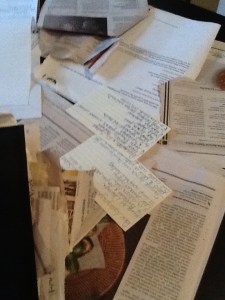
I don’t see this as a pile of recyclables. I see it as, “Wow I love newspapers, and look how many I got through this week.”
papers2.

I get to be awash in my work:
Me Library 2

You’ve seen my wall:
P1130179

I’m having a party!:
IMG_0082

My own special morning-after party:
8087476940_cc213cb158_m

Look at all the extra space I have to throw things!:
books

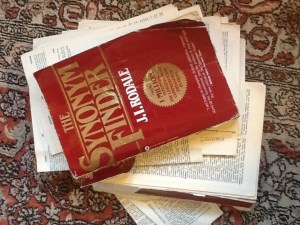
My best friend is a mess too:
thesaurus

So I have no worries that I will turn into that little old lady who is surrounded by decades of stuff. I’ll be fine, because I will always see disarray as creative chaos. I would be depressed and less energetic otherwise.

Could the Gun Debate Come Down to a Comma?

Tags

, , ,

well regulated

BY JULIE SEYLER

When did guns take over our lives? As I was growing up, I do not recall that guns ever entered the daily parlance. We were obsessed with voting rights for 18 year olds (if they could be drafted they should have a right to vote), Haight Ashbury and the drug scene, the loosening of the Hays Code, and Vietnam. I do not remember a community mass-shooting, or a non-stop public outcry that there was not just a “right,” but a “Constitutional right” to own a gun. In fact, to the extent that any discussion about guns arose, it was within the context that they inevitably led to unnecessary tragedy because gun-related murders (at least most of them) were crimes of passion, rage, and anger, and had the gun not been so accessible, a life would have been saved.

Now the scene has shifted so much that the topic of guns as killing devices competes with the topic of guns as a consumer product for the masses. In the past three weeks, The New York Times has run articles on the AR-15 semi-automatic rifle, supposedly the most desired gun in America; how more women then ever are embracing gun ownership; and marketing guns to our children’s children, and this is mere icing on the cake. The question is: How, why and when did the national psyche change from a general consensus that guns were “bad,” to this new world that does not seem to even blink at marketing guns as fashion accessories. The Times article on the escalating number of women purchasers reported that pink guns are a favorite. Like the color of Pepto-Bismol. This whole idea makes me nauseous.

pink handgun in orange handbag

Pink handgun in orange handbag

Certainly Columbine, in 1999, was a major catalyst. And pile on all of the other mass shootings over the past 14 years, and you arrive at an understanding of why guns take up front, and center, stage. But I think the underlying shape-shifting phenomenon that brought the “right” to own a gun to the forefront has been the twisting of the Second Amendment. In its entirety the amendment reads:

A well regulated militia, being necessary to the security of a free state, the right of the people to keep and bear arms, shall not be infringed.

My theory is that some strategist in some gun-loving coalition latched on to the 14-word phrase, “the right of the people to keep and bear arms shall not be infringed,” to push a platform of deregulating any type of government control over gun ownership and sales. In so doing, the meaning of the amendment was distorted beyond recognition. The comma that follows the word “arms” was conveniently dispensed with and the preface about the “well regulated militia” was disposed of as an unnecessary nuisance.

There is a glaring problem in this interpretation, and I know I am flying in the face of the Supreme Court’s decision in District of Columbia v. Heller. However, one cannot divorce a phrase such as the right to bear arms from the entirety of the sentence, nor can one ignore the preamble which explains that, “a well regulated Militia” is “necessary” to ensure that we the people remain safe and secure in a “free State.” The Second Amendment sanctions a military that has a right to bear arms, not the individual’s right to bear arms.

This makes so much sense when we think about the world the founding fathers were living in when the Constitution was adopted in 1787. The colonies, as subjects of England, had fought in a bunch of wars even before the eight year battle to secure their independence from England. The militia had been indispensable to the colonies’ successful separation from King George III and his irksome taxes. They had just won a revolution so it was completely logical that the men who drafted the Constitution would have wanted to ensure that “a well-regulated militia” would be allowed to “bear arms.” They had first-hand knowledge that it was “necessary” to the security of the “free State” they had just formed and wanted to maintain. Ergo the Constitution granted the people a right to bear arms for this purpose. It wasn’t an inalienable right, like those accorded by the First Amendment:

“Congress shall make no law respecting an establishment of religion, or prohibiting the free exercise thereof; or abridging the freedom of speech, or of the press; or the right of the people peaceably to assemble, and to petition the government for a redress of grievances.”

Had the founding fathers believed that the right to bear arms was unfettered, they would have added it to the First Amendment, a simple addition, such as “Congress shall make no law restricting the right to bear arms.” But they didn’t. They drafted an entirely different Second Amendment prefaced with the phrase: “A well regulated Militia, being necessary to the security of a free State.”

So I consider the debate over the Second Amendment as the turning point and tipping point of the shift. The reinvention of the amendment has fueled the NRA. It has the Constitution on its side to relentessly and shamelessly push for unregulated gun sales and the liberty to carry a handgun into a movie theatre. It seems to me their Constitutionally sanctioned efforts are successfully ripping apart the security of our free state.

Men in Midlife: Puberty Revisited? Or a Time to Grow Up?

Tags

, , , , ,

men will be boys

Men will be boys. Photos by Julie Seyler

BY FRANK TERRANELLA

We’ve all heard of the midlife crisis. And if you’re in your 50s, and you haven’t had yours yet, you’re overdue. Anyway, I think that women and men have different midlife crises. For men, it usually comes with the first scent of old age. You know, the sudden inability to remember names, movie titles and even words. Or if the guy is an athlete, it’s the demonstrated failure of his body to do what it used to do. Whatever the trigger, the response is usually the same: In a vain attempt to regain their youth, men revert to behavior they abandoned in their mid-20s. They get drunk, they gamble, they buy expensive toys, and they fool around with women who are not their wives. Not everyone does all of these, but just about everyone has the inclination.

When 50-something married men begin to act like they’re single, this can be disconcerting to their wives, to say the least. But it truly has nothing to do with the wives. The inclinations don’t only hit men in bad, or tired, marriages. I think they’re primal and hard-wired into men’s brains.

You can dress them up but you can't take them out

Men and their games.

What separates the gentlemen from the cads is the response each man has to this inclination. Some men give in and go off for the full ride, including bedding younger women. Divorce soon ensues, and I have actually heard these men brag that, “I traded up from the 1955 model to the 1977 model.” Other men, in the immortal wisdom of President Jimmy Carter, have lust in their hearts. I will confess to being in this group.

As I get older, I have found that intimacy is what’s really important, not just orgasms. There’s nothing wrong with orgasms, it’s just that both men and women can, and do, have them without any intimacy with their partner. This is ultimately very lonely and unfulfilling. So in recent years, I have sought out intimate, non-sexual relationships with a number of women friends. This is something that women do easily without thinking about it. Women tell their women friends intimate details of their lives freely, and it’s no big deal. For men – it’s a big deal.

In the film “When Harry Met Sally,” Billy Crystal’s character is a young man who opines that men and women can never be friends because sex always gets in the way. By that he means that he believes that a guy can’t look at a woman without thinking about getting naked and having sex with her. My experience is that it’s much easier to have an intimate friendship with women in my 50s than it was in my 20s. And that’s a good thing.

My wife has been incredibly understanding as I have begun to have long meals with old girlfriends, work colleagues and a variety of other amazing women. While the conversations have at times been intimate, they have never been orgasmic. I have been proving Billy Crystal wrong for a decade.

In many ways, I think it takes until he’s in his 50s for a man to grow up. The midlife crisis is like a second puberty. The trick is to get through it without making a fool of yourself. And as we all know, there’s no fool like an old fool.

Born to Ride: Is My Love for the Two-Seater Convertible Genetically Driven?

Tags

, , , , ,

In Dad's MG, circa 1960.

In Dad’s MG, circa 1960.

BY JULIE SEYLER

Cars have been on my mind lately. It started because I saw an article in the Sunday Times a couple of weeks ago about a car auction. But it wasn’t any old car auction. This one featured autos with provenance – like a purple 1919 Pierce-Arrow, owned by the silent film star, Fatty Arbuckle, and a 1941 Packard, owned by the ice-skating actress, Sonja Henie. These cars were gorgeous.

Then I was talking to a friend of mine, who was in the middle of multiple car transactions, like selling two cars (including a beloved sports car), and simultaneously buying a new, used, practical car. He was doing everything over eBay. It was natural for our conversation to segue from cars we “loved” to cars we “hated.”  We ended the conversation with the conclusion that everybody has an opinion about cars, even if their opinion is, “no opinion.”

It’s true. I know people who only want to be behind the wheel of an automobile that makes them “feel like they are driving a living room couch,” and others who are passionate about their hybrids (especially the gas-to-mile ratio), and some who just love the majestic height afforded by an SUV. Me? I have always cottoned to small cars with convertible tops.

After all these car musings, I started pondering whether one’s car preferences has anything to do with one’s past? Most people would probably say their car decisions are purely arbitrary, or simply pragmatic, but I am sure there is a Proustian component to my predilection for two-seater convertibles.

Fifty years ago, when I was a kid (just saying that phrase, “50 years ago,” cracks me up – can those words actually be coming from my mouth as an accurate statement of fact), I did pop about in an MGTD. My father, a true-blue sports car devotee, would squeeze me and my sister, and our two Chatty Cathy dolls, into the trundle seat of his MG, and off we’d go up the Garden State Parkway, through the Holland Tunnel and over the Brooklyn Bridge to visit my grandparents. The top would be down, of course, and the wind would fly through our hair. I can’t imagine anyone with a four year old and a six year old contemplating a journey like that today. We live in a world where car seat safety dominates.

In any case, perhaps it is because of those early road trip memories that I love two-seater convertibles. The wind in my hair never gets old. So, while I was reminiscing about the “old” days, I asked my dad what other cars he owned. He replied:

We had a few MGTDs 1950s; also MGA 1960; also MGB 1962; Corvettes – three of them, 1964s. When you were a baby in Fort Lee, we had a ’52 Morris Minor. Grandma made a convertible top for it. I forgot to mention our 55 T-Bird convertible with the hard top.

They were all small, two-seater, convertibles, except maybe the Morris Minor. Not sure if he, too, loves the wind in his hair, but the car genes were passed down.

The Saturday Blog: Snow

Tags

, , ,

Fire escape on 2nd ave after the storm.  2.9.13

Fire escape on 2nd Avenue after February 8 snow storm. Photo by Julie Seyler.

Waking up after a snow storm is like waking up on your birthday. You never know what to expect, but you know it’s going to be something good. That first sight of a snow-topped landscape is something good. At this point, the city and its environs are covered in a pristine white velvet blanket. It may devolve into a muddy slush, but to not appreciate its infancy is definitely not an option. Here’s to the first hour of the first day after a snow storm.

The backyard. Photo by Lois DeSocio.