
Raindrops on white flower. Photo by Julie Seyler.
An April shower on a May flower …

27 Saturday Apr 2013
Posted in Art
Raindrops on white flower. Photo by Julie Seyler.
An April shower on a May flower …
26 Friday Apr 2013
Posted in Confessional

There are NEVER too many mascaras.
Does anyone remember reading Cosmopolitan (Cosmo) magazine in the 1970s? Helen Gurley Brown’s creative inspiration for the single woman – the risqué diversion from Glamour and the now defunct Mademoiselle? Cosmo always ran a quiz. Maybe all the teen mags did. Maybe they still do. In any event, the purpose of the quiz was to give you, the reader, an insight into your personality. Pop psychology in 10 questions as to whether you were an innate extrovert, who embraced the idea of a party with 100 strangers, or a natural introvert, who could think of nothing more fun than a dinner for two by candlelight. Somehow, the choices given were always made to be mutually exclusive. You were this way, or that way, but never a combo of both. I loved taking those quizzes, and counting how many times I answered (a) or (b) or (c), and getting my nutshell diagnoses in a 100 word paragraph. Better yet, was picking the (a) or (b) or (c) based on my prediction of what the magazine had determined was my primary personality trait.
I don’t remember any of the quizzes today, but one question from one quiz has stuck in my mind over the past 40 years. And rather than it being a reflection of how I have changed, it is a reflection of how I have stayed exactly the same – at least with respect to this particular thing.
The question asked what make-up would I take with me to a desert island. I could choose between mascara, lipstick, or foundation. Hands down, I chose mascara, and today I would still choose mascara (albeit I love my red lipstick also). Without mascara on, I always feel just a little bit naked, except at the beach – I draw the line at wearing makeup on the beach.
I am very methodical about how I apply mascara. I always have 6 to 8 wands of black mascara with a different type, size and style of brush. I keep a set at home; a set at the gym. And a travel set, because I hate the idea of leaving home without my mascara. People look at my line up and say, “Huh? Why do you have so many mascaras?”
Well, there is a technical method to my madness. The old ones help build the eyelash so it doesn’t clump. The medium old ones help lengthen the eyelash, and the newest mascara gives it shine. (As soon as I discard an old mascara, I buy a new one.)
I have shown my mascara application process to all my guy friends, and they are so appreciative. In fact, I think money can be made on this process. I intend to ask one of my colleagues if my mascara system can be protected as a business method patent.

7 mascaras and one red lipstick.
25 Thursday Apr 2013
Posted in Confessional, Men

The cicadas are coming. Drawing/photocollage by Julie Seyler.
It’s an entomological Paul Revere moment: the cicadas are coming. Every 17 years these giant, ugly bugs burrow out of their holes in the ground and crawl up every tree in sight en route to the upper branches to mate. On the way,
they make a cacophonous clacking racket as they molt, leaving empty husks of themselves clinging to crevices in the bark. Once the ground temperature reaches 64 degrees Fahrenheit or so, here they come.
The first time cicadas appeared in my lifetime I was seven years old, in second grade at Merritt Memorial School. I was in love with my teacher and a little girl named Charlotte with curly brown hair. I remember reading aloud in class and feeling frustrated when my friend Pete struggled with simple words.
When they emerged again in 1979 I was 24. I was working full-time as a garbage man because it paid roughly twice what I’d earned as a textbook editor, the only job for which I was qualified by my undergraduate degree in English. I had been married for less than a year and was just beginning to realize that it was a disastrous mistake.
I was 41 when the cicadas came again in 1996. I was divorced and fourteen years into my second (much happier) marriage. With three kids between 6 and 11, and an intense career as an attorney, I was too busy to notice the emergence of lumbering red-eyed bugs.
This year’s appearance of the cicadas finds me approaching 60. The kids are fully grown and pursuing their own lives. (Although my youngest son, for now, is doing so under our roof.) The prospect of retirement is a cold reality as opposed to a theoretical, far-off possibility. And for some reason this year’s appearance of the cicadas fills me with foreboding.
Their raucous chorus of mating calls, alien eyes and zombie demeanor, and eerie exoskeleton shadows clinging to tree trunks are bad enough. But what makes me uneasy, what really knaws at me now, is their periodicity.
I’m looking at the timeline: when they come again, I’ll be 75. What quantum changes will have happened in my life by then? What will I have gained and lost in those years while the cicadas lay deep in their burrows, sucking at the tree roots and slowly maturing, marking time until their time comes to dig out again?
And the next time they emerge – as insurance salespeople are so fond of saying, “God willing” – I’ll be 92. Will I be able to see and hear them at all? Will I care? In the words of T.S. Eliot, do I dare to eat a peach?
My chances of living to see a third cicada emergence beyond the one expected this spring are nil. Chances are I will have been deposited into my own hole in the ground long before they crawl out of theirs.
In ancient China cicadas were viewed as symbols of rebirth. Many cultures today see this periodic influx as a gastronomic opportunity. After all, these are billions of slow-moving vegetarians that don’t fly away and can’t bite humans. They’re bundles of readily available nourishment on the hoof (or the wing or weird sticky leg, whatever). Yes, for many people, cicadas are what’s for dinner. Periodically.
I’m not a cicada, so I can’t crawl into a hole and count on coming back in 17 years to climb a tree and get jiggy. But I am a bipedal, meat-eating, surface-dwelling top predator, so why not revel in my role? These fugly bugs may have a high gag factor but they’re incredibly low in cholesterol, and they’re packed with protein and nutrients.
I’ve already found a couple of good recipes. If you can’t join them, eat them.
Maybe I’ll live longer.
24 Wednesday Apr 2013
Photo by Julie Seyler.
Now that I am in my mid 50s, I am reminded daily, not only about the uncertainties and challenges of aging, but the consequences. There are aches and pains and sudden fatigue and weight that will not go away. And unexpected mental lapses. There is also the fear I’ll go to sleep and not wake up.
My mother died over 30 years ago when she was 60. When she was my age she had been diagnosed with breast cancer. This past March, her brother died of complications from dementia at the age of 91. He had more years, but he was never the same after his wife died eight years before of Alzheimer’s, which made the dementia seem like a cruel joke. Which one had the better of it – my mother or her brother?
I lost a friend to a heart attack, and another was recently diagnosed with a form of dementia. Friends are losing their parents. Popular
musicians and actors I grew up with are dying.
Where have you gone, Annette Funicello?
That’s no way to think, my husband constantly reminds me. Which is why those birdwatching walks I take in the woods provide better relief than any anxiety medication. So does keeping up with friends while they’re still around. I recently called one of these friends, who had turned 95. He not only has the distinction of being the oldest of my friends, but he’s my only friend that is also a former employer.
When he answered the phone, he knew who I was. He could hear me “fair,” and we easily talked about family, the news of the day, politics and how much he dislikes sports, as though we were still in the same office rather than 1,000 miles apart. He pens a weekly essay for the writers group at the senior residence where he lives, and reads The New York Times daily to keep up.
He doesn’t understand the Internet and social media, so telling him about blog posts isn’t worth the effort. He stopped looking at email when his inbox got stuffed with spam.
“I live in the past,” he said, preferring old-fashioned letters and phone calls. He doesn’t have a Facebook page or a Twitter feed, and wouldn’t want one, although he has a lot of interesting stories he could tell about his military career during World War II. I would like to age his way. His family is nearby, and people look in on him daily. He is content with his life, despite the sad things, which includes his wife’s passing.
“Anyone who says they’ve never gone through any bad things in his life hasn’t lived,” he told me.
As we were ending our conversation, my 95-year-old friend told me something astonishing. He has weekly conversations with his brother in Florida, who just turned 100! He seemed in awe of the fact his brother is still alive, well, and has all his faculties.
So am I – of both of them. I can only hope to have the same luck.
23 Tuesday Apr 2013
Posted in Confessional, Men
Tags
AM Radio, confessional, Couin Brucie, Dan Ingram, Frank Terranella, Men, The Write Side of 50, WABC

Transistor Head. Collaged drawing by Julie Seyler.
The Baby Boomer generation has some terrible PR. Most people see us as the selfish “Me Generation” – idealists who sold out. This is in stark contrast to our parents, whom I am convinced are called the “Greatest Generation” just to annoy us. Damn you, Tom Brokaw!
But whenever I get into a discussion about how little Baby Boomers have contributed to society, I always point to two things that our generation provided the world – rock music and personal computers. Interestingly, the brand name “Apple” covers both of those.
Now I don’t think that our music is better than the music of our parents or children. (Well, OK I do think it’s better than most of the music my children listened to when they were teenagers.) But obviously “better” is a function of taste, and our music appeals to our tastes just as big band music appealed to our parents, and rap appealed to our children.
Back in the ‘60s, most New York-area Baby Boomers got their music from AM radio. Our parents were listening to Dean Martin on the hi-fi, while we listened to our music on lo-fi (or no-fi) transistor radios. WABC was the perennial top dog in this market with talented people like Dan Ingram and Ron Lundy behind the microphone.
I was reminded of this recently because back on July 3, 1981, I ran my reel-to-reel tape recorder while Dan Ingram celebrated his 20th anniversary on WABC. I put the tape away and forgot about it. A few weeks ago this musical time capsule resurfaced at my house. I carefully threaded the take-up reel and hit the Play button. I was instantly transported back to my youth. The music was there, and that iconic voice, who referred to his audience as “Kemosabe,” and in beach weather told you when to “roll your bod,” presided over “the Ingram mess.”
For much of our youth in New York, WABC was our music. And then on May 10, 1982 the music died, as WABC changed to an all-news station. I think that for many Baby Boomers, that day marked the end of our youth. Our music was gone from the mainstream.
Well, of course it wasn’t gone altogether. It had just migrated to FM. But it wasn’t the same after WABC. I never listened to Top 40 radio again. And certainly the music post-1982 was less “our music” than the music that had dominated the airwaves for the 20 years before that. So Baby Boomer music became oldies, and some of the former WABC disk jockeys migrated to the oldies station -WCBS-FM.
But now I know that whenever I want to be transported back to the heyday of AM radio I have that WABC time capsule on my tape deck. And there is a website called http://www.musicradio77.com/ that is full of recordings and information about this New York radio institution from our youth.
Clearly WABC was not the only radio station in New York that played rock music. It was simply the most popular. It provided that community of common experience that is so hard to find today in our fragmented media world. It was the chief outlet for Baby Boomer music in the New York area, and I will put the music that Baby Boomers produced up against the best of any other generation.
22 Monday Apr 2013
Posted in Art

Observing the city from on high. Bowery Savings Bank. All photos by Julie Seyler.
Sometimes I pretend that I am a tourist in Manhattan. I go for a walk with my camera looking for things that I would notice if I were on vacation in an unknown city. I might wander down Second Avenue or take the bus up to the George Washington Bridge or, if in the mood for a boat trip, hop on the ferry to Staten Island. It’s always great to see the Statue of Liberty.

Liberty in the distance.
One day, I walked south on the Bowery. At the corner of Houston Street, like almost every block in the city, construction was going on. To protect against falling debris, a tarp overhang, bolted down by a mesh wire wall, had been erected, thereby creating a covered pedestrian walkway. I was about to cross the street when I noticed that the obliqueness of the early morning, eastern light created shadows on the sidewalk. When the wind blew against the wire mesh, it looked like ripples on a lake …

… and the steel bars holding everything down reminded me of a Franz Kline painting:

I kept walking south, and came upon a grand old building supported by columns in a Greek Corinthian style, and decorated all over with ornate floral fretwork, which seems to be a ubiquitous characteristic of 19th century architecture.

The Bowery Savings Bank.
It was the Bowery Savings Bank Building, completed in 1895 by the firm of McKim, Mead and White. It had been designated a New York City landmark back in 1966. The architects had even taken into account the ground one stood on before entering the imposing doors of the bank. Red and white mosaic tile had been laid down in a checkered pattern. It framed a red vine with sprouting leaves. Given the speckled concrete floors that support modern commercial buildings, it seemed so exotic despite its somewhat battered condition.

Mosaic tile. Bowery Savings Bank.
At Canal Street, I turned around and headed back uptown. The tenement buildings remained a testament to the city that once was. Slowly, they will be torn down, and replaced with glass boxes. That is the history of New York. Each generation makes its mark, and with it a little more architectural history is stripped away. I snapped this photo in memory of all the long lost fire escapes.

Fire escape confusion.
19 Friday Apr 2013

“The Cycle of Love.” Pillow art by Julie Seyler.
Sometimes, we may think the cycle of love refers only to the cycle of our lovers and spouses. But, does it not also refer to the cycle that imbues the greatest friendships? The cycle of affection, happiness, joy and love we feel, over and over again, when we remember how lucky we are to have the people in our lives whom we call great friends?
So here’s to the five-month anniversary of the blog, and the cycle of love that underlies it. Thanks to everyone for following and reading.
18 Thursday Apr 2013
Posted in Confessional

Two Canada geese. Photo by Julie Seyler.
There is a brook beyond the backyards of some of my neighbors. Canada geese have been hanging out there for years. But each spring they get very restless, fly up more than usual, call to each other continuously, then circle and land not far from where they started. Some long-held instinct tells them they have to be going. But they and their forebears have been on the fields and office park lawns of suburbia for so long they wouldn’t know where to go if they had a GPS strapped to their bills. Meanwhile, their cousins, the migrant Canada geese, have been heading north to their breeding grounds for weeks in long, v-shaped skeins.
Like the local geese, at this time of year, I feel restless. But I know the cause. I’m waiting for the birds to come north. In particular, I am awaiting warblers. Despite their name they are not the sweetest of singers. Their “songs” tend to be more like buzzes or sounds like “weezy, weezy, weezy” and “sweet, sweet I’m so sweet.”
But after a long winter it is wonderful to be outside, looking up a tree that is leafing, and suddenly seeing a hint of movement that turns out to be a brightly colored, yellow and black bird. Then the fun starts – which bird is it? Is the pattern that of a magnolia warbler or ablack-throated green? Is it on the ground or at the very top of a tree or someplace in between? Warblers are an enjoyable test every spring for bird watchers. Their variety forces you to remember their coloring, habits and calls.
You arrive at a trail and hear nothing. A few steps later you are surrounded by calling birds. It is not uncommon to find seven or eight different types of warblers (not to mention other migrating birds) in one small area that has the benefit of seeds to eat and/or water to drink and bathe in. It can be overwhelming. During the winter I feel sluggish and slow, cold and achy no matter how high I keep the heat. (And with the cost, I don’t keep it that high.) But when the days get longer, and the winds finally start coming out of the south, winter is loosening its grip. I know the floodgates will open and the birds will come.
That is why I am restless. Just as I know the birds are pushing through many obstacles to get north to their breeding grounds, I know there will be several Saturday mornings when I will rise earlier than I’d like and drive to an area I favor in New Jersey’s Great Swamp that is hard to hike, but rewarding because it’s literally off the beaten (or boardwalked) track. There will be birds there, and if I am lucky, I’ll be able to know what I’m hearing, and will see the singers without straining my neck too badly from all the looking up. I can’t wait.
17 Wednesday Apr 2013

Flash bulb vases. Made and photographed by Bob Smith.
At the old family house in Cresskill, I found a dusty yellow box bearing the name Kodak DUAFLEX IV Flash Outfit. It was that brown box camera that I recently wrote about – the one Mom had used to take our pictures when we were kids. Tucked away inside was the original receipt dated March 1956 for $22.85 – starting with a $10 deposit. Evidently, Mom and Dad didn’t have enough nickels to rub together to buy it all at once.

The Kodak Duaflex. Photo by Bob Smith.
I decided to get it working again and perhaps recapture some of the magic that camera had seen. A haze of dust had accumulated on the inside of the lenses over the years, so first it had to be taken apart and cleaned. The Duaflex is a simple leather-textured cardboard box with lenses mounted on the front and a viewfinder through the top. Nothing to it.
Well, not completely. I’m mechanically challenged, so once I take something apart, there’s a good chance it’s not getting put back together the same way again. Within 25 minutes, I had screws the size of mustard seeds, lozenge-shaped lenses, metal springs and parts, and the three sections of the leatherette box spread across my kitchen table. Cleaning the lenses took 30 seconds – dab alcohol on a cotton swab, three swipes per side. Done.
Two tense hours later, after numerous cocked screws, a slightly bent viewfinder, and one ugly crease in the cardboard box where I had jammed on the faceplate at the wrong angle, Humpty Dumpty was back together again, nearly as good as new.
But I couldn’t snap pictures yet. Kodak still makes film wide enough for the camera, but not mounted on a spool that fits the brackets on the Duaflex IV. My local camera shop guru cheerfully explained that I could easily adjust the diameter of the plastic spool so it would fit inside the camera housing.
Back to the tools. With X-Acto knife and metal file, I sliced and shaved a 16th of an inch off the perimeter of each end of the film spool so it would fit into the camera. The hour was laced with epithets and sliced fingers, but at the end, that spool had roughly rounded ends that not only fit inside the camera, but actually (with some effort) rolled to allow the film to advance. Photo ready!
Not. You needed a flash for indoor shots. Luckily the kit included the flash attachment, complete with a half dozen old-fashioned flash bulbs. Of course, installing batteries in the flash unit also required a screwdriver, but there was only one screw holding the hard plastic housing together, and even I couldn’t screw up unscrewing that.

Family photos, courtesy of the Duaflex.
I was finally ready for a test shot of the family dog. The flash was accompanied by a crackle-popping sound like a small explosion, and the inside of the bulb turned hazy and gray with smoke – one step removed from flash powder. Its hot surface had partially melted and was bubbled with caramel-colored burnt spots. The dog was so startled, he spent the next hour cowering under the kitchen table.
I moved on to human subjects, snapping my wife and son, my son with his girlfriend, and even one shot of Mom. With each snap, I reflexively looked down at the camera, seeking digital gratification. No such luck. Once you finished a roll, you sent the whole thing away to be developed and wouldn’t know for a week or more if any pictures had turned out well.
As it turned out, none did. Apart from one backyard shot of the dog (which has gone missing – the photo, not the dog, who’s probably still under the table), they’re all dark, out of focus, or both. Either my technique, or the old equipment itself, was not up to the task.
But Maria liked the spent flashbulbs. Online she learned that people make vases out of light bulbs, and suggested we try the same thing. You removed the metal contact at the end of the bulb to create the opening, which was right up my alley: breaking things. I grabbed the nubby metal tip with pliers and twisted. It made a satisfying glassy crunching sound as I turned it back and forth to free it from the edge. Then I pulled the nub out of the bulb, still trailing gossamer traces of filament. I jammed a screwdriver into the hole, and rotated it to smooth the opening and clear away the underbrush of cloudy stuff filling the bulb. I shook out the tiny glass fragments, and the bulb was ready for mounting.
With synthetic modeling clay, we fashioned circular disks and baked them for 10 minutes to make them hard. Then we glued one onto the bottom of each bulb to create a flat platform, and the transformation was complete: each flashbulb was now a freestanding bud vase. Those unique handmade vases are now proudly collecting dust on a shelf in our family room.
The old camera had given us lemons, and we made more lemons.
16 Tuesday Apr 2013
Posted in Concepts
Tags
Cascais, Concepts, El Greco, Jerez de la Frontera, Julie Seyler, Madrid, Marbella, Obidos, Scissors, The Write Side of 50
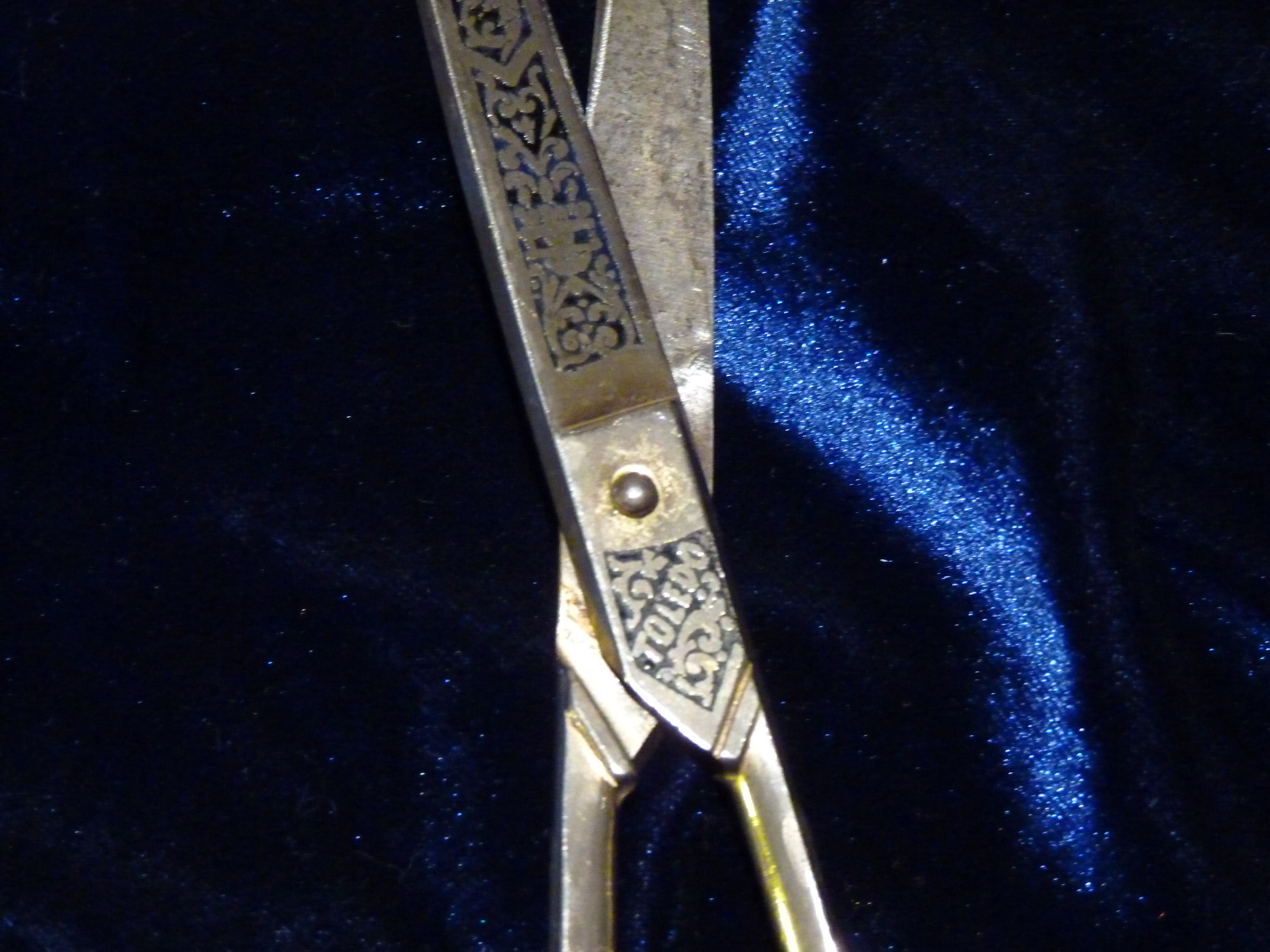
Scissors from Spain, bought in 1984.
I have a pair of scissors I bought in Toledo, Spain in 1984. Everyone knows the connection between Toledo and El Greco, but the city was also once famous for its swords. I could neither afford, nor did I want a sword, but I most definitely wanted a keepsake that would capture their essence. Every tourist shop was filled with swords and knives, and cutlery characterized by the basic inlay of gold or silver known as damascene ware. The design was different from anything I saw back home, and after much thought, I decided a pair of scissors would be the perfect souvenir. Not only pretty and unique, but functional. They were packaged in a black velvet pouch. The pouch is long since lost, but I always know where those scissors are because they define a moment in time.
I was 26. I had met a friend in Lisbon. My traveler’s checks, totally $1500, were stolen the day after I arrived. So we started out with a morning at the American Express office, but quickly got back on track and headed out to the beach in Cascais, and up to the medieval village of Obidos, and back down, and across, to Spain. En route to Marbella, I got a speeding ticket. It was ridiculous, not the ticket, but me driving since I didn’t know how to maneuver a shift. Once I got into fourth gear, I stayed there because it was comfortable, and easier, than downshifting to third. We paid the fine, and drove into Sevilla. From there, we circled Andalusia hitting Granada to see the Alhambra and the Cathedral in Cordoba. We drank sherry in Jerez de la Frontera, saw the aqueducts and a bullfight in Ronda, and moved north to Toledo, where I bought the scissors. In Madrid, our last stop, I lost my camera, but had absolutely no problem boarding the plane with a pair of scissors in my bag.
So whenever I use those scissors I am reminded of the girl and the world of 30 years ago. I was somewhat fearless and mighty trusting, because although my money was stolen, and I was stopped by a Portuguese policeman, the world seemed like a safe place. I think back and so many things were different. I always went to the post office to buy stamps because the best way to communicate was through post cards. Overseas phone calls were prohibitively expensive, and you had to find a place that had international telephone service. I was able to afford a three- week trip not just because everything was cheaper, but because I could sleep in a lumpy bed in a hostel, and didn’t give a thought to group showers with a bunch of other kids. Even losing my camera was not devastating, because I used film. The camera was gone, but not the 12 rolls of film documenting every adventure before Madrid.
Fade back to 2013. Needless to say those scissors have became dull after 30 years of use. One night, Steve was sharpening knives, so I asked if he could hone the scissors as well. Who knew a knife sharpener is the death knell of a scissor blade? They no longer cut, and I am in the middle of researching scissor sharpeners, because I can never give them up.
 The Write Side of 59