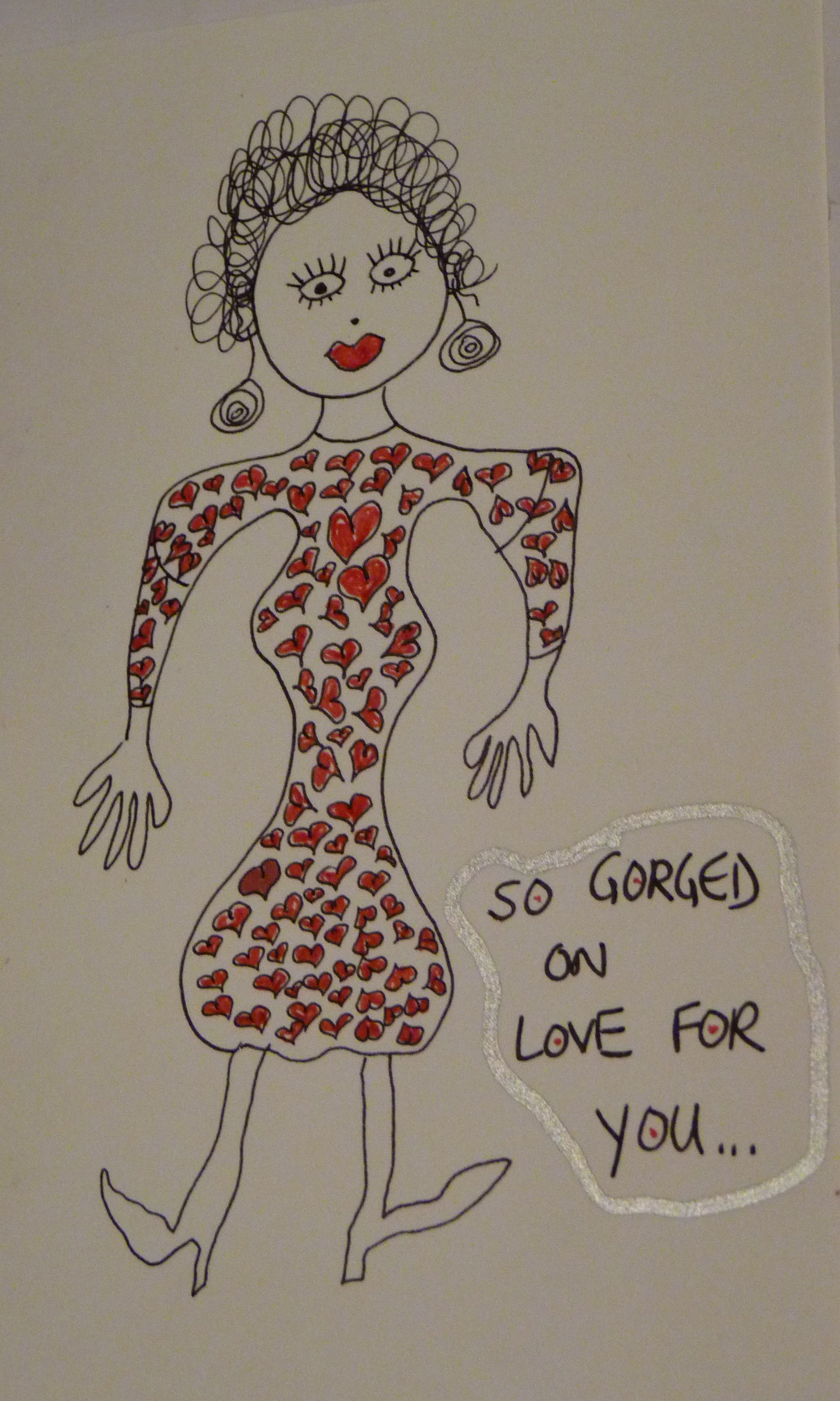
Card designed by Julie Seyler ...


14 Thursday Feb 2013
Posted in Art
Card designed by Julie Seyler ...
13 Wednesday Feb 2013
Posted in Confessional

When did guns take over our lives? As I was growing up, I do not recall that guns ever entered the daily parlance. We were obsessed with voting rights for 18 year olds (if they could be drafted they should have a right to vote), Haight Ashbury and the drug scene, the loosening of the Hays Code, and Vietnam. I do not remember a community mass-shooting, or a non-stop public outcry that there was not just a “right,” but a “Constitutional right” to own a gun. In fact, to the extent that any discussion about guns arose, it was within the context that they inevitably led to unnecessary tragedy because gun-related murders (at least most of them) were crimes of passion, rage, and anger, and had the gun not been so accessible, a life would have been saved.
Now the scene has shifted so much that the topic of guns as killing devices competes with the topic of guns as a consumer product for the masses. In the past three weeks, The New York Times has run articles on the AR-15 semi-automatic rifle, supposedly the most desired gun in America; how more women then ever are embracing gun ownership; and marketing guns to our children’s children, and this is mere icing on the cake. The question is: How, why and when did the national psyche change from a general consensus that guns were “bad,” to this new world that does not seem to even blink at marketing guns as fashion accessories. The Times article on the escalating number of women purchasers reported that pink guns are a favorite. Like the color of Pepto-Bismol. This whole idea makes me nauseous.

Pink handgun in orange handbag
Certainly Columbine, in 1999, was a major catalyst. And pile on all of the other mass shootings over the past 14 years, and you arrive at an understanding of why guns take up front, and center, stage. But I think the underlying shape-shifting phenomenon that brought the “right” to own a gun to the forefront has been the twisting of the Second Amendment. In its entirety the amendment reads:
A well regulated militia, being necessary to the security of a free state, the right of the people to keep and bear arms, shall not be infringed.
My theory is that some strategist in some gun-loving coalition latched on to the 14-word phrase, “the right of the people to keep and bear arms shall not be infringed,” to push a platform of deregulating any type of government control over gun ownership and sales. In so doing, the meaning of the amendment was distorted beyond recognition. The comma that follows the word “arms” was conveniently dispensed with and the preface about the “well regulated militia” was disposed of as an unnecessary nuisance.
There is a glaring problem in this interpretation, and I know I am flying in the face of the Supreme Court’s decision in District of Columbia v. Heller. However, one cannot divorce a phrase such as the right to bear arms from the entirety of the sentence, nor can one ignore the preamble which explains that, “a well regulated Militia” is “necessary” to ensure that we the people remain safe and secure in a “free State.” The Second Amendment sanctions a military that has a right to bear arms, not the individual’s right to bear arms.
This makes so much sense when we think about the world the founding fathers were living in when the Constitution was adopted in 1787. The colonies, as subjects of England, had fought in a bunch of wars even before the eight year battle to secure their independence from England. The militia had been indispensable to the colonies’ successful separation from King George III and his irksome taxes. They had just won a revolution so it was completely logical that the men who drafted the Constitution would have wanted to ensure that “a well-regulated militia” would be allowed to “bear arms.” They had first-hand knowledge that it was “necessary” to the security of the “free State” they had just formed and wanted to maintain. Ergo the Constitution granted the people a right to bear arms for this purpose. It wasn’t an inalienable right, like those accorded by the First Amendment:
“Congress shall make no law respecting an establishment of religion, or prohibiting the free exercise thereof; or abridging the freedom of speech, or of the press; or the right of the people peaceably to assemble, and to petition the government for a redress of grievances.”
Had the founding fathers believed that the right to bear arms was unfettered, they would have added it to the First Amendment, a simple addition, such as “Congress shall make no law restricting the right to bear arms.” But they didn’t. They drafted an entirely different Second Amendment prefaced with the phrase: “A well regulated Militia, being necessary to the security of a free State.”
So I consider the debate over the Second Amendment as the turning point and tipping point of the shift. The reinvention of the amendment has fueled the NRA. It has the Constitution on its side to relentessly and shamelessly push for unregulated gun sales and the liberty to carry a handgun into a movie theatre. It seems to me their Constitutionally sanctioned efforts are successfully ripping apart the security of our free state.
12 Tuesday Feb 2013
Tags
Concepts, Frank Terranella, Jimmy Carter, Midlife Crises, The Write Side of 50, When Harry Met Sally

Men will be boys. Photos by Julie Seyler
We’ve all heard of the midlife crisis. And if you’re in your 50s, and you haven’t had yours yet, you’re overdue. Anyway, I think that women and men have different midlife crises. For men, it usually comes with the first scent of old age. You know, the sudden inability to remember names, movie titles and even words. Or if the guy is an athlete, it’s the demonstrated failure of his body to do what it used to do. Whatever the trigger, the response is usually the same: In a vain attempt to regain their youth, men revert to behavior they abandoned in their mid-20s. They get drunk, they gamble, they buy expensive toys, and they fool around with women who are not their wives. Not everyone does all of these, but just about everyone has the inclination.
When 50-something married men begin to act like they’re single, this can be disconcerting to their wives, to say the least. But it truly has nothing to do with the wives. The inclinations don’t only hit men in bad, or tired, marriages. I think they’re primal and hard-wired into men’s brains.

Men and their games.
What separates the gentlemen from the cads is the response each man has to this inclination. Some men give in and go off for the full ride, including bedding younger women. Divorce soon ensues, and I have actually heard these men brag that, “I traded up from the 1955 model to the 1977 model.” Other men, in the immortal wisdom of President Jimmy Carter, have lust in their hearts. I will confess to being in this group.
As I get older, I have found that intimacy is what’s really important, not just orgasms. There’s nothing wrong with orgasms, it’s just that both men and women can, and do, have them without any intimacy with their partner. This is ultimately very lonely and unfulfilling. So in recent years, I have sought out intimate, non-sexual relationships with a number of women friends. This is something that women do easily without thinking about it. Women tell their women friends intimate details of their lives freely, and it’s no big deal. For men – it’s a big deal.
In the film “When Harry Met Sally,” Billy Crystal’s character is a young man who opines that men and women can never be friends because sex always gets in the way. By that he means that he believes that a guy can’t look at a woman without thinking about getting naked and having sex with her. My experience is that it’s much easier to have an intimate friendship with women in my 50s than it was in my 20s. And that’s a good thing.
My wife has been incredibly understanding as I have begun to have long meals with old girlfriends, work colleagues and a variety of other amazing women. While the conversations have at times been intimate, they have never been orgasmic. I have been proving Billy Crystal wrong for a decade.
In many ways, I think it takes until he’s in his 50s for a man to grow up. The midlife crisis is like a second puberty. The trick is to get through it without making a fool of yourself. And as we all know, there’s no fool like an old fool.
11 Monday Feb 2013
Posted in Concepts

In Dad’s MG, circa 1960.
Cars have been on my mind lately. It started because I saw an article in the Sunday Times a couple of weeks ago about a car auction. But it wasn’t any old car auction. This one featured autos with provenance – like a purple 1919 Pierce-Arrow, owned by the silent film star, Fatty Arbuckle, and a 1941 Packard, owned by the ice-skating actress, Sonja Henie. These cars were gorgeous.
Then I was talking to a friend of mine, who was in the middle of multiple car transactions, like selling two cars (including a beloved sports car), and simultaneously buying a new, used, practical car. He was doing everything over eBay. It was natural for our conversation to segue from cars we “loved” to cars we “hated.” We ended the conversation with the conclusion that everybody has an opinion about cars, even if their opinion is, “no opinion.”
It’s true. I know people who only want to be behind the wheel of an automobile that makes them “feel like they are driving a living room couch,” and others who are passionate about their hybrids (especially the gas-to-mile ratio), and some who just love the majestic height afforded by an SUV. Me? I have always cottoned to small cars with convertible tops.
After all these car musings, I started pondering whether one’s car preferences has anything to do with one’s past? Most people would probably say their car decisions are purely arbitrary, or simply pragmatic, but I am sure there is a Proustian component to my predilection for two-seater convertibles.
Fifty years ago, when I was a kid (just saying that phrase, “50 years ago,” cracks me up – can those words actually be coming from my mouth as an accurate statement of fact), I did pop about in an MGTD. My father, a true-blue sports car devotee, would squeeze me and my sister, and our two Chatty Cathy dolls, into the trundle seat of his MG, and off we’d go up the Garden State Parkway, through the Holland Tunnel and over the Brooklyn Bridge to visit my grandparents. The top would be down, of course, and the wind would fly through our hair. I can’t imagine anyone with a four year old and a six year old contemplating a journey like that today. We live in a world where car seat safety dominates.
In any case, perhaps it is because of those early road trip memories that I love two-seater convertibles. The wind in my hair never gets old. So, while I was reminiscing about the “old” days, I asked my dad what other cars he owned. He replied:
We had a few MGTDs 1950s; also MGA 1960; also MGB 1962; Corvettes – three of them, 1964s. When you were a baby in Fort Lee, we had a ’52 Morris Minor. Grandma made a convertible top for it. I forgot to mention our 55 T-Bird convertible with the hard top.
They were all small, two-seater, convertibles, except maybe the Morris Minor. Not sure if he, too, loves the wind in his hair, but the car genes were passed down.
09 Saturday Feb 2013
Posted in Art

Fire escape on 2nd Avenue after February 8 snow storm. Photo by Julie Seyler.
Waking up after a snow storm is like waking up on your birthday. You never know what to expect, but you know it’s going to be something good. That first sight of a snow-topped landscape is something good. At this point, the city and its environs are covered in a pristine white velvet blanket. It may devolve into a muddy slush, but to not appreciate its infancy is definitely not an option. Here’s to the first hour of the first day after a snow storm.

The backyard. Photo by Lois DeSocio.
08 Friday Feb 2013
Tags

Drawing by Julie Seyler
So many mysteries seem to descend on the right side of 50 body. You know, that icky age spot that pops up on the left hand; the appearance of a clump, not a strand, of gray hairs, dead center on your head. And those bags of flesh hanging just below the armpits. Lovely! We think this drawing basically sums it up.
07 Thursday Feb 2013
Posted in Confessional, Men
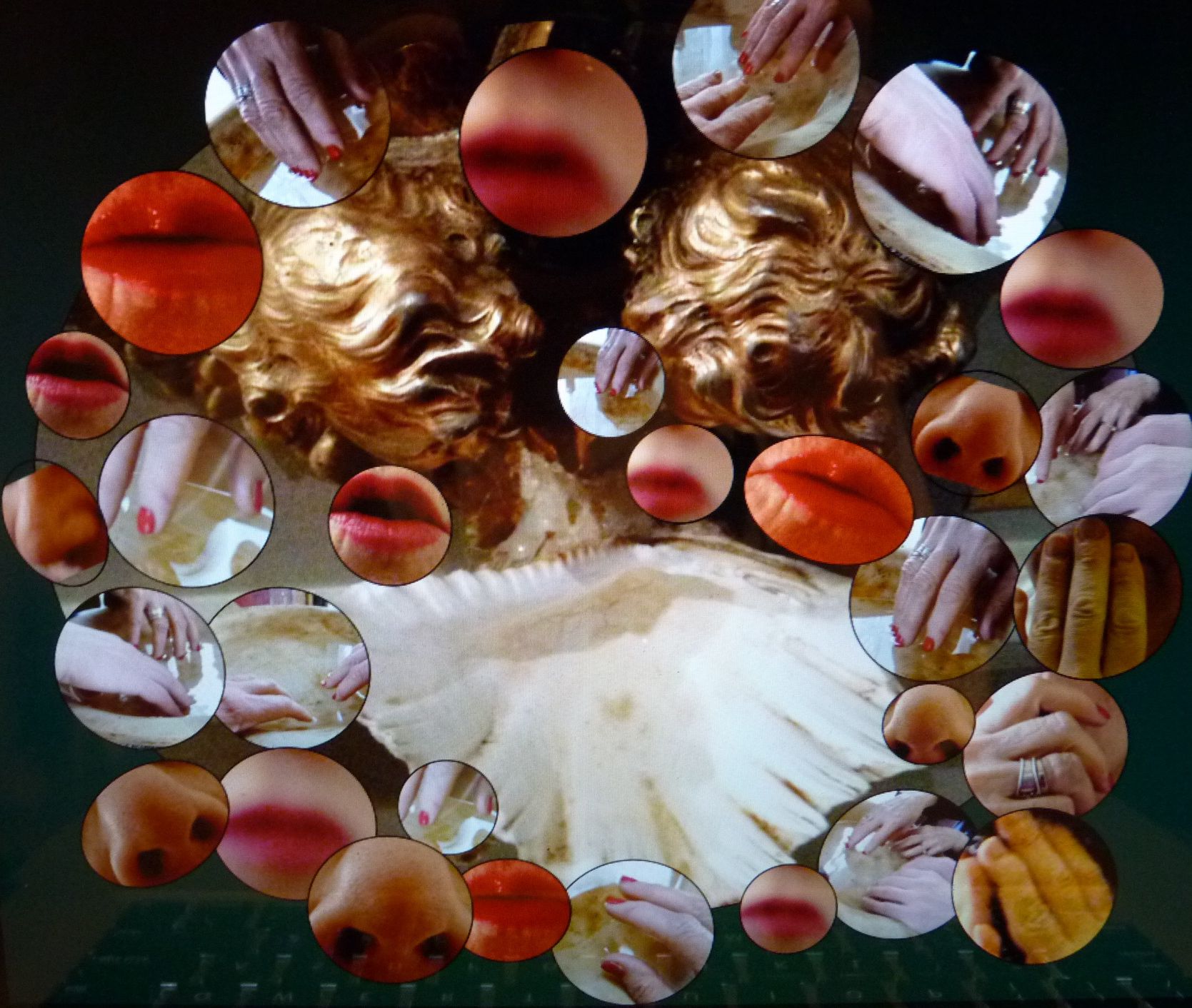
Noses and mouths and hands (oh my!) fly around the font at St Agnes Church. Photo collage by Julie Seyler.
With the flu at epidemic levels, and as I edge closer to the “over 65” at-risk age group, I’ve become a lot more careful. Of course, I’ve been getting the flu shot – and not the flu – for the last 10 years. But there’s always a chance. So I also obsessively wash my hands, like Lady Macbeth, twelve times a day, and avoid sick people – which includes skipping the infection festival at Sunday mass.
The facts: flu virus can survive on surfaces for anywhere from a few minutes up to 48 hours or more. It also tends to live longer on hard nonporous surfaces, and it thrives in wet environments.
Glued to the wall next to every door in our church is a stone finger bowl filled with holy water. As worshipers enter, they dip the potentially germ-smeared fingers of their right hands into the water and bless themselves by dabbing their foreheads and both shoulders. The font is hard, nonporous marble, and because of splashes or drips from sloppy blessers, the area around the bowl is always a wet environment. Essentially, the holy water fonts are flu ponds – grab a dose, anoint your face and body, and take a seat.
Another fun fact: It’s easy to catch the flu or a cold from rubbing your nose after handling an object an infected person sneezed on a few moments ago. But personal contact with an infected person — a handshake, for example — is the most common way these germs spread.
Guess what? Later in the service you’re expected to extend a sign of peace by shaking hands with the people surrounding you in your pew – who just a few minutes ago dipped the fingers of those hands into the flu ponds. Last week, as I dozed through the sermon, the woman directly behind me hacked and wheezed every couple of minutes – clearly an infected person. Out of the corner of my eye I saw her coughing into her right hand. When the “sign of peace” came, I simply ignored her. Let someone else give her peace by taking the flu off her germ-laden hands.
Then there’s the ritual of dispensing wafers that represent the body of Christ. Apart from the priest, the wafers are handed out by Eucharistic ministers – regular churchgoers who have been deputized to dispense communion. Given their dedication to service and the faith, I’m sure these good folks both dip in the flu pond upon entering church and enthusiastically glad-hand everybody in their pew during the sign of peace.
After all that infectious fun, they use that hand to pick up a wafer and place it in your palm. If you’re really old school, they’ll slap the wafer directly onto your outstretched tongue. Either way, I suspect that any flu virus hitchhiking on their hands will readily transfer over to you, and vice versa.
Finally, there’s the (hard, nonporous) silver goblet of wine offered to anyone that wants a sip after they eat the wafer. Fifteen people or more may take a swig before it’s your turn, so the server (another Eucharistic minister) passes a linen napkin across the damp rim of the goblet after each sip, presumably to wipe off germs. But after more than a dozen swipes, isn’t it just as likely to wipe germs onto the goblet as it is to wipe them off?
And do I trust the wine in the goblet to somehow disinfect the rim? Not really – the area below the rim isn’t coated with wine, it’s only been touched by the damp lips of devout sippers. As I look around the church, I ask myself: “Would I want to kiss all these people? No. Then why on earth would I drink from that cup?”
So I refuse to dip in the flu pond. During the sign of peace, I flash the peace sign from afar, and I entirely eschew communion and the goblet of germs. Better safe than holy.
06 Wednesday Feb 2013
Posted in Art, Confessional

“The fascination of beauty.” Collage by Julie Seyler
I live in Manhattan, and am surrounded by gorgeous women of all ages. But my eye gravitates towards those younger than me, who can still traverse the city streets in 7″ heels, completely oblivious to foot pain. Their wrinkle-free skin holds the dewy blush of infinite confidence. The world truly is their oyster, or at least that is what I choose to project onto them as they stride down the street, smartphone in hand, laughing jauntingly on their way to Thursday night happy hour.
I was her once. But alas, no more. At a time long prior to now, could I ever really imagine that one day I would be 57? Approaching 60? It was much too far away, and in my mind, it was not going to happen. I would stay stuck in whatever year I happened to be immersed in at the moment.
I am ashamed to admit it, but there are times when envy for “their” current youth smacks right up against wistfulness for “my” long lost youth. At those precarious moments, I take gleeful pleasure in singing to myself a la Audrey Hepburn in “My Fair Lady,” “Just you wait ‘enry ‘iggins, just you wait.”
That small, petty part of me just needs to secretly and quietly cackle:
“Ha, ha, ha. One day, you flawless flexible soul of youth, will be here – on the right side of 50. And you’ll also wonder where it all went, and how did it go so fast?”
05 Tuesday Feb 2013
Posted in Confessional, Men

Photo by Julie Seyler.
In 1953, when I was born, my life expectancy was 66. That’s why, back in the 1950s, when my grandfathers quit working, most people were retired by age 65. The American Association of Retired Persons (AARP) admitted members at age 50. Today, my life expectancy is 83. Those 17 extra years are literally life-changing, and quite significant for retirement planning. This year I will turn 60. And rather than consider retirement as my grandfathers did at this age, I am looking forward to at least another decade of work. I can’t imagine retiring in my 60s. That’s the difference the extra 17 years of life expectancy have made.
Yet the world has not adapted to the longer life expectancies.The AARP still admits members at age 50. Senior citizen housing is available at age 55. Most senior citizen discounts still kick in between 60 and 65. Perhaps this is a subtle hint for us baby boomers to step aside and make way for the younger generation to move into our jobs. But I have a problem thinking of myself as a senior citizen at age 60 because there are still members of my parents’ generation alive and well in their 80s and 90s. Those are the real senior citizens – the Greatest Generation. People in their 60s and 70s are perhaps juniors. That makes 50-somethings just sophomores in the school of life.
So with almost another quarter century until my life expectancy age, I have no intention of slowing down. It’s full speed ahead into my pre-retirement. The only thing I hope to do is begin retirement saving in earnest. But that will be tempered by all the vacation traveling I hope to do in the next 10 years. My wife and I already have the next five years of trips mapped out. This is really my idea of a hedge against not making it to retirement. For someone like me who has had heart disease and cancer, it’s more important to live life than to save for retirement.
Actually, as long as I can take frequent vacations, I see no reason to ever retire. I’ve seen retirement, and it didn’t look like fun for my grandfathers. It was just a lot of television. I would much prefer to be useful every day and earn a paycheck. Maybe I’ll revisit the issue of retiring when I hit 80. But I doubt that it will be attractive even then. I think that our generation may actually retire the word “retirement.”
04 Monday Feb 2013
Posted in Confessional
Tags
Asbury Park Boardwalk, Casino Coffee Shop, confessional, Convention Hall, Lois DeSocio, Long Branch, Planters Peanuts, The Write Side of 50, Yvonne's Rhapsody in Blue and Rendevous Lounge

I believe the truisms (“share,” be “fair,” be “aware of wonder,” and “don’t hit people,” to name a few), as noted in Robert L. Fulghum’s book, “All I Really Need to Know I Learned in Kindergarten,” to be spot-on advice on how to grow into a decent, content, and essentially happy human being.
Add to these, the scholarship that comes with those early working years. Those first jobs. They not only may help you pinpoint what you want, or don’t want, to do when you grow up, but if you pay attention, they are also ripe with opportunities that can grant you what we all need to be decent at, content with, and essentially happy with our career choices.
For me, I knew in third grade that I wanted to be a writer. But I worked my way towards today through more jobs than I can count.
So here’s my short list of the basics on working as a writer, and how I got them:
Low wage: Those of us who grew up in Asbury Park in the 1960s and 1970s spent summers working on the Boardwalk. I did it for 10 years, starting at 14 years old as a counter girl at The Miramar Grill in Convention Hall. This was my induction into hard work at low pay. But it was also my premier tutelage in how to make my pennies count and get more for my money. After work, I would glom on to the 16 and 17 year old employees that would sneak through the secret tunnel alongside the restaurant and got us into neighboring Convention Hall during Led Zeppelin and Janis Joplin concerts for free.
Check your ego at the door: The next summer I moved across the hall and was Mr. Peanut at Planters Peanuts. I spent hours waving people in to the store with my unwieldy peanut head. Everyone who worked there started out this way, and if you were a cracker at being a peanut, you were eventually promoted to selling them inside the store.
Don’t cry when your editor yells at you: My three summers at the other end of the Boardwalk as a waitress at the Casino Coffee Shop is where I learned to be nice to people who weren’t nice to me. I would suck it up when the cook yelled that the food was getting cold, when the customers yelled that the food was cold, and when the boss yelled if I forgot to drip those three partially-used ketchup bottles into one at the end of the day.
Be honest: And it was also at the Casino Coffee Shop where I switched from concert-sneaker to concert-companion by treating the rock stars that performed at the Casino across the way, and regularly came in to eat, like rocks stars, so they would put me on their guest lists. (Leslie West, from Mountain, gave me a plastic, “World’s Best Waitress” trophy.)
Pay attention to details: After college, I moved down Ocean Avenue and worked as a waitress at Yvonne’s Rhapsody in Blue and Rendevous Lounge in Long Branch. Yvonne – owner, chanteuse, and drummer – would bang the drums set up in the corner of the dining room, and would throw her drumsticks into the crowd when she was done. Patrons that were upset with the near-miss-to-the-head would have been more unnerved had they known that the chef’s cigar ashes that would continuously bend towards, and then garnish the food, were accompanied by Yvonne’s fingers poking through every plate before it left the kitchen. I noticed that the clientel that hung out in the lounge under the restaurant had deeper pockets, and therefore tipped well. And there were no drums, no food, no Yvonne. I asked to work there, where I learned to chat up the mobsters that were regulars, like Anthony “Little Pussy” Russo, who took a liking to me, tipped up to 40 percent on his bills, and gave me an extra $20 bill if I would get him cigarettes from the machine.
Give people what they want, and deliver it reliably: I spent a summer as a bartender at a huge club – The Fountain Casino – where my constant attention in both mixing the drinks (a little extra booze), remembering what the regulars wanted (had it ready when they walked through the door), and smiling and winking at the inebriated, had them coming back for more, and made me more money in tips than I had made in any other job before that.
Work on deadline. Accept heaps of rejection. Be clear. And just say it already!: Short on length, but long on lessons learned – I sold encyclopedias door-to-door for one month in Hackensack. I had seconds to sell myself, and those books that nobody wanted. What began as a five-minute, carefully-chosen, beautiful, wordy spiel, turned into a one-minute, bordering-on-begging sales pitch, because people were slamming the door in my face.
Interviewing chops: I worked my way up to credit manager for a contractors supply company in my mid-20s. I spent the bulk of my day on the phone asking big wigs to pay us, please.
And sage instruction, no matter what:
Throw yourself out there, no matter your age, and do things that are really hard : I went back to school at 54 years old.
Learn how to move on when the best job in the world ends: My kids grew up.
 The Write Side of 59