
Santiago, Guatemala. December, 2010. Photo by Julie Seyler.
Not Manhattan transit.

08 Saturday Jun 2013
Posted in Art
Santiago, Guatemala. December, 2010. Photo by Julie Seyler.
Not Manhattan transit.
04 Tuesday Jun 2013
Tags
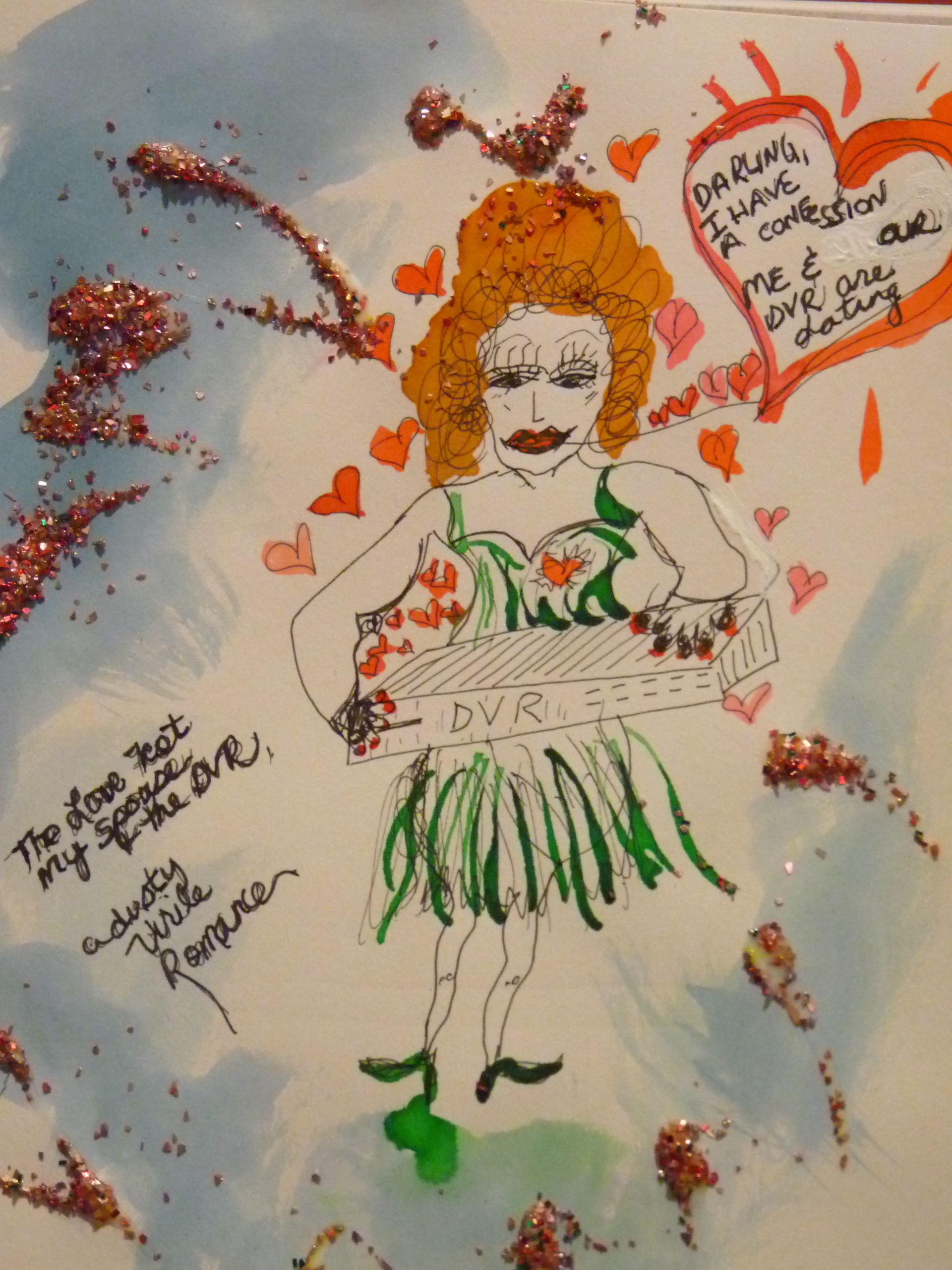
Darling, I have a confession. Me and the DVR are dating. By Julie Seyler.
Modern video technology has revolutionized the way we watch television. The digital video recorder (DVR) has made it so easy to record television that many people no longer watch anything “live.” It’s easier to watch later (even just 20 minutes later), and then zip through the commercials.
This has had two unanticipated social repercussions. First, since most people do not watch television when it is broadcast, it’s no longer possible to have water-cooler discussions at work of the previous night’s programs because many people have not yet watched them. And a related phenomenon is the new form of marital infidelity called “video cheating.”
What is video cheating and how serious a problem is it? Video cheating is watching a show alone rather than waiting to watch it later with your significant other. How serious a problem is it? Oh, it’s very serious. It’s a sign of pure selfishness, like finishing the last of the chocolate ice cream without offering to share it.
Back before video recording, we all had to watch the shows live or not at all. We all found out together who shot JR. You either were in front of a television set on Tuesday, August 29, 1967, or you missed the series finale of “The Fugitive,” and probably still don’t know the fate of the one-armed man. The VCR brought some freedom from the network schedule, but the DVR made recoding shows to watch later (so-called “time shifting”) a way of life. And so today, we rarely ever watch live television except for sports and news.
But with great power over the television viewing experience came great responsibility. The shows you formerly watched together with your spouse now could be watched without him or her. This led to a silent pact wherein each partner agreed to wait for the other before viewing so that the former live TV sharing experience could be replicated. While the rest of the world was on week five of “Mad Men,” in our house, we could be on week four, or even week three. But as long as we watched it together, it didn’t matter.
Breaking the pact could be as simple as watching the show live while your spouse is out. The absent spouse comes home, and the following scene is played out:
Spouse 1: “You missed a great episode of ‘Burn Notice.’”
Spouse 2 (voice rising): “What do you mean I missed it? We’re supposed to watch that together. Why didn’t you wait for me?”
Spouse 1 (apologetic): “I’m sorry, the DVR changed the channel I was watching and started recording ‘Burn Notice.’ What did you want me to do, shut off the TV?”
Spouse 2 (outraged): “Yes!!! That’s OUR show. You can’t watch it without me. What’s wrong with you?”
(Spouse 2 storms out of the room to pout.)
Video cheating – it’s a terrible thing that technology has wrought. And don’t get me started about spouses hijacking the Netflix queue and refusing a friend request from their spouse on Facebook. It’s a miracle the divorce rate isn’t 80%.
03 Monday Jun 2013
Posted in Travel

Route 340, Lancaster County, Pa.
This past Memorial Day weekend, Steve and I took a trip to Lancaster Pa., aka Pennsylvania Dutch Country, where some of the Amish still dress in traditional garb and wield horse-driven carriages down Route 30:

Amish Carriage.
One friend immediately replied, “BORRRING!” Another waxed passionately on the merits of a local restaurant called, “Good ‘n Plenty.” We envisioned quaint colonial towns, and restaurants brimming with local farm fresh produce. What we did experience was not boring, but neither could it be called dynamic. Rather, our three-day sojourn in Lancaster can be viewed through two separate lenses: On one side of the frame is an image of the canned string beans served at Good ‘n Plenty – limp and dull. But what one sees through the other lens, is best summed up by the landscape – flat, but filled with a quiet lushness, and richness of color that screams beauty.
Saturday, the day we arrived, we spent trolling Route 340 in Intercourse. It is a town inundated with front yard garage sales, standard souvenir shops selling mass-produced chochcalas, and boutiques decked with only the finest handmade quilts and textiles.
(The area is also dotted with lots of poetically phallic silos):

Landscape. Pennsylvania Dutch Country.
My first reaction to the boutiques was anticipation – I love to shop when I visit a new place. But by the time I stepped into the third quilt shop, I was a little numb. So it was definitely time for a beer. We stopped at a local brewery called the Rumspringa, enjoyed a couple of stouts, bought souvenir glasses, and headed into Lancaster, the capital of the United States for one day in 1781, and now known as the oldest inland city in the United States. Not a whole lot going on in downtown Lancaster on a Saturday in May. But there were lots and lots of brick buildings that were quite lovely when seen basking in the late afternoon sun:

Sunset light in Lancaster, Pa.
A local recommended dinner at a restaurant called The Belvedere Inn. It was good. The chef came out to chat with us, so we asked him for suggestions for Sunday, as we were a little lost on a game plan for the next day. He thought Muddy Run State Park, where we could rent row boats, and tour the reservoir might be interesting. So on Sunday morning, after a hearty breakfast, and a tour of the farm we were staying at, we headed off to sing, “Row, Row, Row Your Boat.”

Rowing on the reservoir.

I want a tractor.
Then it was time for another brewery – this time Stoudt’s in Adamstown. Adamstown, like Lambertville, N.J., and Hudson, N.Y., is renowned as one of the premier antique shopping meccas in the Eastern United States. We walked through one of the markets filled with old lamps, tables, headboards, china, flatware, paintings, but weren’t really in the mood to peruse, so we headed back into Lancaster. Sunday afternoon was more dead than Saturday, so we wandered through the cemetery of the St. James Episcopal Church:

The next day we decided to visit Longwood Gardens on our way back home. In 1906, Pierre S. DuPont, a scion of the DuPont family, purchased a modest farm for the sole purpose of conserving, and protecting the surrounding woodlands. Ultimately, it morphed into a public garden. It was spectacular:

The Water Garden.

Cricket on white flower.
All in all, the weekend was mighty fine. But we probably won’t ever go back to Lancaster, Pa. Except with a U-Haul for antiques.
31 Friday May 2013
Posted in Confessional

“Mirror mirror on the wall? Am I old?” By Julie Seyler.
Age is a fascinating racket. At 30, I wailed I was old. That seems like such a quaint thought today. There are those who say age is merely a number, and has to nothing to do with anything. I disagree. Age is a measurement; a tool we use to mark the passing of time when we are shocked that we graduated high school 40 years ago. So I play the age-boggling game.
For example, I have a friend that I have known since I was 12, when we both had Miss (this was an era before Ms., when one was either a Miss or Mrs.) Isaacs for 8th grade history. My friend just became a grandmother for the second time. This makes no sense to me because it was yesterday when I was taking pictures of her pregnant with the daughter that just gave birth for the second time around. My girlfriend, through my eyes, looks exactly like she did when we were on the cusp of becoming teenagers. Her daughter, who for me stands as a symbol for the child-bearing generation, also looks like a teenager, but not a grown-up teenager in the way I thought we were. Rather, I see her as a teenager playing house. But she’s not – she is an adult woman raising two children with all the responsibilities that goes with that. My girlfriend is now cast in the role of Nana. And that’s one mind-boggling aspect of the aging process.
Another mind-boggling aspect of the aging game is what does “old” look like? I see a woman who looks older than me. Why do I think that? When I look again, and try to pinpoint her age, I realize, “Whoa, she may be younger than me. Or maybe only 60, tops. And that’s only two years older than me.” That means to a stranger I, too, may look that old. Ergo, “old” is a mere perception conjured from the point you are at any given time. I still remember my French teacher in 9th grade. She was so old. She was 24. But then, I flip it, and figure I bet I still look pretty “young” to my 85-year-old buddy, Alan.
Some, like Lois (aka,Lola), fabulously defy the fact that they may be getting old. For me, a documenter, analyzer, and dissector of every stage in life, I just want to make sure I embrace “now,” because one day I may really be “old.”

Julie, at the Cape of Good Hope. May 29, 2011.
28 Tuesday May 2013
Posted in Confessional

Allenhurst in the a.m. All photos by Julie Seyler.
BY JULIE SEYLER
Is it accurate to state that we on the right side of 50 can automatically conjure up that scene from “The Sound of Music” when the seven Von Trapp children are jumping off their beds while Julie Andrews, aka Maria, is trilling “Raindrops on roses and whiskers on kittens?”
I am not saying the vision conjures up the same feelings – there are those who embrace that movie, and those who disdain it. But what I am saying is that it is a cultural set-point of the mid-60s. Because of that scene, and that song (and nobody but nobody does a better interpretation of “My Favorite Things” than John Coltrane), I love to think about, and make lists of my favorite things – many of which have changed; others of which have stayed the same.
So something like sitting on the beach before the crowds arrive, watching the sea slurp in and out, and the gulls swoop up and down, is a no-brainer favorite thing since way before I started coasting past the half-century mark. However, a super-chilled gin martini with a single olive on a Saturday evening is a new favorite thing – the gin factor making it “new.”

Frosted.
But the best-of-all favorite thing evolved soon after I became a pasta addict in 1986 following a trip to Italy. The favorite part is not simply eating spaghetti, it’s eating spaghetti at 6 a.m. on a rainy Sunday morning with a glass of fermented grape juice.

Spaghetti for breakfast.
25 Saturday May 2013
Posted in Art

Green stairs on 21st Street. Photo by Julie Seyler.
This stairwell with rusting, lime-green steps, and a cherry-red bannister leads to the basement of a building on 21st Street. The tiled checkered floor evokes a time long past. Against a steel-gray, mesh window guard and white painted brick wall, everything is amiss. And yet it all fits together.
21 Tuesday May 2013

All photos by Julie Seyler.
If anyone has a chance to get up to the The Cathedral of St. John the Divine at 112th Street and Amsterdam Avenue by July 29, there is an exhibit up called, Jane Alexander: Surveys (from the Cape of Good Hope). It’s visually mesmerizing and provocative. If you decide to go, check the Web site because accessibility to the the show is limited.
Upon entry to the cathedral, head straight to the back right chapel named after St. James. There is a slideshow presented of black and white photos of the South African landscape, and the city of Cape Town. It contributes to appreciating the fantastical anthropomorphic animal humans Ms. Alexander constructs out of fiberglass. But it is not simply the figures that intrigue, it is how and where they are placed in space. Each scene is staged in a different chapel.

Infantry, 2008-2010.
The fact that a show evoking both the primal anger of wild animals, and the connection between all “different” types of people, fits seamlessly into the majestic and spiritual chapels of a 19th century cathedral is a testament to the artist’s vision that the world – segmented, divided, and scary as it might be – is, nonetheless, woven together as a whole.

African Adventure, 1999-2002.
I kept running back and forth and back and forth between the various chapels trying to absorb the work, and commit it to memory. It was fabulous!
But even before I entered the cathedral doors, I had encountered unexpected pleasures. Like 527 West 110th Street – a building festooned with human gargoyles, each separately depicting some unpleasant characteristic of the psyche. They were carved out of stone, and hung as appendages on the building’s facade:

Mistrust.

Greedy.
Then I came upon the cathedral complex, which consists of the Synod House:

Doors into Synod House.
And a green knoll known as the Pulpit Green, where a pure, white, peacock struts his stuff for the camera gawkers:
 And then I was in the middle of Europe facing a cathedral built in the mode of Notre Dame in the middle ages. It is vast and domineering. It is somewhat difficult to capture the fullness of The Cathedral of St. John the Divine, a “chartered house of prayer for all people” erected in 1892.

Trying to take in St John the Divine.

Rose Window.
16 Thursday May 2013
Posted in Concepts

Sigmund Freud and Montgomery Clift. By Julie Seyler.
Does anyone remember coming home from school and turning on Channel 9 at 4:00 to watch the Million Dollar Movie? When I was in my Clark Gable movie phase, I was able to catch a myriad of his pre and post “Gone with the Wind films” like, “Test Pilot” with Myrna Loy, and “China Seas” with Jean Harlow, while lying on my flower bedspread eating forbidden potato chips. But this was not the only station where we could indulge ourselves in Hollywood fantasy. Before Turner Classic Movies, there was also NBC Saturday Night at the Movies inviting us to an evening of at home entertainment. Anyway, this is a long-winded segue into to a movie I discovered when I was about 12 or so.
I remember it was a Saturday evening, and I was home babysitting my younger sisters. After the Swanson’s Turkey TV dinner (the ubiquitous fare on nights when my parents dined out), I settled in to watch the movie of the week. It was “Freud,” which I just learned was directed by John Huston. It starred a bearded Montgomery Clift as Dr. Sigmund Freud. The plot revolves around a woman patient riddled with issues – she is repressed, depressed, and hysterical but there are no physical symptoms that can explain her illness. Freud takes her on as a patient and after two hour’s worth of hypnosis, and lying on Freud’s famous couch, she is cured. Freud’s theories of the unconscious have helped unlock her buried memories and released her from emotional bondage so she can blossom again in the world. Hollywood schmaltz, no doubt, but it turned me on to the power of dreams; the notion that childhood events can shape one’s psyche. And rehashing it all can be a wondrous experience. A few years later, this was confirmed when I saw, “The Three Faces of Eve” with Joanne Woodward’s academy award winning portrayal of a woman with three separate and distinct personalities that had sprouted in response to a traumatic childhood event. Two hours later, she is completely cured by Lee J. Cobb.
These movies simplistically collapsed psychological theory into a 120 minute drama, but the message they contained – that the hidden psyche is a complex and perplexing phenomenon – resonated for me as a teenager. I cannot say that all these years later I have changed my opinion much.
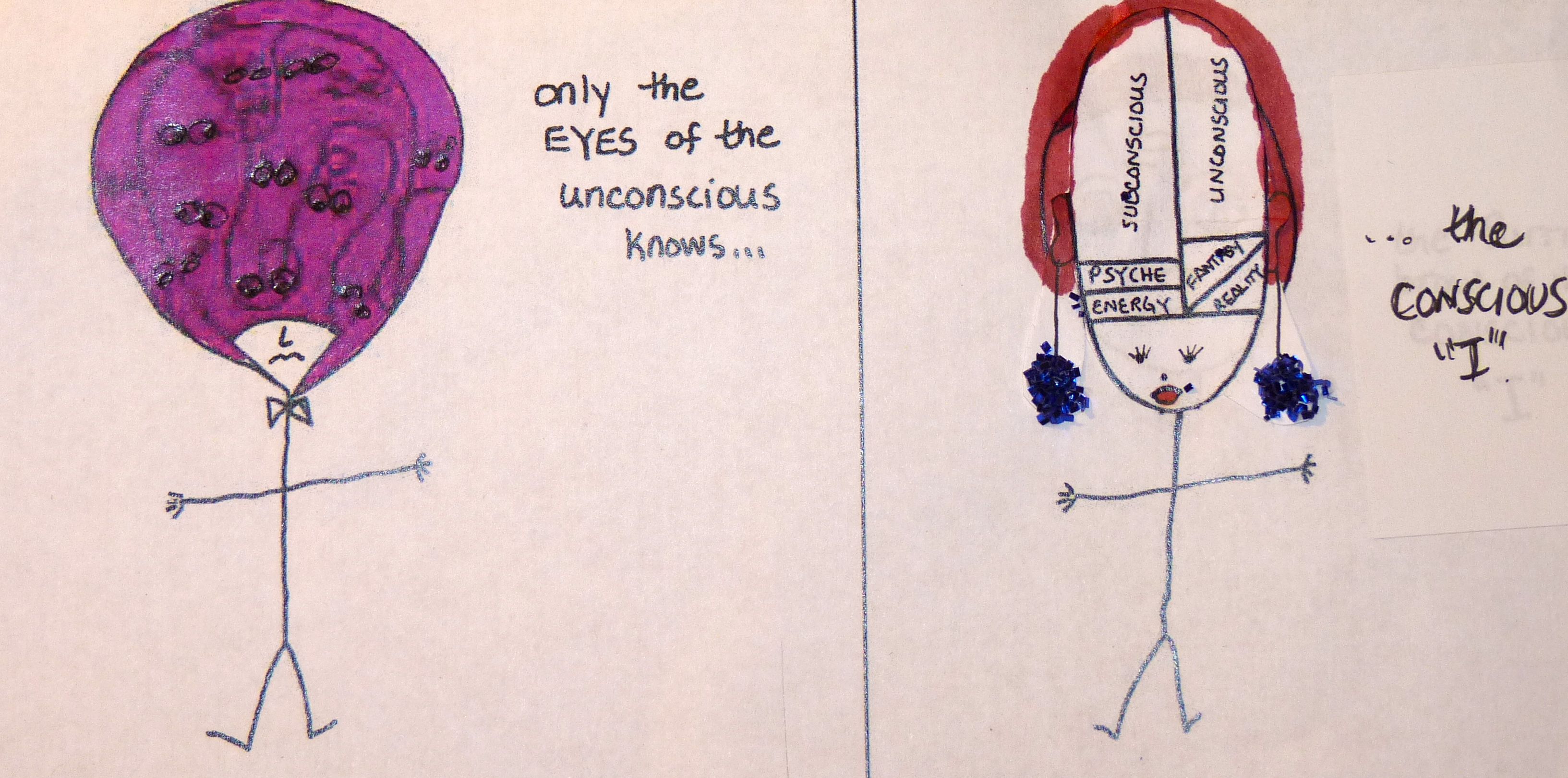
Did the movies lead me to embrace the phenomenon of the psyche? I mean, Montgomery Clift as Freud is a pretty sexy role model. Or was I destined to discover the curious case of the unconscious mind, regardless. It does not matter. I remain a firm believer that the unconscious is way more powerful than what we think we “know.” In fact, I think if scientists could figure out a way to harness the unconscious, the energy problems of the world would be solved.
14 Tuesday May 2013

Flying in style, back in the old days. By Julie Seyler.
A lot of what makes those of us on the right side of 50 special is the fact that we can remember the world of 50 years ago. There is an advantage to being able to take the long view of current events. For example, I think that we are uniquely situated to see the broad pendulum swing of majority political thought from the liberalism of the 1960s to 21st century conservatism. If you’re in your 30s, you have never experienced a world where liberal thought was dominant. It’s only when you’re as old as we are that you have the perspective in which to view debates about universal health care, gay marriage and equal rights. We have lived in a world where a president from Texas enacted government-provided health care for senior citizens. That same Texas president signed into law sweeping civil rights legislation that transformed America. With a stroke of the President’s pen, it became illegal to discriminate in employment and housing on the basis of gender or race. You have to be on the right side of 50 to remember classified advertising in newspapers where the columns were headed “Help Wanted – Male,” and “Help Wanted – Female.”
Contrast that with the current political climate out of Texas. Governor Rick Perry would consider President Johnson a socialist. No one under 50 can remember a time when Texas was a solidly Democratic state. They can’t imagine a time when that might happen again. But we on the right side of 50 know that the pendulum that swung all the way to the right can just as easily swing back to the left. Look at Vermont. In 1936 it was one of only two states that FDR did not carry (Maine was the other), and today Vermont is a bastion of liberalism.
I bring all this up because I recently traveled to Dallas and, like my colleague Bob Smith, visited the old Texas School Book Depository that is now a museum built around a crime scene. I walked through all the memories of that time.I choked up again as I watched Walter Cronkite report the president’s death. It brought me back to that time, nearly 50 years ago, when America lost its innocence. Just as 9/11 changed America forever, so, too, did November 22, 1963. But you have to be old enough to remember pre-assassination America in order to understand how profoundly this event affected the American psyche. The world depicted so accurately on the television series,”Mad Men,” disappeared by the end of the decade.
And nowhere is the change so apparent than at our airports. First off, in 1963, only a small fraction of Americans traveled by air. People routinely took the train to Florida, and the ship to Europe. Those who did travel by air were treated to an elite world of privilege with stewards and stewardesses (terms borrowed from the world of luxury steamships). Air travelers could walk directly to their gate without passing through any security. Then came the first hijackings to Cuba, and with it came the first metal detectors. And of course, after 9/11, airports became a world of shoeless, beltless passengers being patted down by Homeland Security agents.
On my flight out to Dallas the captain made an announcement that one of our female flight attendants (no longer stewardesses) was on her last flight after 49 years on the job. That’s right, this woman began as a stewardess for the now-defunct Eastern Airlines in 1964, and after that company folded, she moved to American Airlines. The entire cabin gave her a round of applause as she and her beverage cart made the final victory walk up the aisle. And while watching at this youthful-looking woman, who has to be older than me, I wondered what stories she could tell of her 49 years in the air. She began work at a time when airline passengers were a pampered elite, and lived to see the era where passengers have to pay for a cookie. This woman has perspective on air travel – the kind of perspective that comes with long experience.
And so I guess what all of us on the right side of 50 can claim is perspective. We can see the forest, not just the trees. Maybe there is wisdom in age after all.
13 Monday May 2013
Tags
Abortion, Harry Blackmun, Julie Seyler, News, opinion, Roe v Wade, Ruth Bader Ginsburg, Supreme Court, Texas, The Write Side of 50, United States Supreme Court

“The Inside Story.” Oil on canvas. Julie Seyler
In 1973 the United States Supreme Court issued its decision in Roe v. Wade. Forty years later, while speaking at a symposium at Columbia Law School, Justice Ruth Bader Ginsburg opined that she was not sure that the time had been right for the country’s federal judiciary to legalize abortion. I was surprised that a liberal of the current court would question the rightness or timing of that decision.
The social discussion of the 1960s and 1970s was imbued with an understanding of the horror wrought on women, who, for social or economic reasons, could not afford to raise a child. Perhaps she was 18, and had just gotten admitted to college. Would it be fair to her to abort her opportunities because there was not sufficient information available about birth control? Or what if she was 40, and already had four children, and her husband made barely enough money to feed and clothe a family of six? What could they do if they became a family of seven? The law punished women by forcing them into dirty rooms in back alleys where men with wire hangers or venomous liquids would help terminate the cells that were starting to gel. There was guilt and shame and illness, and it was society’s morals, not society’s interest in public health, that governed what was legal. I remember debating the reasons for and against abortion with my friends, teachers and family.
Then in 1973, the decision came out. I recently reread the opinion of the court in its entirety. I stand in awe of this brilliant tripartite balancing of a woman’s right to privacy against the right of the state to regulate the health and safety of its citizens.
The case came before the Supreme Court because an unmarried, pregnant woman had sued the state of Texas on the ground that the law, which made it a crime to terminate a pregnancy unless the mother would die, was unconstitutional.
Just for a minor peek at how the Court addressed the topic, I quote from the opening paragraphs of Justice Blackmun’s opinion:
“We forthwith acknowledge our awareness of the sensitive and emotional nature of the abortion controversy, of the vigorous opposing views, even among physicians, and of the deep and seemingly absolute convictions that the subject inspires. One’s philosophy, one’s experiences, one’s exposure to the raw edges of human existence, one’s religious training, one’s attitudes toward life and family and their values, and the moral standards one establishes and seeks to observe, are all likely to influence and to color one’s thinking and conclusions about abortion.”
With this awareness in mind, the Court commenced its discussion on the constitutionality of the Texas statute. It provided an historical overview of abortion from ancient Greece (where “it was resorted to without scruple”), to the common law (which held that abortion was not an indictable offense prior to the “quickening” or first movement of the fetus), to the punitive statutes of the modern era that banned abortion “unless done to save or preserve the life of the mother.”
Thus the Court, in determining that a woman had an unfettered right to make her decision concerning pregnancy during the first three months after conception, did not arrive at its decision in a vacuum. It looked to history, science, medicine, philosophy, religion, and precedential case law to confirm that the Constitution guaranteed a right to privacy. However, it also acknowledged that this right of privacy was not unbridled. After that first trimester, the State could intervene and regulate the procedure to preserve and protect the health of the mother. Further at the point of “viability,” the compelling interest of potential life meant the State “may go so far as to proscribe abortion during that period, except when it is necessary to preserve the life or health of the mother.”
Why would anyone want to reverse this decision? It legitimized the right of women to have control over their body for a total of 90 days after the joining of a sperm, and an egg. Thereafter, the law of the land held that the state has a right to regulate, legislate and protect its persons. This decision, founded squarely on prior law, took into account the entire package: the person who carried the united egg and sperm, the emerging fetus, and state government.
As Justice Blackmun opined, this is, and will always be, a sensitive and emotional topic. The Court’s decision that balances an individual’s right to make the most private decision of her life against the state’s right to protect the health and welfare of its citizens embraced the Constitution, a law “made for people of fundamentally differing views…” Lochner v. New York, 198 U.S. 45, 76 (1905).
The debate will continue. I hope future courts reaffirm and reaffirm and reaffirm the findings of the Supreme Court in 1973.
 The Write Side of 59