Boomers Rocked AM Radio in the ’60s

Tags

, , , , , , ,

Transistor Head.  Collaged drawing by Julie Seyler

Transistor Head. Collaged drawing by Julie Seyler.

BY FRANK TERRANELLA

The Baby Boomer generation has some terrible PR. Most people see us as the selfish “Me Generation” – idealists who sold out. This is in stark contrast to our parents, whom I am convinced are called the “Greatest Generation” just to annoy us. Damn you, Tom Brokaw!

But whenever I get into a discussion about how little Baby Boomers have contributed to society, I always point to two things that our generation provided the world – rock music and personal computers. Interestingly, the brand name “Apple” covers both of those.

Now I don’t think that our music is better than the music of our parents or children. (Well, OK I do think it’s better than most of the music my children listened to when they were teenagers.) But obviously “better” is a function of taste, and our music appeals to our tastes just as big band music appealed to our parents, and rap appealed to our children.

Back in the ‘60s, most New York-area Baby Boomers got their music from AM radio. Our parents were listening to Dean Martin on the hi-fi, while we listened to our music on lo-fi (or no-fi) transistor radios. WABC was the perennial top dog in this market with talented people like Dan Ingram and Ron Lundy behind the microphone.

I was reminded of this recently because back on July 3, 1981, I ran my reel-to-reel tape recorder while Dan Ingram celebrated his 20th anniversary on WABC. I put the tape away and forgot about it. A few weeks ago this musical time capsule resurfaced at my house. I carefully threaded the take-up reel and hit the Play button. I was instantly transported back to my youth. The music was there, and that iconic voice, who referred to his audience as “Kemosabe,” and in beach weather told you when to “roll your bod,” presided over “the Ingram mess.”

For much of our youth in New York, WABC was our music. And then on May 10, 1982 the music died, as WABC changed to an all-news station. I think that for many Baby Boomers, that day marked the end of our youth. Our music was gone from the mainstream.

Well, of course it wasn’t gone altogether. It had just migrated to FM. But it wasn’t the same after WABC. I never listened to Top 40 radio again. And certainly the music post-1982 was less “our music” than the music that had dominated the airwaves for the 20 years before that. So Baby Boomer music became oldies, and some of the former WABC disk jockeys migrated to the oldies station -WCBS-FM.

But now I know that whenever I want to be transported back to the heyday of AM radio I have that WABC time capsule on my tape deck. And there is a website called http://www.musicradio77.com/ that is full of recordings and information about this New York radio institution from our youth.

Clearly WABC was not the only radio station in New York that played rock music. It was simply the most popular. It provided that community of common experience that is so hard to find today in our fragmented media world. It was the chief outlet for Baby Boomer music in the New York area, and I will put the music that Baby Boomers produced up against the best of any other generation.

My Sixth, Zero-Birthday, and Counting (On Two Hands)

Tags

, , , , ,

Frank bday

It’s my birthday.

BY FRANK TERRANELLA

Fingers. We have 10 of them. So ancient people decided that our numbering system would be based on 10 – one number for each finger. I bring this up because it causes us to get all worked up about birthdays ending in a zero. Does turning 50 or 60 or 70 really mean anything? The answer is that it does for many people.

The first zero-birthday that mattered to me was when I turned 30. Having grown up at a time when we were warned not to trust anyone over 30, there was some trepidation at reaching that milestone. Turning 40 was a bit more traumatic. It’s the entrance to “middle age.” It would have been tough to take no longer being “young,” except that by this time, I had two young children, and I knew full well what young was.

I can honestly say that turning 50 was a big snore. Oh sure, it’s a half-century, and that sounds really old. And the AARP comes to claim you. But all in all, it’s no worse than turning 40. That being said, my body sure knew the difference between 40 and 50. Cancer,” the “Big C,” hit me at 52, and again at 57.

That old saying is correct – you’re as old as you feel. Billy Crystal’s Fernando character on “Saturday Night Live” used to say that it doesn’t matter how you feel, as long as you look “mahvalus.” But I think it’s just the opposite. It doesn’t matter how you look, as long as you feel “mahvalus.”

All this is apropos of my turning 60 today. I have survived a decade that was hard on my health. But I can truthfully say that I am as healthy today as I was when I was 40. So for me, the idea that turning 60 is a milestone is strange. I don’t feel any older. That is not to say that I won’t take advantage of the senior citizen discounts that will now come my way. I certainly will. (If I remember I’m 60.)

Frank bday 2

I was “Medieval” in the ’60s.

Back in the summer of 1967, the Beatles released Sgt. Pepper’s Lonely Hearts Club Band. I was 14, and was playing lead guitar in a garage band called, The Medievals.

We played local dances, and actually got paid for it. My band mates and I sat and listened to Sgt. Pepper’s as soon as it came out. On Side 2 was a song called, “When I’m Sixty-Four,” that imagined a distant future, and the uncertainty of love surviving. At the time, I couldn’t imagine a time 50 years into the future when I would be 64. Now, it’s just four years away.

When I started writing for this blog, I wrote an article about the sands of an hourglass, and the days of our lives. I have had 21,915 days so far. Some of them have been dull; some exciting. Some lovely. Some terrifying. Many of them have been memorable. On my 60th birthday, I look forward to several thousand more memorable days. On to 70!

Time Warp in Copenhagen: Counterculture Thrives in Christiania

Tags

, , , , ,

Frank Christiania

In Christiania, it’s 1973 all over again.

BY FRANK TERRANELLA

Back in the summer of 1973, I attended a concert in Jersey City that was my closest meet-up with the hippie counterculture of the time.  It was a double bill of The Band and the Grateful Dead. I remember thinking, as soon as I got to my seat in the old Roosevelt Stadium, that this was not a run-of-the-mill concert. The guy in the seat next to me had set up a small recording studio. He had a portable reel-to-reel tape recorder that he had lugged in, along with two microphones that he had on stands. You see, the Grateful Dead did not object to people recording their concerts. That’s why there are so many bootlegs around today.

Sirius/XM satellite radio has a whole channel devoted to the Grateful Dead, and features these “audience recordings.” The next thing that told me I wasn’t in Kansas anymore was the open sale of drugs and drug paraphernalia. It wasn’t just pot, which was the dominant smell at the concert. People were walking through the stands selling all sorts of pharmaceuticals from amphetamines to LSD and more. This, too, was done openly.

Fast forward 40 years to 2013. I am touring Copenhagen with my cousin and he takes me to a section of Copenhagen called Christiania.
Frank Christiania 3

Frank Chritiania 2
We walk in, and it’s 1973 all over again. There are peace signs on the buildings, clothing from another era and open sales of drugs. It’s a hippie time warp. Christiania is 84 acres of downtown Copenhagen founded in 1971 as a commune. The founders simply squatted on an abandoned military base and have never left. The relationship between Christiania and the people of Copenhagen has been tense at times, but much to the credit of the liberal Danish people, it has been allowed to survive for all these years. Christiania considers itself a separate city state from Denmark. They even have their own currency, the Løn.

As you walk around Christiania, and see the carpentry shops, bike shops, bakeries, restaurants and jazz clubs, you get a sense of what might have happened if our generation had held on to the spirit of Woodstock.  That’s not to say that everything in Christiania is peace and love. There have been some violent incidents in recent years arising out of the drug trade. But by and large, this small community, estimated at about 850 people, has managed to support itself, and live the spirit of the Age of Aquarius. How much longer the Danish people will allow this extremely valuable piece of prime, downtown Copenhagen real estate to be occupied by the residents of Christiania remains to be seen.  But let’s salute a group of dedicated people who have held off “The Man” for more than 40 years.

Serendipity: Don’t Look, and You Will Find It

Tags

, , , ,

road trip

Be open to the unexpected on the road ahead. Photo by Julie Seyler.

BY FRANK TERRANELLA

I believe in the power of serendipity.

The dictionary defines serendipity as, “the phenomenon of finding valuable or agreeable things not sought for.” Probably the most common form of serendipity these days is using an Internet search engine, and finding something great that was not what you were looking for. This is part of the attraction of “surfing the web” for many people.

But serendipity is not a new phenomenon. I first noticed its power back in the 1970s when I got my driver’s license. I would set out on a Sunday afternoon in a random direction from my house seeking an adventure. I would make turns on a whim. Sometimes, the reason for a turn would be simply to follow an interesting car like a Corvette or an Alfa Romeo. Sometimes, after the law allowing right on red was passed, it was simply a matter of making a right to keep moving. Most often, the turn was just a feeling drawing me off in that direction.

These trips (long before GPS) invariably ended in an intriguing new place. In addition to adventure, these trips served to familiarize a new driver with all the roads in a 50-mile radius of his home because I always had to find my way home. Then in college, I found serendipity in choosing college courses. My school had a system of registering for courses back then that was based on seniority. Juniors and seniors got first choice of their electives over sophomores and freshmen. I remember one year trying to get into a popular professor’s history course that was filled, and having to settle instead for a course with a professor I did not know. The course proved to be fascinating, and I went on to take two more courses with the professor.

And then there’s serendipity television. That’s when you turn on the television, and a great movie you’ve never seen is on the channel that the television happens to be tuned to. Back about 30 years ago, my wife and I turned on our television on a Saturday morning just to have something to watch while we woke up and ate our breakfast. Three hours later we finished watching “The Best Years of Our Lives.” The film pulled us in and never let go. We later found out that it was an Academy Award winner in 1947, but neither of us had ever heard of it, and probably would not have seen it for many years, if not for serendipity.

The Internet has increased exponentially the possibility of serendipity. Just about every time I go to Netflix to have a particular movie loaded into my queue, I come across another movie or two that I have never heard of that goes on to be a favorite. Companies like Netflix and Amazon have raised “we thought you also might like” to an art form. This is manufactured serendipity, but it still works if you go along with it.

And of course, that’s the secret to serendipity. You have to have a mindset that allows you to go off in an unexpected direction. I know people who have never had a serendipitous experience in their lives, because they simply opt not to. I feel sorry for them. Serendipity adds wonder to life.

A few years ago, my wife and I planned a trip to Colorado and nearby states. We had plotted a complete course for the 4,500-mile drive. Then, two days before we left, I happened upon a picture online that was just breathtaking. I found out that it was taken in Arches National Park near Moab, Utah. As a man who knows serendipity when he sees it, I knew that I had to re-plot my entire trip (including changing motel reservations) to fit in a swing into neighboring Utah. I did that, and the Utah detour proved to be one of the most enjoyable parts of our road trip.

So I am sold on serendipity. I think it adds spice to life in wondrous ways. It’s not knowing what’s around the next bend that makes life interesting. The great sage Yogi Berra would agree. After all, it was Yogi who said, “When you arrive at a fork in the road, take it.” That’s serendipity.

I Have a Doppelganger in Denmark

Tags

, , , , ,

Frank Copehnagen 2

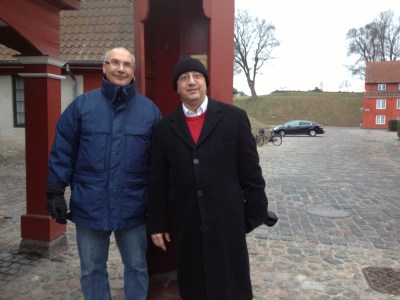
My cousin Frank.

BY FRANK TERRANELLA

Thanks to an invitation to lecture in Copenhagen, I recently was reunited with my first cousin for the first time in 40 years. And here’s the kicker – his name is exactly the same as mine. Now, there are many people who have common names, and some with less common ones. I have a rare name. I don’t know of another person in the world alive today with the name Frank Terranella, except my cousin in Copenhagen. It was the name of our common grandfather, who died many years ago. I’m sure there are others, but I have never crossed paths with one.

Frank - Denmark

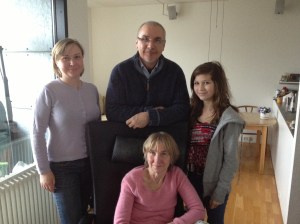
The Gang.

So how did my doppelganger end up in Copenhagen for the last 40 years? Well it’s a wonderful love story. My cousin went on his college junior year abroad in Copenhagen in 1970. There he met and fell in love with a beautiful blonde Danish girl named Karin, who stole his heart. They were married soon afterward. My cousin finished his education in Denmark, and then found a job as a teacher. Their daughter, Anna, came along a year later. Frank never saw a reason to go home much after that. Of course, that’s because he was home. And Copenhagen has been his home for the last 40 years.

Frank would visit the United States occasionally, but those visits were never in the New York area, so we never connected. As time passed, Frank’s daughter Anna grew up and gave him a granddaughter, Lea. She’s a teenager now, and I’ll swear that the 25 percent of her that’s American is dominant. Or maybe that’s just a function of the Internet, or American television on European youth.

So all this was going on a continent away, while I resolved year after year, decade after decade, to get to Copenhagen to visit the other Frank Terranella. Finally, I was asked to lecture in Copenhagen on United States trademark law. It was an offer I couldn’t refuse (even though lecturing is not something I’ve ever done). I knew it would give me the chance to see my cousin.
So my wife and I flew over to Copenhagen, and I gave my lecture. All went well. As soon as I was done, I called Frank. He came over to our hotel, and there we had the historic 40-year reunion. Both of us have a lot less hair than the last time we saw each other, but the ties of family are strong. It wasn’t long before we were telling stories of our youth, and bringing each other up to date on our lives for the last 40 years. It made us both smile – a lot.

Frank walked us back to his apartment where we met Karin. Now, when Frank’s daughter, Anna, was about a year old, he and Karin came to New Jersey to visit my grandfather, and I met Karin and Anna there. Seeing her 40 years later, her eyes and smile were just as bright as they were all those years ago, despite the fact that multiple sclerosis has now taken away her ability to walk. I recognized her immediately. She’s like a ray of sunshine, a grown-up flower child. It’s not hard to see why Frank gave up his home country for her.

Seeing my cousin with his wife was a testament to the fact that true love conquers all – including multiple sclerosis. I know that it sounds corny, but Frank and Karin are as much in love in their 60s as they were in their 20s. All that’s changed is that Karin requires a little more assistance than she used to, and Frank is more than happy to provide it.

The next day, I got to meet the now grown-up Anna and her daughter Lea. As do most Danes, they both speak flawless English. I am so sorry I didn’t get to see Anna grow up, but maybe now I’ll get to see Lea from time to time. We invited her to stay with us if she comes to America. Family reunions can sometimes be dreadful, but my recent trip to Copenhagen couldn’t have been a better experience. Reconnecting with Frank and his family made us forget the cold and often-dreary Copenhagen weather. We all resolved that we won’t wait another 40 years to connect again.

My “Torch Song” to Sondheim

Tags

, , , ,

Sondhein with group

There’s Frank – second from right. Photo courtesy Frank Terranella.

BY FRANK TERRANELLA

Recently I attended one of those cultural events that only happen in New York. The New York Philharmonic played an entire evening of the music of Stephen Sondheim with the composer in attendance. We reveled to an orchestral music-only evening of selections from “Sweeney Todd,” “Sunday in the Park with George,” “Into the Woods,” and other less, well-known masterpieces like, “Pacific Overtures,” and “Stavisky.”

As I sat there listening to the concert, it occurred to me that I have been enjoying the music of Stephen Sondheim on New York stages my entire adult life. I saw the original productions of,” A Little Night Music,” “Pacific Overtures,” “Sweeney Todd,” “Merrily We Roll Along,” “Sunday in the Park With George,” and “Into the Woods.” This was as a result of being turned on to Sondheim by a college professor whose History of the American Musical course that I took in 1973 named Sondheim as the current torch carrier for the art form.

In the late 1970s, I started to correspond with Sondheim. I found him to be a most diligent correspondent. He never failed to answer every letter I sent him. I treasure those today. We conversed about his work on, “Do I Hear a Waltz?,” with Richard Rodgers, and his adaptation of George Kaufman and Moss Hart’s play, “Merrily We Roll Along.” He shared his feelings about collaborating with Leonard Bernstein on “West Side Story,” and about “Sweeney Todd” being performed by opera companies.

Over the course of the next 20 years I sometimes spied Sondheim on the streets of New York. I saw him outside the theater where a revival of “Follies” was being staged, and he sat behind me at a revival of “West Side Story.” Abiding by the unwritten code that New Yorkers have regarding celebrities in their midst, I did not try to engage with the musical master. Then, in 2007, I had a chance to meet Stephen Sondheim, and spend some time with him discussing his work. A good friend of mine, who teaches theater at a Midwest college, was leading a theater tour of students through New York and London.

Knowing what a big fan I am, he and his wife graciously invited me to join a small get-together they had arranged where the students would meet with Sondheim and get to ask him questions. And so on a spring day in 2007, I found myself shaking hands with Stephen Sondheim and sitting around a table asking the master questions. It was a delightful hour. It’s not often you get to meet someone who has given you so much cultural enjoyment over so many years. From the movie versions I saw of “West Side Story,” “Gypsy,” and “A Funny thing Happened on the Way to the Forum,” in the early 1960s, through “Assassins and Passion” in the 1990s, it has been a wonderful ride.

Unfortunately, with ticket prices now routinely more than $100, and nearing $150, Broadway has turned away from the Sondheim type of show in favor of spectacles like, “The Lion King,” and “Wicked.” These days, the master can only get revivals of his earlier work produced on Broadway. Sondheim ’s latest musical, “Road Show,” was seen only off-Broadway, and out of town. There has not been a new Sondheim show on Broadway in nearly 20 years.

However, the change in Broadway fashions has not reduced the respect that the New York theater community has for Stephen Sondheim. We know that we are not likely to ever again see such a talent writing for the musical theater. But we will always have his great works. And perhaps the master, who will be 83 on March 22, will give us a few more masterpieces in the years when most men are long-retired. After all, he’s been through “Phantom,” and he’s been though “Spiderman” too, and he’s here. He’s still here. And aren’t we lucky.

Men in Midlife: Puberty Revisited? Or a Time to Grow Up?

Tags

, , , , ,

men will be boys

Men will be boys. Photos by Julie Seyler

BY FRANK TERRANELLA

We’ve all heard of the midlife crisis. And if you’re in your 50s, and you haven’t had yours yet, you’re overdue. Anyway, I think that women and men have different midlife crises. For men, it usually comes with the first scent of old age. You know, the sudden inability to remember names, movie titles and even words. Or if the guy is an athlete, it’s the demonstrated failure of his body to do what it used to do. Whatever the trigger, the response is usually the same: In a vain attempt to regain their youth, men revert to behavior they abandoned in their mid-20s. They get drunk, they gamble, they buy expensive toys, and they fool around with women who are not their wives. Not everyone does all of these, but just about everyone has the inclination.

When 50-something married men begin to act like they’re single, this can be disconcerting to their wives, to say the least. But it truly has nothing to do with the wives. The inclinations don’t only hit men in bad, or tired, marriages. I think they’re primal and hard-wired into men’s brains.

You can dress them up but you can't take them out

Men and their games.

What separates the gentlemen from the cads is the response each man has to this inclination. Some men give in and go off for the full ride, including bedding younger women. Divorce soon ensues, and I have actually heard these men brag that, “I traded up from the 1955 model to the 1977 model.” Other men, in the immortal wisdom of President Jimmy Carter, have lust in their hearts. I will confess to being in this group.

As I get older, I have found that intimacy is what’s really important, not just orgasms. There’s nothing wrong with orgasms, it’s just that both men and women can, and do, have them without any intimacy with their partner. This is ultimately very lonely and unfulfilling. So in recent years, I have sought out intimate, non-sexual relationships with a number of women friends. This is something that women do easily without thinking about it. Women tell their women friends intimate details of their lives freely, and it’s no big deal. For men – it’s a big deal.

In the film “When Harry Met Sally,” Billy Crystal’s character is a young man who opines that men and women can never be friends because sex always gets in the way. By that he means that he believes that a guy can’t look at a woman without thinking about getting naked and having sex with her. My experience is that it’s much easier to have an intimate friendship with women in my 50s than it was in my 20s. And that’s a good thing.

My wife has been incredibly understanding as I have begun to have long meals with old girlfriends, work colleagues and a variety of other amazing women. While the conversations have at times been intimate, they have never been orgasmic. I have been proving Billy Crystal wrong for a decade.

In many ways, I think it takes until he’s in his 50s for a man to grow up. The midlife crisis is like a second puberty. The trick is to get through it without making a fool of yourself. And as we all know, there’s no fool like an old fool.

Close to 60, but Nowhere Near Retirement

Tags

, , , , ,

what me retire

Photo by Julie Seyler.

BY FRANK TERRANELLA

In 1953, when I was born, my life expectancy was 66. That’s why, back in the 1950s, when my grandfathers quit working, most people were retired by age 65. The American Association of Retired Persons (AARP) admitted members at age 50. Today, my life expectancy is 83. Those 17 extra years are literally life-changing, and quite significant for retirement planning. This year I will turn 60. And rather than consider retirement as my grandfathers did at this age, I am looking forward to at least another decade of work. I can’t imagine retiring in my 60s. That’s the difference the extra 17 years of life expectancy have made.

Yet the world has not adapted to the longer life expectancies.The AARP still admits members at age 50. Senior citizen housing is available at age 55. Most senior citizen discounts still kick in between 60 and 65. Perhaps this is a subtle hint for us baby boomers to step aside and make way for the younger generation to move into our jobs. But I have a problem thinking of myself as a senior citizen at age 60 because there are still members of my parents’ generation alive and well in their 80s and 90s. Those are the real senior citizens – the Greatest Generation. People in their 60s and 70s are perhaps juniors. That makes 50-somethings just sophomores in the school of life.

So with almost another quarter century until my life expectancy age, I have no intention of slowing down. It’s full speed ahead into my pre-retirement. The only thing I hope to do is begin retirement saving in earnest. But that will be tempered by all the vacation traveling I hope to do in the next 10 years. My wife and I already have the next five years of trips mapped out. This is really my idea of a hedge against not making it to retirement. For someone like me who has had heart disease and cancer, it’s more important to live life than to save for retirement.

Actually, as long as I can take frequent vacations, I see no reason to ever retire. I’ve seen retirement, and it didn’t look like fun for my grandfathers. It was just a lot of television. I would much prefer to be useful every day and earn a paycheck. Maybe I’ll revisit the issue of retiring when I hit 80. But I doubt that it will be attractive even then. I think that our generation may actually retire the word “retirement.”